Saint Euplius
Died 304
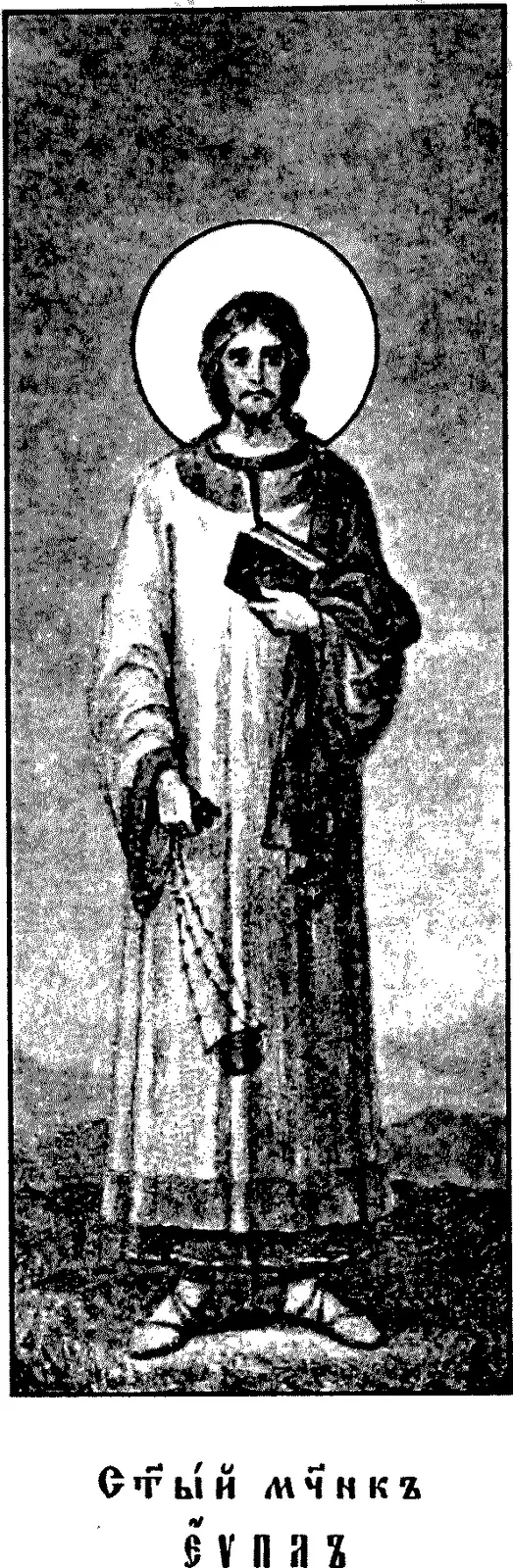
- Died
- At Catania under Diocletian and Maximian, in 304 according to Butler and in 308 according to the Byzantine Menaion 123
- Account
- The Acts printed by Baronius and Ruinart, which Butler calls genuine 1
Saint Euplius was a deacon of Catania in Sicily who walked up to the governor's door during the persecution of Diocletian, called out that he was a Christian, and was brought in carrying the book of the Gospels. 1 Asked to read from it, he read the Beatitudes, and he was tortured and put to death for refusing to give the book up or to sacrifice. 12 His feast is August 12. 24
A deacon at the curtain
Alban Butler tells the story from the Acts printed by Baronius, Ruinart and Tillemont, which he calls "genuine"; he adds that the version published by Metaphrastes is spurious. 1 The Acts open with a date. "In Sicily, in the year 304, under the ninth consulate of Dioclesian, and the eighth of Maximian, on the twelfth of August, in the city of Catana, Euplius, a deacon, was brought to the governor's audience-chamber." 1
Nobody arrested him, at least at first. He stood outside the curtain that screened the governor's hearing room and shouted: "I am a Christian, and shall rejoice to die for the name of Jesus Christ." 1 The governor, Calvisianus, a man of consular rank, heard the voice and ordered whoever had made the outcry to be brought before him. 1
Euplius came in with the book of the Gospels in his hand. 1 The current Roman Martyrology keeps that detail at the center of its short entry: according to tradition, it says, he was thrown into prison by the governor Calvisianus because he was found with the book of the Gospels in his hands. 4 The Byzantine Catholic Menaion says the same. 3
Reading the Gospel in court
One of the governor's friends, a man named Maximus, objected at once. "You ought not to keep such writings, contrary to the edicts of the emperors." 1 Calvisianus asked where the books had come from, and whether Euplius had brought them from his house. Euplius answered that he had no house, and that he had been taken with the book on him. 1
Then the judge told him to read something from it. Euplius opened the book and read: "Blessed are they who suffer persecution for justice sake, for theirs is the kingdom of heaven." And in another place: "He that will come after me, let him take up his cross, and follow me." 1
Calvisianus asked what it meant. "It is the law of my Lord, which hath been delivered to me." By whom? "By Jesus Christ, the Son of the living God." 1 The governor gave his order: since the confession was plain, the prisoner was to be handed to the torturers and examined on the rack. 1
On the rack
It was done the same day. Asked under torture whether he held to what he had said, Euplius made the sign of the cross on his forehead with the hand that was still free and repeated it: he was a Christian, and he read the holy Scriptures. 1 He would not hand them over, he said, because that would offend God, and it was better to die than to give them up. 1
The governor tried persuasion. "Lay aside thy folly; adore our gods, and thou shalt be set at liberty." 1 Euplius answered, "I adore Jesus Christ; I detest the devils. Do what you please; add new torments; for I am a Christian." 1 Told to worship Mars, Apollo and Aesculapius, he said he worshiped the Father, the Son and the Holy Spirit. Told to sacrifice and be freed, he said, "I sacrifice myself now to Jesus Christ my God." 1
The torture was increased. Butler's Acts record the prayer he kept repeating: "I thank thee, my God; Jesus Christ, succour me. It is for thy name's sake that I endure these torments." 1 When his voice gave out, the onlookers could see his lips still moving with the same words. 1
The sentence
At last Calvisianus withdrew behind the curtain and dictated a sentence to a secretary, then came out and read it from a tablet: "I command that Euplius a Christian be put to death by the sword, for contemning the prince's edicts, blaspheming the gods, and not repenting. Take him away." 1
The executioners hung the book of the Gospels around his neck, and a crier walked ahead of him calling out, "This is Euplius the Christian, an enemy to the gods and the emperors." 1 He went cheerfully, Butler says, repeating, "I give thanks to Jesus Christ my God. Confirm, O Lord, what thou hast wrought in me." 1 At the place of execution he prayed a long time on his knees, gave thanks once more, and offered his neck to the executioner. Christians took his body away, embalmed it and buried it. 1
The 1897 English edition of the Roman Martyrology agrees: a deacon under Diocletian and Maximian, tortured for a long time for confessing the Lord, who finally won the palm of martyrdom by the sword. 2
Sword or blows
Not every source ends the story the same way. The current Roman Martyrology says that, questioned again and again, he answered that he kept the Gospel proudly in his heart, and was beaten to death. 4 The Byzantine Catholic Menaion's note for August 11 says almost the same thing: questioned again, he answered that he rejoiced to bear the Gospels in his heart, and he was beaten to death with cudgels. 3
Yet the Menaion's own kontakion for the day sings that he carried the law of Christ in his hands, cried out that he was ready to be martyred, and then "bending your neck, they cut off your head." 3 Butler and the older Martyrology have the sword. 12 This page reports both endings and does not choose between them.
The sources differ on the year as well. Butler's Acts date the trial to 304 by the consulships of Diocletian and Maximian; the Menaion gives 308. 13 On the substance they agree: a deacon, the Gospels in his hands, a refusal to give them up. 134
In the Eastern liturgy
The Byzantine Churches keep his memory on August 11, during the days after the feast of the Transfiguration, so that the hymns of the two are sung together. 3 The Menaion of the Archeparchy of Pittsburgh calls him "a server of the Word, and a tower of faith," and sings, "O Euplus, worthy of praise, you were a servant of the Master's mysteries." 3
What is Saint Euplius the patron saint of?
Saint Euplius's feast day
Saint Euplius's feast day is August 12. The current Roman Martyrology, as the Italian bishops print it, enters him on that day at Catania. 4 The 1897 English edition of the Martyrology places him on August 12 as well, and Butler's Acts date his trial to the twelfth of August. 12
The Byzantine calendar, followed by the Eastern Catholic Churches, keeps him one day earlier, on August 11. 3
Praying with Saint Euplius
The Acts show a deacon who did not wait to be found. He went to the governor's door and said who he was. 1 The book he carried was the thing the edicts had made a crime to keep, and he had it in his hands when he walked in. 14
When the judge told him to read, he did not argue. He read the Gospel aloud in the courtroom, a blessing on those persecuted for justice and a word about taking up the cross. 1 Asked what it meant, he said it was the law of his Lord. 1
Under torture his prayer was thanks. He thanked God that he was suffering for Christ's sake, asked for help, and kept saying it after his voice failed. 1 On the way to his death he asked God to confirm what had been done in him. 1
The sources disagree about how he died. They agree that he kept the Gospel, in his hands, as Butler tells it, or in his heart, as the Martyrology and the Menaion put it. 134
Saint Euplius, pray for us.
Sources
- 1.Alban Butler, "St. Euplius, M.," August 12, in The Lives of the Fathers, Martyrs, and Other Principal Saints, Vol. VIII (London: J. Murphy, 1812), pp. 152-154, Internet Archive.
- 2.The Roman Martyrology, August 12 (Baltimore: John Murphy & Co., 1897).
- 3."Menaion - August 11," Metropolitan Cantor Institute, Byzantine Catholic Archeparchy of Pittsburgh.
- 4.Roman Martyrology, entry for August 12, Santo del giorno, Conferenza Episcopale Italiana (in Italian).
Saints to turn to next
Others in this collection who are turned to for some of the same things.