Saint Euphemia of Chalcedon
c. 288 - c. 303
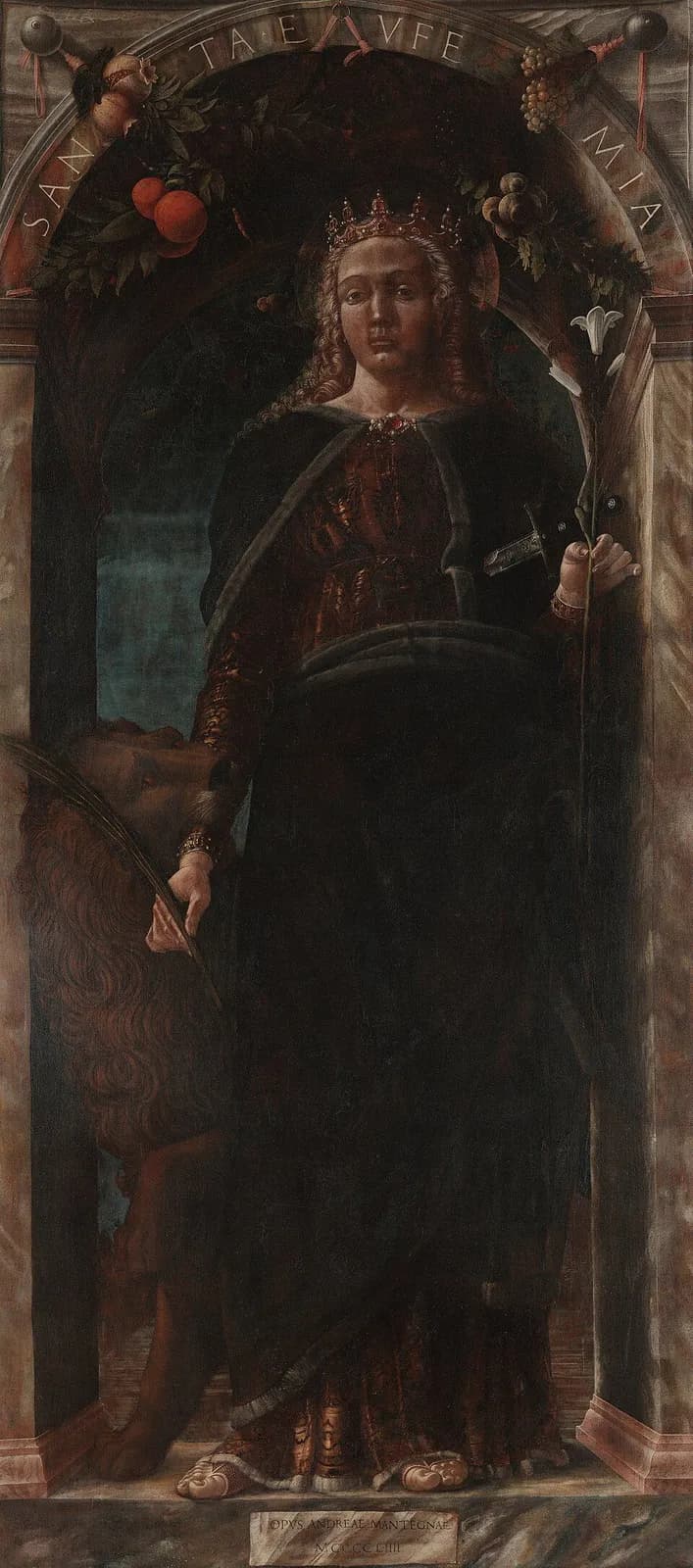
- Born
- About 288, at Chalcedon, across the Bosporus from Constantinople 1
- Died
- About 303 under Diocletian 12; the 1908 Catholic Encyclopedia says probably under Galerius (305-11) 3
- Historical record
- Her death and her age are regarded as historical; her Acts, compiled after 451, are of doubtful value 1
- Relics
- In a marble sarcophagus at Rovinj, Croatia 1
Saint Euphemia of Chalcedon was a young Christian woman put to death at Chalcedon, on the Asian shore of the Bosporus opposite Constantinople, in the persecution of the early fourth century. 13 Her basilica there was so large and so famous that in 451 the Fourth Ecumenical Council met in it, and the bishops wrote to Pope Leo that she had "crowned the meeting." 46 The long story of her tortures is another matter: the Acts that tell it were compiled after that council and are regarded as of doubtful value. 1
What is known
Chalcedon was an old Greek city on the Bithynian coast, older than Byzantium across the water, and by the Roman imperial period a free city. 3 The encyclopedia article on it says simply that "Euphemia and her companions suffered martyrdom there, probably under Galerius (305-11)." 3 The Roman Martyrology, as the Italian bishops print it, places her death under the emperor Diocletian and the proconsul Priscus, and says that after overcoming many torments for Christ she reached the crown of glory through a hard fight. 2
The date comes from an old Roman chronicle, the Fasti Vindobonenses priores. Under the consulship that fell in 303, it records that churches were pulled down, the Lord's books burned, and that Saint Euphemia suffered on the sixteenth day before the Kalends of October, which is September 16. 1 The Norwegian bishops' saints database, which gathers the older scholarship, gives her birth as about 288 and her death as probably about 303. It notes that Butler placed it in 307 under Galerius, and that 290 is also found. 1
Its verdict on the rest is plain. Her death, and the tradition that she was about fifteen, are regarded as historical. Her Acts were not collected until after the Council of Chalcedon and are considered of doubtful value, consisting mainly of a list of every torture she miraculously survived. 1
The story her Acts tell
In the legend Euphemia is the daughter of a senator, Philophronos, and his wife Theodosia, raised a Christian and living as a consecrated virgin who spent her wealth on the poor. 1 Priscus orders the whole city to sacrifice to Ares. She is found with forty-eight other Christians hiding in a house to pray, and when they refuse to sacrifice they are tortured for eleven days. The others are beheaded in front of her, in the hope of frightening the youngest into giving way. 1
Then come the marvels. A wheel set with knives stops and will not turn. Two soldiers, Victor and Sosthenes, are ordered to throw her into a furnace, see angels in the flames, declare themselves Christians, and are given to the beasts. She is thrown in by others and comes out unhurt. A pit full of blades is hidden under turf, and she walks over it. 1 At last she is sent into the arena, and none of the animals will attack her until a she-bear gives her a small wound on the leg, and she dies. An earthquake scatters the guards and the crowd, and her parents bury her not far from Chalcedon. 1 The Martyrology quoted by Catholic Culture keeps the same shape: many torments survived, and death in the amphitheater from a single bite while the other beasts licked her feet. 7
The council in her church
Her cult grew fast. Paulinus of Nola, Ennodius of Pavia and Venantius Fortunatus all wrote in her praise, and the pilgrim Egeria described the magnificent church at Chalcedon in her account of about 384. 1 The historian Evagrius later described it in detail and recorded that churchmen, officials and ordinary people came there for the blessings obtained through her. 1
In 451 that church became the meeting place of the Fourth Ecumenical Council, called against the teaching of Eutyches. 36 It sat from October 8 to November 1 in the church of Saint Euphemia, "outside the city and directly opposite Constantinople." 6 Pius XII, writing for the council's fifteen-hundredth anniversary, called it "the vast suburban basilica of St. Euphemia, virgin and martyr," said that about six hundred fathers assembled there, and noted that the council's definition of the faith was worked out by bishops "congregated from diverse lands in the basilica of St. Euphemia." 5
When it was over, the council wrote to Pope Leo. Its letter credits the result to God and to the martyr: "For it was God who worked, and the triumphant Euphemia who crowned the meeting as for a bridal, and who, taking our definition of the Faith as her own confession, presented it to her Bridegroom by our most religious Emperor and Christ-loving Empress." 4
A story grew up around that sentence. As katolsk.no tells it, the two parties could not agree, and the patriarch Anatolius proposed leaving the decision to the Holy Spirit through Euphemia. Each side wrote its confession of faith and laid it in her tomb, which the emperor Marcian sealed and guarded for three days of fasting and prayer. When it was opened, the orthodox confession was in her right hand and the other at her feet. 1 katolsk.no takes the council's letter as witness to the miracle. The letter itself, in the translation read here, says she took the definition as her own confession and says nothing of a tomb being opened. 14
Where her relics went
Chalcedon fell to the Persians early in the seventh century; katolsk.no gives 617, and the encyclopedia says they held it from 616 to 626. 13 Around 620 her relics were moved to a new church in Constantinople. 1 During the iconoclast controversy an emperor, either Leo III or Constantine V, ordered them thrown into the sea. Two brothers who owned ships, Sergius and Sergonos, saved them and gave them to a bishop, who hid them; later they were taken to the island of Lemnos, and in 796, after the Second Council of Nicaea had condemned iconoclasm, they were brought back to Constantinople with ceremony. 1
The West has its own ending. According to tradition, on July 13, 800, after a storm, a marble sarcophagus holding her relics came ashore at Rovinj on the Istrian coast. Nobody in the town could haul it up the hill to the church of Saint George until a small boy with two small cows did it, and the people took her as their patron. 1 The sarcophagus is still in Rovinj, in the church built in her name in the eighteenth century. 1
Elsewhere in the West she was known early. Place names along Italy's eastern coast suggest the cult came from Asia Minor and spread inland, especially around Milan. Victricius of Rouen mentions her in Gaul, Pope Sergius I restored a ruined church of hers in Rome, and she is named in the canon of the Ambrosian Mass. 1 Catholic Culture notes that she was venerated in the West "especially in Italy." 7 Mantegna painted her in the fifteenth century with a lion, a lily, a palm and a sword, the panel at the top of this page. 1
What is Saint Euphemia the patron saint of?
Saint Euphemia is the patron saint of Rovinj in Croatia and of Alba Adriatica in Italy. 17 katolsk.no also lists her as a patron for good weather. 1 She is shown with a lion, a bear or snakes, which in her story did her no harm, pierced by a sword, or holding a lily and a palm. 17 The Orthodox call her the "All-praised" Great Martyr. 1
Saint Euphemia's feast day
Saint Euphemia's feast day is September 16, the day the old chronicle gives for her death, and the day the Roman Martyrology enters her. 12 In the 1969 reform of the calendar her feast was taken out of the universal calendar and left to local and particular calendars, but she remains in the current Martyrology. 1 The Orthodox and the Armenians also keep her on September 16, and the Orthodox add a commemoration of the miracle at Chalcedon on July 11; the Copts and the Syriac Orthodox remember her on July 11. 1
Praying with Saint Euphemia
The Acts give a girl whom nothing can hurt, and that is the least believable thing about them. Underneath is something plainer and harder: a teenager in a provincial city who would not sacrifice, and was killed for it. 1 Whatever the bears and the furnaces were, the refusal was real.
Her afterlife is unusual. A martyr of no special rank became the host of the council that settled how the Church speaks about Christ as God and man, and the bishops, writing to Rome, found it natural to give her a share of the credit. 45 Pius XII ended his encyclical by asking for the intercession of "Euphemia the Virgin Martyr, who triumphed at Chalcedon," alongside Mary, Peter and Paul. 5 The faith she died for was simpler than the formulas argued over in her church. The bishops still thought she belonged there.
Her relics were moved, thrown into the sea, hidden, carried to an island and brought back, and Rovinj tells its own story of a stone coffin that would only move for a child with two small cows. 1 It is a long way from Chalcedon. People have gone on asking her for things anyway, in Croatia and in Italy and in the East, for seventeen centuries. 17
Saint Euphemia of Chalcedon, pray for us.
Sources
- 1."Den hellige Eufemia av Kalkedon (~288-~303)," Den katolske kirke (katolsk.no), Catholic Diocese of Oslo (in Norwegian).
- 2.Roman Martyrology, entry for September 16, "Santa Eufemia, vergine e martire," as printed in "Santo del giorno," Conferenza Episcopale Italiana (in Italian).
- 3.Sophrone Pétridès, "Chalcedon," The Catholic Encyclopedia, Vol. 3 (New York: Robert Appleton Company, 1908).
- 4.The Synod of Chalcedon to Leo (Letter 98 among the letters of Leo the Great), trans. Charles Lett Feltoe, Nicene and Post-Nicene Fathers, Second Series, Vol. 12 (1895), New Advent.
- 5.Pius XII, Sempiternus Rex Christus, encyclical on the Council of Chalcedon, September 8, 1951, vatican.va.
- 6.Francis Schaefer, "Council of Chalcedon," The Catholic Encyclopedia, Vol. 3 (New York: Robert Appleton Company, 1908).
- 7."September 16," Liturgical Year calendar, Catholic Culture (Trinity Communications), with the Roman Martyrology entry for Saint Euphemia.
Saints to turn to next
Others in this collection who are turned to for some of the same things.