Saint Eulalia of Mérida
Died c. 304
- Lived
- Mérida, in Roman Spain; born at the end of the third century 4
- Died
- About 304, in the persecution of Diocletian, at the age of twelve by the traditional account 234
- Not to be confused with
- Saint Eulalia of Barcelona, kept on February 12 1
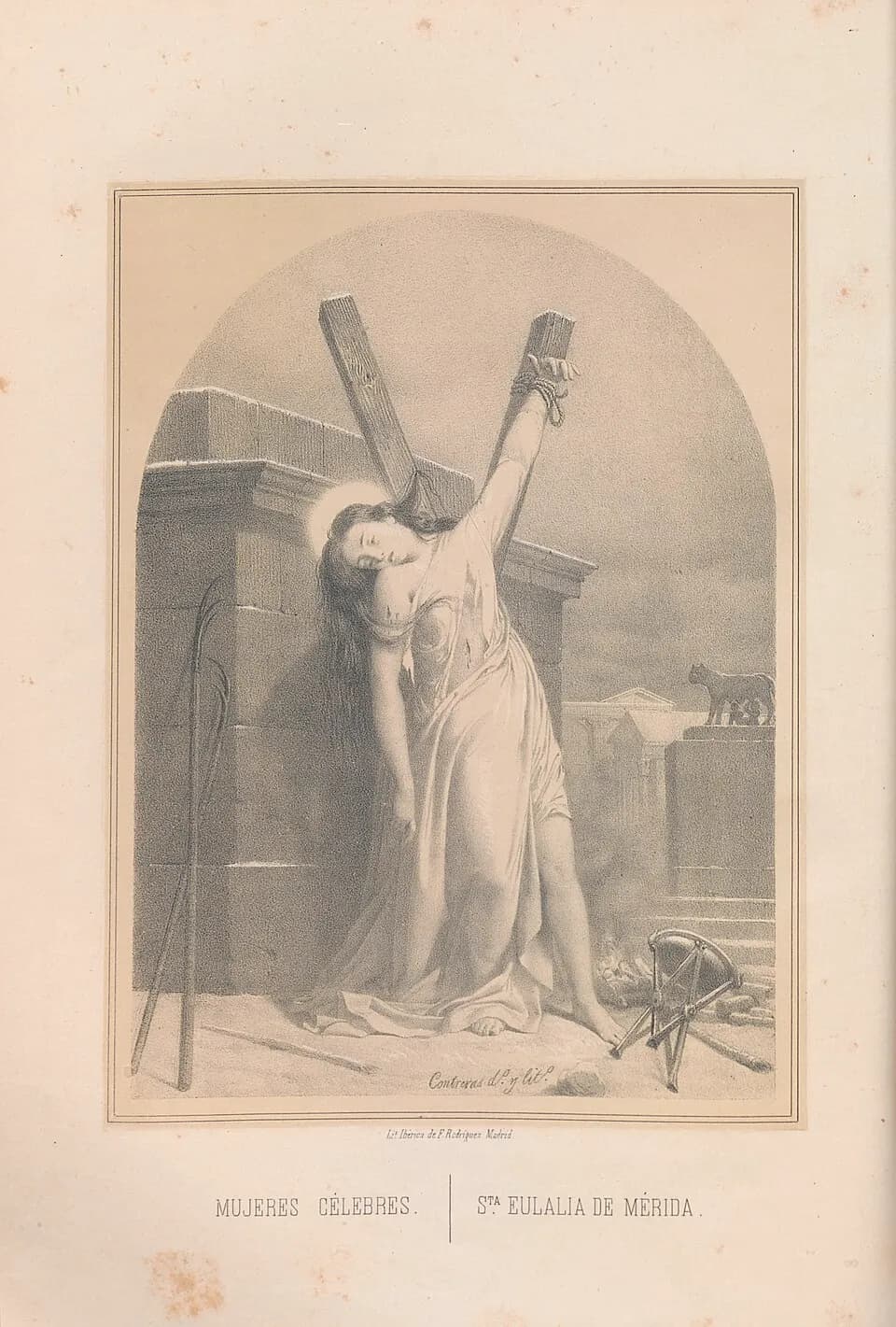
Saint Eulalia of Mérida was a girl of about twelve who, during the persecution of Diocletian, walked into the governor's court in her city, declared herself a Christian, and was tortured and burned. 23 The poet Prudentius, a Spaniard born within fifty years of her death, wrote her story as a hymn, and her tomb at Mérida became the most popular shrine in Visigothic Spain. 3 She is a different saint from Eulalia of Barcelona, though old hymns and inscriptions do not always tell the two apart. 1 Her feast is December 10. 2
Where the story comes from
There are two early tellings, and they are not of equal weight. The first is a hymn by Prudentius, whom Patrick Duffy at CatholicIreland.net dates to 348-413. 3 It belongs to his Peristephanon, a set of poems in honor of the martyrs. 9 The Catholic Encyclopedia is cool about the collection as a whole, in which "the narratives are spoiled with too much rhetoric," but singles out the hymn on Eulalia for "some pretty details." 9
The second is a set of Acta from the seventh century, which Duffy calls "probably not reliable." 3 Outside those two texts he notes that she is the subject of a sermon by Saint Augustine and a poem by Venantius Fortunatus, and that her name stands in the Calendar of Carthage and the Martyrology of Jerome. 3 Whatever is uncertain in the details, then, she was honored widely and early.
The sources do not agree on which text supplies which detail. Duffy says Prudentius presents "a consecrated virgin of noble family" with a seriousness beyond her years, and that it is the Acta that make her a girl of twelve. 3 The Archdiocese of Mérida-Badajoz and the Archdiocese of Oviedo both say she won the double crown of virginity and martyrdom at twelve, as Prudentius describes. 47 Butler's Lives, as CatholicCulture.org excerpts it, gives the age without saying where it comes from. 2
The girl who went looking for the judge
Eulalia was born at Mérida at the end of the third century, of a prominent family, and brought up a Christian. 24 Butler says she cared nothing for dress or amusements and loved the state of virginity from childhood. 2 Then came Diocletian's edicts, which required everyone to sacrifice to the gods of the empire. Oviedo Cathedral dates the ban on Christian worship to 303; Duffy and the encyclopedia put her death in 304. 136
Her mother, seeing how eager the girl was for martyrdom, took her out of the city into the country. 23 Eulalia slipped away at night and reached Mérida before daybreak. 2 When the court opened that morning she presented herself to the judge, whom Butler and Duffy both name as Dacian, and reproached him for trying to destroy souls by forcing them to deny the one true God. 23 Oviedo Cathedral puts it that she came to protest laws which, being unjust, could not be obeyed. 6
The judge tried kindness first. He reminded her of her birth, her youth and her parents' grief, then showed her the instruments of torture and said, in Butler's version, "All this you shall escape if you will but touch a little salt and frankincense with the tip of your finger." 2 Duffy quotes her answer from Prudentius: "Isis, Apollo and Venus are nothing," and "Even Maximian himself is nothing." 3
She threw down the idol, trampled the sacrificial cake and spat at the judge. Butler could not let that last pass and called it "an action only to be excused by her youth." 2
Hooks, fire and a dove
Two executioners tore her sides with iron hooks, and Butler says "she called the strokes the trophies of Christ." 2 Lighted torches were then put to her body. The fire caught her hair, and she died stifled by the smoke and flame. 23
The accounts end with two signs. A white dove was seen at the moment of her death; Butler says it "seemed to come out of her mouth, and to wing its way upward," Duffy that it flew out of her mouth, and Oviedo Cathedral, following Prudentius, that it flew toward heaven. 236 The executioners fled in terror and left the body. 2 Then snow fell and covered her, which Duffy calls miraculous and reads as a sign of her holiness. 36
Mérida, and then Oviedo
A shrine rose over her tomb, and devotion spread quickly. Duffy says her veneration was already popular by 350 and that her relics were distributed through Iberia; around 560 Bishop Fidelis of Mérida rebuilt a basilica in her honor, and hers became the most popular shrine in Visigothic Spain. 3 The encyclopedia mentions that a bishop of Mérida founded a convent of nuns beside "the basilica of the celebrated martyr of his episcopal city" in 651. 1
In the eighth century, to keep her remains from profanation after the Muslim conquest, King Silo carried them north to Asturias; Duffy gives the year as 780. 367 Alfonso II later moved them to the basilica of the Savior at Oviedo, and they rest today in a chapel of the cathedral built for them between 1660 and 1669, in an eleventh-century silver casket. 6 Each December 10 the casket is carried in procession to the high altar. 6
Mérida has not forgotten her. The Holy See granted the basilica of Saint Eulalia a jubilee year running from December 10, 2023, to the same date in 2024, to be renewed whenever her day falls on a Sunday. 5 In a video message to the city during that year Pope Francis spoke of the child martyr whose cult made Mérida a cradle of Christianity in Spain and a destination for pilgrims through the centuries. 8
Not Eulalia of Barcelona
Barcelona has a martyr of the same name, placed in the same persecution and kept on February 12. 1 Some scholars have doubted that there were ever two. The Catholic Encyclopedia takes up the question in its article on the Barcelona saint and comes down firmly: "There is no reason to doubt the existence of two distinct saints of this name, despite the over-hasty and hypercritical doubts of some." 1
It is honest about why the doubt arose. The seventh-century hymn for the Barcelona martyr is, it says, "identical with that of Prudentius" for the martyr of Mérida, and the inscriptions on Visigothic altars that held relics of Saint Eulalia "do not distinguish between the martyr of Barcelona and the one of Mérida" except by context. 1 Against that it sets the separate basilicas and bishops of the two cities, a church of the Barcelona saint at Córdoba and the old Mozarabic calendars. 1 The encyclopedia's article on Spain likewise lists the two among the martyrs of Diocletian as separate names. 10
So the patronages should be kept apart. It is Eulalia of Barcelona whom the encyclopedia calls patron of that city, its cathedral and sailors. 1
What is Saint Eulalia of Mérida the patron saint of?
Her patronages are places. The Archdiocese of Mérida-Badajoz calls her patron of Mérida and of the youth of the archdiocese. 5 In the north she is principal patron of the Archdiocese of Oviedo; the cathedral says she has been patron of the city and diocese since 1630 and of the Principality of Asturias since 1639, while the archdiocese dates the diocesan patronage to 1639. 67 Oviedo's local police count her as their patron too. 6
CatholicCulture.org gives a longer list: "Merida, Spain; Oviedo, Spain; runaways; torture victims; widows." 2 The first four follow plainly enough from her story. None of the other sources read for this page mentions widows. 346
Saint Eulalia of Mérida's feast day
Saint Eulalia of Mérida's feast is December 10. "The Roman Martyrology mentions her name on December 10," Butler says, and CatholicCulture.org marks her as that day's commemoration from the Martyrology. 2 Mérida keeps the day as a solemnity and the rest of its archdiocese as a memorial, and Oviedo Cathedral calls it one of the most important feasts of its year. 46
Praying with Saint Eulalia of Mérida
This is not a comfortable story and the tradition has never pretended it was. A child runs away from the mother who is trying to keep her alive, and goes straight to her death. 2 Even Butler, who admired her, stopped to apologize for her manners in court. 2
What the sources admire is her clarity. Oviedo Cathedral reads her protest as a judgment on the law itself: it forbade the worship of the true God, it was unjust, and it could not be obeyed. 6 The lines Duffy quotes from Prudentius say the same thing in a child's flat voice. The gods are nothing, and the emperor who worships them is nothing. 3
The tradition closes her story with two images of whiteness, a dove and a fall of snow, and Duffy reads the whiteness of the snow as the sign of her sainthood. 36
Her city and the city that sheltered her bones still keep December 10 together, seventeen centuries on. 46 The Archdiocese of Mérida-Badajoz has made her the patron of its young people. 5
Saint Eulalia of Mérida, pray for us.
Sources
- 1.Fidel Fita y Colomé, "St. Eulalia of Barcelona," The Catholic Encyclopedia, vol. 5 (New York: Robert Appleton Company, 1909).
- 2."St. Eulalia," excerpted from Butler's Lives of the Saints, with calendar notes, CatholicCulture.org, Liturgical Year, December 10, 2025.
- 3.Patrick Duffy, "Dec 10 - St Eulalia of Merida (d. 304) Spain's best known virgin martyr," CatholicIreland.net, December 10, 2012.
- 4."Santa Eulalia, virgen y mártir," Arzobispado de Mérida-Badajoz (in Spanish).
- 5."La Santa Sede concede la celebración del Año Jubilar Eulaliense en Mérida en 2023," Arzobispado de Mérida-Badajoz, May 27, 2021 (in Spanish).
- 6."Santa Eulalia," Catedral de Oviedo, Sancta Ovetensis (in Spanish).
- 7."Patronos," Arzobispado de Oviedo (in Spanish).
- 8.Francis, Video message for Holy Week in Mérida, March 16, 2024 (in Spanish).
- 9.Paul Lejay, "Aurelius Clemens Prudentius," The Catholic Encyclopedia, vol. 12 (New York: Robert Appleton Company, 1911).
- 10.Ramón Ruiz Amadó, "Spain," The Catholic Encyclopedia, vol. 14 (New York: Robert Appleton Company, 1912).
Saints to turn to next
Others in this collection who are turned to for some of the same things.