Saint Eugene I
Born at Rome - died 657
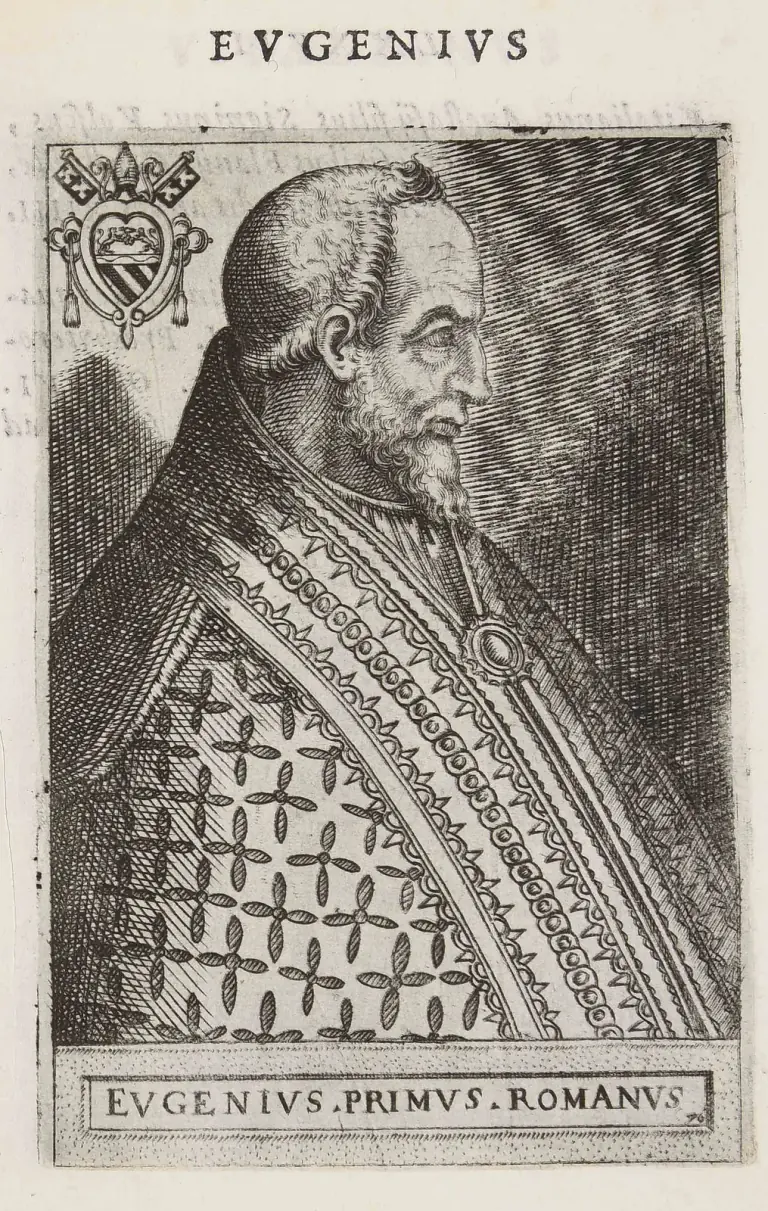
- Born
- At Rome, in the first ecclesiastical region of the city, the Aventine, son of Rufinianus; date unknown 1237
- Known for
- Refusing the profession of faith of Peter, patriarch of Constantinople, and blessing the young Wilfrid of York 12
Saint Eugene I became pope in August 654, more than a year after the emperor's men had carried Martin I out of Rome, and while Martin was still alive in exile on the Black Sea. 123 He tried to make peace with Constantinople, but when the patriarch's letter was read out in Saint Mary Major, the Romans would not let him leave the church until he promised to refuse it, and he did; the imperial officials then swore to roast him as they had roasted Martin. 12 He died before they could, in 657, and his feast is June 2. 4
A clerk from the cradle
Little is known of his life before his election. The Liber Pontificalis, the old book of the lives of the popes, says he was a Roman, the son of Rufinianus, from the first ecclesiastical region of the city, which Mann identifies as the Aventine quarter, and that he had been a cleric "from the cradle." 12 katolsk.no adds that he was by then an elderly priest. 3 The Holy See gives his birthplace simply as Rome. 7
The same book remembered him kindly. Mann prints its Latin, which calls him kind, gentle and mild, approachable to all and outstanding in holiness, and says he paid the clergy their customary allowance and gave alms to the needy. 2 The encyclopedia sums it up as "distinguished for his gentleness, sanctity, and generosity." 1 katolsk.no says he left bequests in his will to both the clergy and the people of Rome. 3
Chosen while Martin lived
The quarrel he inherited was over whether Christ, being both God and man, has a human will as well as a divine one. Constantinople favored the teaching of one will, monothelitism, and the emperor Constans II had forbidden discussion of the question in an edict, the Typos. 3 Martin I would not submit to it, and the exarch Theodore Calliopas declared him deposed on June 17, 653; he was shipped to Constantinople, condemned, and exiled to Cherson in the Crimea. 123
For a time Rome governed itself as it did whenever the see was empty or the pope away: through the archpriest, the archdeacon and the chief of the notaries. 12 Mann draws on Martin's own letters from exile to show that Calliopas tried, for a while in vain, to get the clergy and people to elect someone in Martin's place. 2 katolsk.no says Martin had hoped they would not elect a successor while he lived, that at first they refused, and that under pressure from the emperor and the exarch they found they had no choice. 3
Eugene was installed after a vacancy of one year, one month and twenty-five days. 2 The encyclopedia gives August 10, 654, as the day of his election; Mann and katolsk.no give it as the day of his consecration. 123 Martin was still alive. He died at Cherson on September 16, 655. 3
Three readings of one election
The sources do not settle how this election should be judged, and they are given here in their own terms. The encyclopedia is careful to the point of declining to decide: "if he was forcibly placed on the Chair of Peter by the power of the emperor, in the hope that he would follow the imperial will, these calculations miscarried; and that, if he was elected against the will of the reigning pope in the first instance, Pope Martin subsequently acquiesced in his election." 1
Mann asks the question outright. "Was Eugenius an anti-pope elected in compliance with the will of the emperor, or was he elected by the clergy and people, and consecrated, in reliance on the presumed consent of Pope Martin, as a defensive measure against attempts on the part of Constans to foist a Monothelite on the Church?" 2 He takes the second view. His reasons are that Calliopas did not get his way, that Eugene showed no sign of being the emperor's man, and that Martin himself recognized him. 2
That recognition comes from Martin's letters from Cherson to a friend in Constantinople. In the first, written in the summer of 654, Martin seems to think the same three officials are still governing in Rome. 2 In the second, of September 655, written in the last weeks of his life, he prays especially, in Mann's rendering, for "the one who is now ruling over the Church." 2 The same letters complain that no help ever came to him from Rome. 2
katolsk.no puts the other side more plainly. Many hold, it says, that Eugene cannot be counted a legitimate pope until Martin's death, since Martin never abdicated; but Martin, though deeply disappointed, resigned himself to the situation, and Eugene is therefore reckoned pope from his consecration. 3
The letter in Saint Mary Major
One of his first acts was to send legates to Constantinople to announce his election to the emperor and present a profession of his faith. 12 They did not do well. Mann calls them "simple-minded men": in the summer of 655 they received the new patriarch, Peter, into communion on the strength of a formula that spoke of one will in Christ on top of two, which, as katolsk.no points out, comes to three. 23 Saint Maximus the Confessor, then on trial in Constantinople, answered that their conduct "did not in the least degree prejudice the Roman See, as they had not received any commission to the patriarch." 2
The legates came home with Peter's synodical letter, and an imperial envoy came with them bringing an offering for Saint Peter's and a request that the pope enter into communion with the patriarch. 12 The letter, in the encyclopedia's words, "proved to be written in the most obscure style, and avoided making any specific declaration as to the number of 'wills or operations' in Christ." 1
It was read to the clergy and people in the church of Saint Mary Major, probably in 656. 12 The encyclopedia says they "not only rejected the letter with indignation, but would not allow the pope to leave the basilica until he had promised that he would not on any account accept it." 1 Mann says they would not let him say Mass until he had calmed them with that assurance. 2 The sources part over what Eugene himself intended. Mann reads him as firm throughout; katolsk.no says he was inclined to accept the letter, and that the clergy and people stopped him. 23 Either way, the letter was refused.
"As Pope Martin has been roasted"
Constantinople took the refusal badly. Mann quotes the imperial officers speaking to Maximus on September 14, 656, the day he was sent into exile: "when we get a little rest from this rout of heathens, by the Holy Trinity, we will treat as we are treating you, the Pope who is now lifted up, and all the talkers there, and the rest of your disciples. And we will roast you all, each in his own place, as Pope Martin has been roasted." 2
They never had the rest. The encyclopedia says Eugene was spared his predecessor's fate by the advance of the Muslims, who took Rhodes in 654 and defeated Constans himself at sea at Phoenix in 655. 1 katolsk.no says his death, and no doubt the Arab threat to the eastern empire, saved him from it. 3
Wilfrid in Rome
In these years a young English monk came to Rome. Bede tells how Wilfrid, trained at Lindisfarne, decided that the way of life taught there was not perfect, and set out "to see what ecclesiastical or monastic rites were in use there." 6 In Rome he won the friendship of Boniface, the archdeacon, "who was also counselor to the pope," and learned from him the four Gospels and the reckoning of Easter. 6
Bede does not name the pope. Wilfrid's early biographer Eddius does tell of the meeting: the archdeacon presented him, and the pope "placed his blessed hand on the head of the youthful servant of God, prayed for him, and blessed him." 12 The encyclopedia says this was "almost certainly" Eugene; Mann agrees but adds that it is "not quite certain." 12 Wilfrid went home to become one of the great defenders of Roman ways in England. 2
His death
The encyclopedia records one more thing: he consecrated twenty-one bishops for different parts of the world. 1 He died in 657 and was buried in Saint Peter's. 123 The encyclopedia and the Holy See give June 2 as the day he died; Mann and katolsk.no give it as the day he was buried, and katolsk.no places his death at the end of May, with a question mark. 1723
What is Saint Eugene I the patron saint of?
Saint Eugene I's feast day
Saint Eugene I's feast day is June 2. 34 The Roman Martyrology, in the text published by the Italian bishops, enters on that day at Rome, at Saint Peter's, Saint Eugene I, pope, who succeeded Saint Martin, martyr. 4 The 1897 English Martyrology has on June 2, "At Rome, of St. Eugenius, pope and confessor." 5 Mann and the encyclopedia give the same day. 12
katolsk.no notes that he does not appear in the old martyrologies; Cardinal Cesare Baronius, the church historian who revised the Roman Martyrology in the sixteenth century, put his name into it. 3
Praying with Saint Eugene I
Eugene came to the papacy by a door nobody would choose: his predecessor had been taken away in chains and was still alive. 123 His sources do not agree on how he should have felt about that, or how Martin did. What they record is Martin, in the last weeks of his life, writing from a famine to pray for "the one who is now ruling over the Church." 2
He was, by every account, a gentle man, and he seems to have hoped for peace with Constantinople. 13 When peace was offered on terms that blurred what Rome believed about Christ, it was refused, by the pope and by the people standing in Saint Mary Major. 12 katolsk.no thinks the people held him to it. 3 The Martyrology does not say, and needs only one line: he succeeded Martin. 4
The threat was spoken to Maximus on the day he was sent into exile, and Martin was by then dead. 23 Eugene went on as pope with it hanging over him, and died in Rome before it could be carried out. 13
Saint Eugene I, pray for us.
Sources
- 1."Pope St. Eugene I," The Catholic Encyclopedia, vol. 5 (New York: Robert Appleton Company, 1909).
- 2.Horace K. Mann, "Eugenius I," in The Lives of the Popes in the Early Middle Ages, vol. I, part 1 (London: Kegan Paul, Trench, Trübner, 1902), pp. 406-412, with the chapter on Martin I, Internet Archive.
- 3."Den hellige pave Eugenius I (~600 - 657)," Den katolske kirke (katolsk.no), Catholic Diocese of Oslo (in Norwegian).
- 4.Roman Martyrology, entry for June 2, "Sant'Eugenio I, papa," as printed in "Santo del giorno," Conferenza Episcopale Italiana (in Italian).
- 5.The Roman Martyrology, June 2 (Baltimore: John Murphy Company, 1897), Internet Archive.
- 6.Bede, Ecclesiastical History of the English Nation, Book V, chapter 19, Internet Medieval Sourcebook, Fordham University.
- 7."Eugene I," The Supreme Pontiffs, The Holy See.
Saints to turn to next
Others in this collection who are turned to for some of the same things.