Saint Ethelbert of Kent
552 - February 24, 616
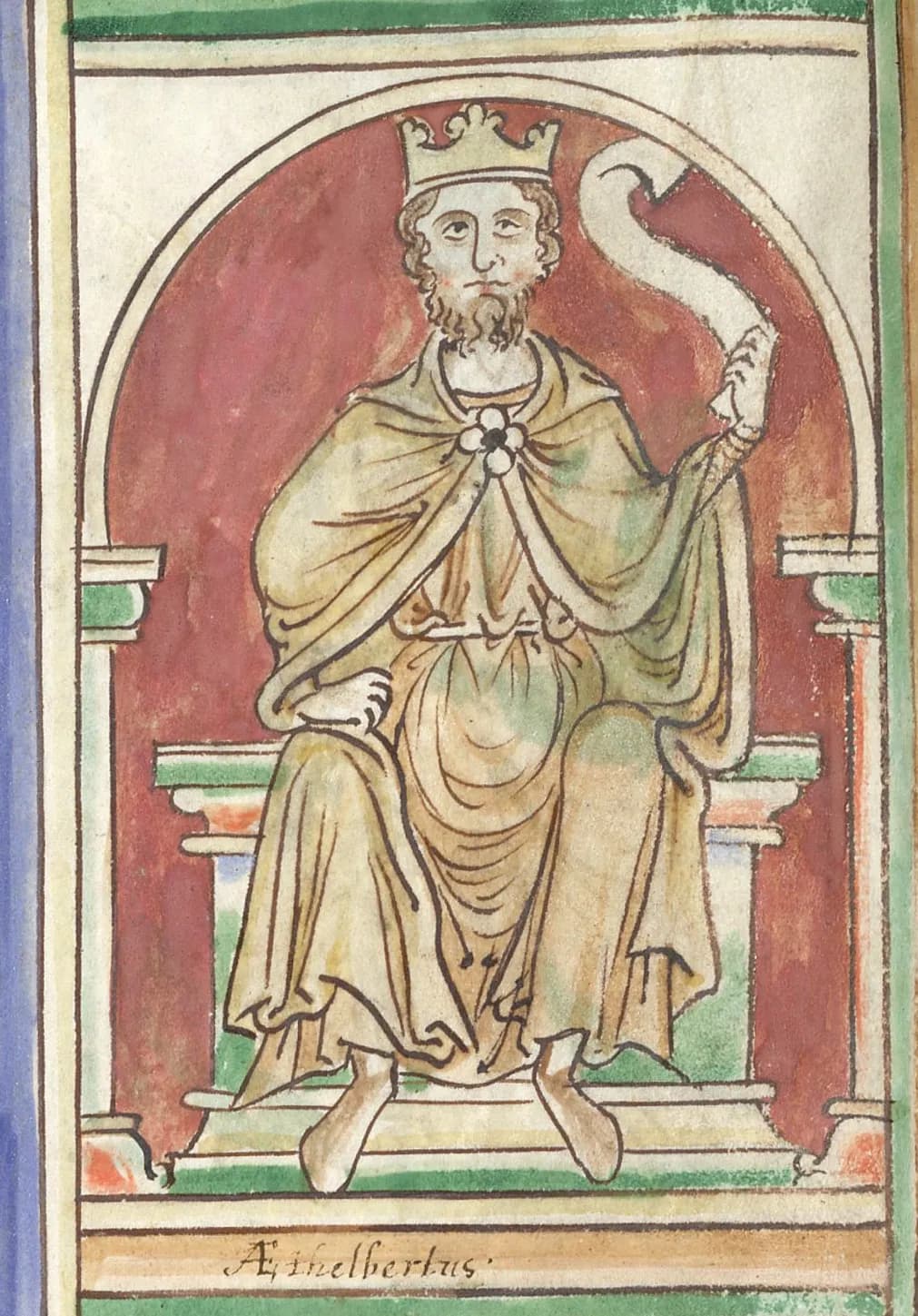
- King of Kent
- For fifty-six years, by Bede's count 2
- Buried
- In Saint Martin's porch of the church of Saints Peter and Paul at Canterbury, beside Bertha 24
- Also known as
- Saint Albert, titular saint of numerous churches in England 6
Saint Ethelbert of Kent was the first English king to become a Christian: the pagan ruler who met Saint Augustine and his monks on the Isle of Thanet in 597, let them preach in Canterbury, and was baptized himself. 135 Bede says he forced nobody to follow him, because his teachers had taught him "that the service of Christ ought to be voluntary, not by compulsion." 1 He gave the English their first written laws, founded the churches that became the cathedrals of Canterbury, Rochester and London, and died in 616 after fifty-six years as king. 236
A pagan king with a Christian wife
Ethelbert was the son of Eormenric, and Bede traces the family back to Hengist, who first brought the Saxons into Britain. 23 He succeeded his father in 560, according to the 1909 Catholic Encyclopedia, and failed in an early attempt to take the overlordship of southern Britain from Ceawlin of Wessex. 3 After Ceawlin died, Ethelbert held that position himself. Bede counts him the third English king with sovereignty over all the provinces south of the Humber. 24
Before 588 he married Bertha, a Christian princess of the Franks, daughter of King Charibert of Paris. 34 A condition of the marriage was that she could practice her religion, and she brought a bishop, Liudhard, as her chaplain. 14 Ethelbert gave her the old Roman church of Saint Martin outside Canterbury to pray in. The encyclopedia sees "a noble disposition to fair dealing" in that, all the more because he himself "had been reared, and remained, a worshipper of Odin." 3 katolsk.no warns that legend has often exaggerated the part Bertha and Liudhard played in converting Kent; as late as 601 Pope Gregory the Great gently reproached her for not having converted her husband. 4
The meeting on Thanet
In 597 Augustine landed on the Isle of Thanet with nearly forty companions, sent by Gregory from Rome, and with Frankish interpreters. 1 They sent word to the king that they had come with a joyful message. Ethelbert told them to stay on the island and had them supplied with what they needed while he decided what to do. 1
A few days later he crossed to the island and sat in the open air to receive them. Bede explains why: the king would not meet them under a roof, "lest, according to an ancient superstition, if they practiced any magical arts, they might impose upon him." 1 The monks came carrying a silver cross and an image of Christ painted on a board, singing the litany. 1 The encyclopedia calls the king's caution "quaint." 3 His answer, as Bede gives it, is careful and generous at once:
"Your words and promises are very fair, but as they are new to us, and of uncertain import, I cannot approve of them so far as to forsake that which I have so long followed with the whole English nation. But because you are come from far into my kingdom, and, as I conceive, are desirous to impart to us those things which you believe to be true, and most beneficial, we will not molest you, but give you favourable entertainment, and take care to supply you with your necessary sustenance; nor do we forbid you to preach and gain as many as you can to your religion." 1
He gave them a house in Canterbury, and they began to pray and say Mass in Bertha's church of Saint Martin. 1 Some of the townspeople were baptized, Bede says, admiring "the simplicity of their innocent life, and the sweetness of their heavenly doctrine." 1
His baptism, and a Church without compulsion
Then the king himself believed and was baptized. 1 The 1909 encyclopedia gives the date as Whitsunday, June 2, 597, and says that as many as ten thousand of his people "are said to have followed his example" within a few months. 3 katolsk.no is more cautious on both counts. Gregory reported the ten thousand to the patriarch of Alexandria in 598, a number katolsk.no thinks exaggerated, and a great many of the king's subjects seem to have been baptized before he was. Bede's statement that he died twenty-one years after receiving the faith would put the baptism in 595, which cannot be right, and katolsk.no thinks 601 more likely. 24
What Bede stresses is the manner of it. The king "compelled none to embrace Christianity, but only showed more affection to the believers, as to his fellow-citizens in the heavenly kingdom." 1 The encyclopedia agrees: although he helped Augustine turn a pagan temple into the church of Saint Pancras, "he never compelled his heathen subjects to accept baptism." 3 Gregory's own letter to him, which Bede copies out in full, urged something sterner. It tells the king to "suppress the worship of idols; overthrow the structures of the temples," and holds up the emperor Constantine as his model. 1 The letter also asks him to listen to Augustine and to "further his endeavours." 1 On the evidence of both Bede and the encyclopedia, Ethelbert took the second piece of advice more readily than the first. 13
Builder and lawgiver
With the king's support Augustine restored an old Roman church in Canterbury and consecrated it to Christ the Savior as his cathedral. 1 Near the city Ethelbert built from the foundations the church of the apostles Peter and Paul, as a burial place for the archbishops and the kings of Kent. 1 When Augustine consecrated Justus as bishop of Rochester in 604, Ethelbert built the church of Saint Andrew there; when Mellitus converted the East Saxons, ruled by Ethelbert's nephew Sabert, the king built the church of Saint Paul in London as the bishop's seat. 2 He endowed all three sees with land. 2 When it was proposed to make London rather than Canterbury the metropolitan see, Ethelbert, with Augustine, resisted it successfully. 34
He was also the first English lawgiver. Bede says that "by the advice of wise persons" he issued judicial decrees "after the Roman model," written in English and still observed in Bede's day. 2 The first of them set out the compensation owed by anyone who stole from the church, the bishop or the clergy. 2 The encyclopedia counts ninety of these "Dooms of Ethelbert" and dates them to 604. 3
His death
Bertha died in 612, and the king married again soon afterward. 4 He died on February 24, 616, "having most gloriously governed his temporal kingdom fifty-six years," and was buried in Saint Martin's porch inside the church of Peter and Paul, where Bertha also lay. 2 Bede calls him the first English king "that ascended to the heavenly kingdom." 2 Until the Reformation, katolsk.no says, a candle always burned at the royal tomb. 4
The young Church nearly died with him. His son Eadbald refused baptism and took his father's widow as his wife, and Bede says many who had accepted the faith out of favor or fear of the old king went back to their former ways. 2 In Essex, Sabert's pagan sons drove out Bishop Mellitus. 2 The encyclopedia says Eadbald "lived and died a pagan"; katolsk.no notes that other sources say he was converted later. 34 Ethelbert's daughter Ethelburga became a saint herself. 4
What is Saint Ethelbert the patron saint of?
No source consulted for this page names a patronage for Saint Ethelbert. 346 The New Catholic Dictionary, quoted by Catholic Culture, says he was popularly called Saint Albert and is known by that name as the titular saint of numerous churches in England. 6 He is remembered above all as the king through whom the Roman mission to the English took root. The Martyrology describes him as the first of the English princes whom Augustine brought to the faith of Christ. 5
Saint Ethelbert's feast day
Saint Ethelbert's feast day is February 24, the day of his death, and the day on which the Roman Martyrology commemorates him. 456 katolsk.no says that in England he was usually kept on February 25, or sometimes the 26th, because the apostle Matthias held February 24; since the 1969 reform moved Matthias to May 14, the day of his death is free for him again. 4 His feast appears in calendars only from the thirteenth century, though an unofficial cult at Canterbury seems to have existed from early times. 4
Praying with Saint Ethelbert
His first recorded words to the missionaries are a refusal. He would not give up what he had followed all his life on the strength of one meeting. 1 He also would not send the strangers away, and he fed them while he thought about it. 1 There is something to learn from a man who could hold a question open that long, with courtesy, and let the answer come slowly.
He was a king, with every means of making his people Christian by order, and the pope himself urged him to tear down the temples. 1 Bede remembered instead that he compelled no one, because he had been taught that the service of Christ has to be freely given. 1 For a man used to command, that cannot have been an easy lesson.
He also had to watch his life's work go uncertain. His son would not be baptized, and soon after his death the bishops of London and Rochester had withdrawn to Gaul. 2 Nothing on the page makes that come out well during his lifetime. The Church he sheltered survived anyway, and Canterbury is still where he gave Augustine a house. 12
Saint Ethelbert of Kent, pray for us.
Sources
- 1.Bede, Ecclesiastical History of the English People, Book I, chapters 25, 26, 32 and 33, Internet Medieval Sourcebook, Fordham University.
- 2.Bede, Ecclesiastical History of the English People, Book II, chapters 3 and 5, Internet Medieval Sourcebook, Fordham University.
- 3.Ewan Macpherson, "St. Ethelbert," The Catholic Encyclopedia, Vol. 5 (New York: Robert Appleton Company, 1909).
- 4."Den hellige Ethelbert av Kent (552-616)," Den katolske kirke (katolsk.no), Catholic Diocese of Oslo (in Norwegian).
- 5.Roman Martyrology, entry for February 24, "Sant'Etelberto, re del Kent," as printed in "Santo del giorno," Conferenza Episcopale Italiana (in Italian).
- 6."February 24," Liturgical Year calendar, Catholic Culture (Trinity Communications), with the New Catholic Dictionary entry for Saint Ethelbert of Kent.
Saints to turn to next
Others in this collection who are turned to for some of the same things.
- Saint Clotildec. 474 - June 3, 545ConversionMarriage and family
- Saint Elizabeth Ann SetonAugust 28, 1774 - January 4, 1821Marriage and familyConversion
- Saint EustaceMartyred at Rome, in 118 by tradition; other accounts give 140 or 188ConversionMarriage and family
- Saint HelenaMid-third century - c. 329 or 330ConversionMarriage and family