Saint Emmeram of Regensburg
Seventh century
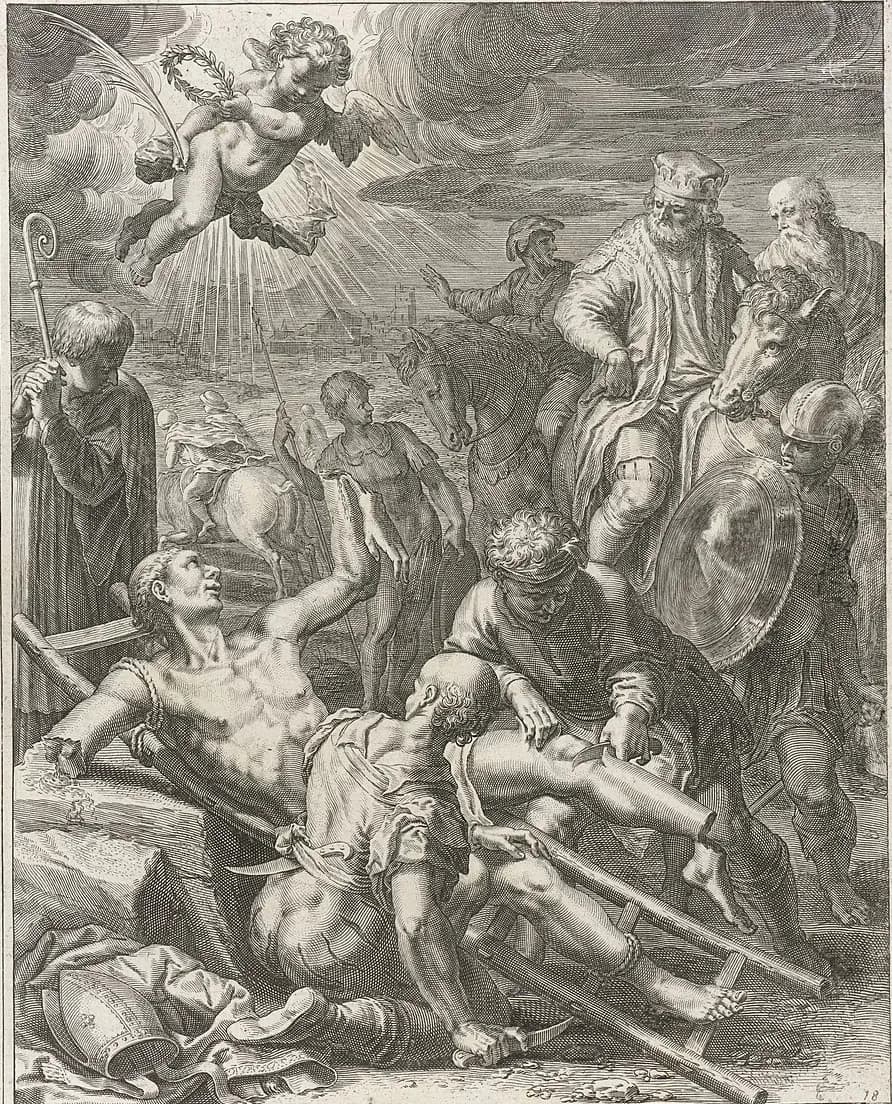
Saint Emmeram of Regensburg was a seventh-century missionary bishop from Aquitaine who preached for about three years at the court of the dukes of Bavaria and was then run down on the road to Rome, tied to a ladder and mutilated at Kleinhelfendorf, near Munich. 12 According to his first biographer, he died for a sin that was not his: he had let a pregnant girl name him as the father in order to shield her. 12 His relics lie in the basilica that bears his name in Regensburg, he is a patron of that diocese, and his feast is September 22. 3
A bishop from Aquitaine
The Diocese of Regensburg says candidly that nothing is known of his childhood or youth. He was born in the seventh century in what is now France, probably at Poitiers. 3 The 1909 Catholic Encyclopedia makes him the son of a noble family of Aquitaine, well educated and ordained a priest. 1 Katolsk.no, the website of the Catholic Church in Norway, lists more than a dozen spellings of his name, among them Haimhram and Heimeran, and puts his birth about the year 600. 4
Was he bishop of Poitiers? The Archdiocese of Munich and Freising says so without hedging. 2 Regensburg says he was a bishop in his homeland, "possibly" at Poitiers. 3 The encyclopedia is more careful than either: "this cannot be verified, for his name does not appear among the bishops of Poitiers," though its author thinks he probably held the see for a short while before 674. 1 Katolsk.no calls him a wandering bishop, a missionary with no fixed see. 4
The source behind all of these is a single book. Arbeo, bishop of Freising, wrote a life of Emmeram about 770, and the Munich page treats it as the beginning of written literature in Bavaria. 2 The encyclopedia, which spells the author Aribo, calls him the first to write the saint's life. 1
Three years at Regensburg
Emmeram did not set out for Bavaria. He meant to go farther east and preach to the pagan Avars in what is now Hungary, and Regensburg was a stop on the way. 234 Duke Theodo, who ruled from there, talked him out of it. The Munich page says the duke pointed to the wars on the eastern border; katolsk.no says he pleaded that his own country was short of priests. 24 The encyclopedia tells it differently, with Emmeram hearing that the Bavarians were still idolaters and traveling up the Loire, across the Black Forest and down the Danube to reach them. 1
The later sources do not think he found a pagan country. Christianity had come to Regensburg with the Romans, the Diocese of Regensburg points out, and Emmeram was not the first to bring it; what he did was preach the Gospel "anew," first at the court and then, at the duke's request, among the people. 3 The Munich page describes a land whose ruling class was already largely Christian and sets Emmeram at the start of a second stage, the strengthening of a faith already planted, which ended when Saint Boniface organized the Bavarian dioceses in 739. 2
He stayed about three years and was held in high regard. 124 Of what he actually did in that time, the Munich page notes, Arbeo says almost nothing. 2
Uta's secret
Arbeo's story of his death runs as follows. The duke's daughter Uta was pregnant by Sigibald, the son of one of her father's judges, and the two of them came to the bishop in fear of the duke. 23 Emmeram rebuked them. Then he told them to name him as the father. 3 He would leave for Rome, answer for the supposed offense before the pope, and explain the truth to the duke when he came back. 2
He left. Uta told her father what had been agreed, and her brother Lantpert rode after the bishop, who looked to him like a man in flight. 2 He caught him at the place now called Kleinhelfendorf, southeast of Munich, had him bound to a ladder and tortured. 2 By the tradition his limbs were cut off. 3 His companions tried to carry him to the ducal estate at Aschheim, and he died a few kilometers short of it. 2
The encyclopedia tells a slightly different version, in which the seducer is "Sigipaldus, an important personage" of the court and the attackers are envoys sent by Theodo himself. 1 It does not believe the story in either form. "The cause of this attack and the circumstances attending his death are not known," it says, and it judges that Arbeo, "infected by the pious mania of his time," added imaginary details to the bare facts for the glory of the martyr. 1
What may have happened
The two Bavarian dioceses take Arbeo more seriously than the encyclopedia did, and they also look past him. Both report that scholars have repeatedly suspected a political murder. Emmeram was a Frank, the Christianizing of Bavaria had a Frankish cast, and the Agilolfing dukes at Regensburg had reason to fear Frankish dominance. 23 Yet the duke had the body brought back to Regensburg, and Arbeo says Lantpert was banished, which suggests to the Munich author that the killing was the work of an anti-Frankish party around the duke's son and not of the duke. 2 Both pages add that the very heavy penalty for killing a bishop in the old Bavarian law code has been read as a response to this death. 23
There is also physical evidence. An anthropological examination of the bones venerated at St. Emmeram found traces of severe mistreatment, the Munich page reports, and at Aschheim archaeologists have interpreted an empty grave shaft in what was probably the first church there as his temporary tomb. 2 The same page concludes that research has largely confirmed that Emmeram was a real person, something long doubted. 2
When he died is another matter. The encyclopedia says only that it was some time before Saint Rupert arrived in Bavaria in 696, toward the end of the seventh century. 1 Katolsk.no has him reach Regensburg in 649 and die in 652. 4 Auxiliary Bishop Reinhard Pappenberger, preaching in the saint's basilica in 2012, gave 642 as the year according to the latest research. 7
Aschheim and Regensburg
He was buried first in the church at Aschheim. 23 Legend says it then rained for forty days, which was taken as a sign that he wished to lie where he had worked, and Theodo, who had by then learned the truth, had the body carried to Regensburg. 24
At Regensburg he was laid in the church of St. George. 13 About the middle of the eighth century, in 752 by the Diocese of Regensburg's reckoning, Bishop Gaubald moved the relics into the church of the Benedictine abbey named for him, and that elevation counted as his canonization. 13 The church burned in 1642; the body was found under the altar in 1645 and placed in a reliquary. 1
Chapels stand at Kleinhelfendorf, which grew into a place of pilgrimage, and at Aschheim. 12
What is Saint Emmeram the patron saint of?
Saint Emmeram is a patron of the Diocese of Regensburg, venerated there beside its principal patron, Saint Wolfgang, and Saint Erhard. 23 The encyclopedia's article on his abbey calls him "the patron saint of the city." 5 None of the sources read for this page assigns him a trade, an illness or a cause.
Whether he was ever bishop of the place is unsettled. The Munich page gives him the title, and Bishop Pappenberger called him the first to hold it. 27 The encyclopedia answers that "it is impossible to prove that Emmeram occupied the See of Ratisbon," since the official list begins with Gaubald, consecrated by Saint Boniface in 739. 1 With Saints Rupert and Corbinian he is counted among the apostles of Bavaria. 24
In art the oldest images from Regensburg show him in Mass vestments. Since the fifteenth century he has usually been a bishop with miter and crosier, carrying a ladder. 2
Saint Emmeram's feast day
Saint Emmeram's feast day is September 22, which the encyclopedia and katolsk.no give as the day he died. 134 The Roman Martyrology enters him on that date at Regensburg in Bavaria, as a bishop killed for his faith in Christ. 6 In his basilica the day is kept as a solemnity with a Pontifical Mass, and the encyclopedia records that his relics were shown to the faithful every year on that day. 17 Katolsk.no adds that it is an optional memorial in the dioceses of Eichstatt and Munich and Freising. 4
Praying with Saint Emmeram
The Munich page names what Arbeo's book is about: a man who freely took on someone else's guilt, and so stands as a witness in blood directly behind Christ. 2 The diocese that keeps his bones describes his offer to the frightened couple with the word generous. 3 Even the encyclopedia, which believes none of the details, calls him "moved with compassion." 1
It is an uncomfortable story all the same. What Emmeram proposed was a lie, told to protect two people from a father's rage, and by Arbeo's account it got him killed before he could undo it. 2 The Munich page admits that the real motive for his death is still largely unexplained. 2
Bishop Pappenberger told his congregation that what triggered the killing can no longer be traced. 7 He did not think that left nothing to say. Emmeram, he said, "died upright and brave for his faith" (the words are translated here from the diocese's German report), and he held him up as the measure for every bishop: a servant of the Gospel, and unafraid. 7
What can be said without Arbeo is modest and enough. A foreign bishop gave up the mission he had planned because a duke asked him to stay, spent three years on the unglamorous work of strengthening a faith that was already half there, and was killed. 2 The bones in Regensburg carry the marks of it. 2
Saint Emmeram of Regensburg, pray for us.
Sources
- 1.Leon Clugnet, "St. Emmeram," The Catholic Encyclopedia, Vol. 5 (New York: Robert Appleton Company, 1909).
- 2.Michael Volpert, "Hl. Emmeram: Bischof von Regensburg, Glaubensbote in Bayern, Märtyrer - 22. September," Erzbistum München und Freising (in German).
- 3."EMMERAM: Heiliger und Märtyrer aus Regensburg," Bistum Regensburg (in German).
- 4.Per Einar Odden, "Den hellige Emmeram av Regensburg (~600-652)," Den katolske kirke (the Catholic Church in Norway), July 1, 2014 (in Norwegian).
- 5.George Cyprian Alston, "Abbey of St. Emmeram," The Catholic Encyclopedia, Vol. 5 (New York: Robert Appleton Company, 1909).
- 6.Roman Martyrology, entry for September 22, "Sant'Emmerammo, vescovo," as printed in "Santo del giorno," Conferenza Episcopale Italiana (in Italian).
- 7."Pontifikalamt zu Ehren des Heiligen Emmeram," Bistum Regensburg, September 22, 2012 (in German).
Saints to turn to next
Others in this collection who are turned to for some of the same things.