Saint Elzear of Sabran
1285 - September 27, 1323
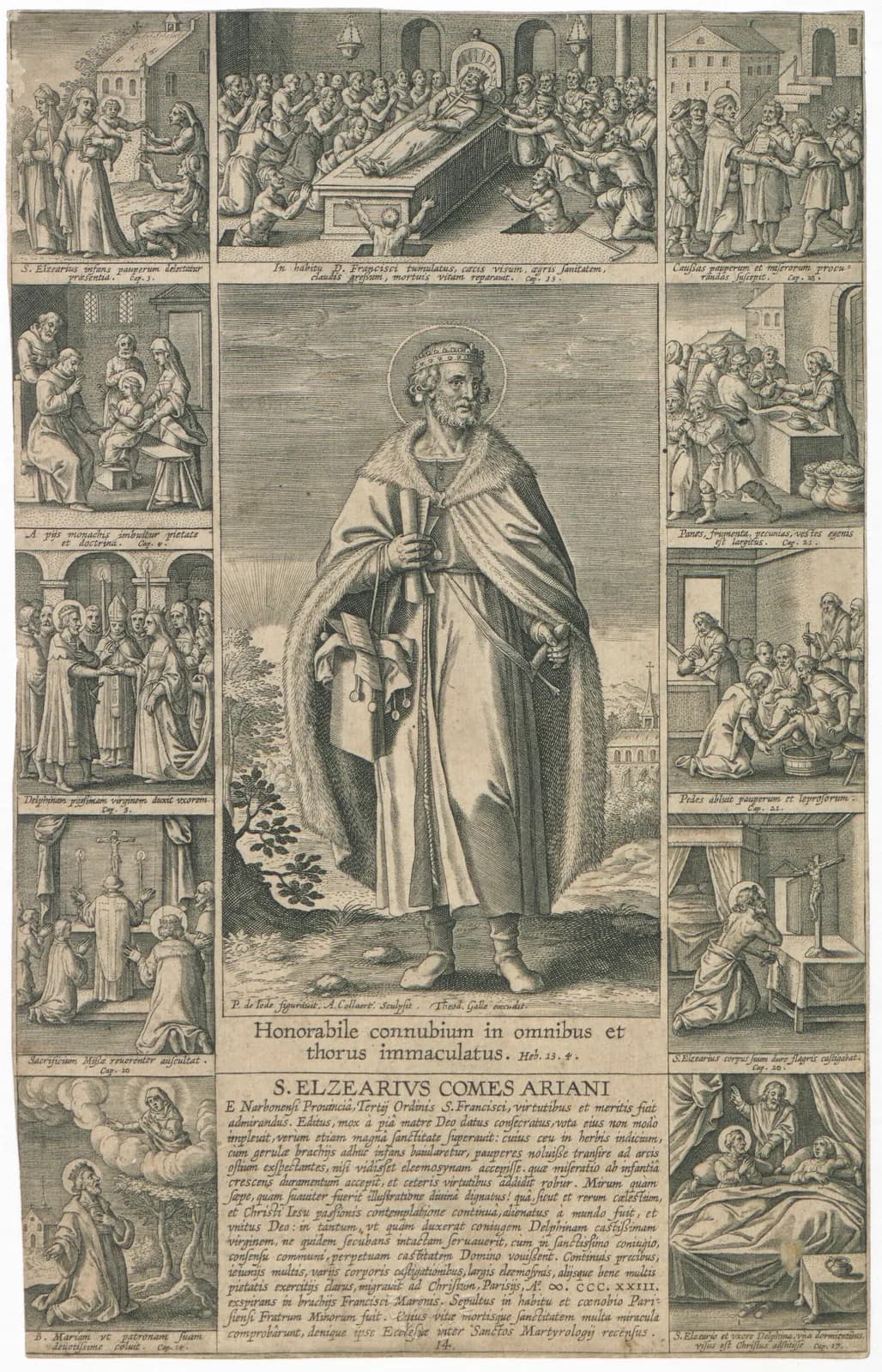
Saint Elzear of Sabran was a nobleman of Provence, Count of Ariano in the kingdom of Naples, who served two kings as soldier, tutor and ambassador and died in Paris in 1323 at about thirty-eight. 12 He and his wife, Blessed Delphine, lived their marriage in continence as members of the Third Order of Saint Francis. 13 The Roman Martyrology remembers him with her, for the virtues they kept together. 4
A household in Provence
Elzear was born in 1285 in his father's castle of Saint-Jean de Robians at Ansouis, in the Luberon. 12 katolsk.no says he was the eldest son of Hermengaud of Sabran, Count of Ariano, and of Landine d'Albe de Roquemartine, a mother so gentle that the country called her the good countess. 2 She offered him to God at his birth and prayed that he might rather die young than live long in sin. 2 He was educated at the abbey of Saint-Victor in Marseilles, where his uncle William of Sabran was abbot. 12
The marriage was arranged at the wish of King Charles II of Naples, who wanted the houses of Sabran and Glandèves joined. 12 Delphine was an orphan and an heiress. Stephen Donovan, writing on her in the 1908 Catholic Encyclopedia, says she was raised under the direction of an aunt who was an abbess, and that she had taken a vow of virginity. 3 katolsk.no says she resisted the marriage in vain, and that they were married at about sixteen, or by other accounts he at fifteen and she at thirteen. 2 Donovan puts her marriage in her twentieth year. 3
On their wedding night, katolsk.no relates, Delphine told him of her resolve, and after some hesitation he agreed to it; they promised to live as brother and sister. 2 Gregory Carr, in the encyclopedia's article on Elzear, says he "respected her desire to live in virginity," and dates their formal vow of chastity later, after his return from Italy. 1 Both joined the Third Order of Saint Francis. 13 Carr describes them "vying with her in the practice of prayer, mortification, and charity towards the unfortunate." 1 katolsk.no adds that he washed the feet of twelve poor men every day and visited the sick in the hospitals, especially the lepers. 2
At twenty, with his father's leave, he moved from Ansouis to Puy-Michel for greater solitude. 12 There, says Carr, he "formulated for his servants rules of conduct that made his household a model of Christian virtue." 1
Ariano, Rome and Naples
His father died in 1309, and Elzear inherited Sabran and Ansouis in Provence and the county of Ariano in Apulia. 12 The people of Ariano would not accept a Frenchman as their lord. 12 katolsk.no says King Charles II offered him troops, and that he refused them; his friends told him to play the lion with the unruly, and he spent three years winning his subjects over by patient firmness until they submitted of their own accord. 2 Carr says he subdued them "by kindness." 1 katolsk.no adds that he visited men condemned to death and secretly gave back their confiscated property to their wives and children. 2
He was also a soldier. Carr says he went to Rome "at the head of an army and aided in expelling the Emperor Henry VII." 1 katolsk.no dates this to 1312, when King Robert of Naples gave him command of troops sent to relieve the pope, then besieged by Henry's army. 2
In 1317 he went back to Naples. 12 Delphine became a lady-in-waiting to Queen Sancia, and Elzear became tutor to the king's son, Duke Charles. 2 katolsk.no calls the young prince stubborn and tyrannical, and says that Elzear found him the best teachers and lived to see him become a wise ruler. 2 Carr says he later became the duke's "prime minister when he became regent"; katolsk.no says instead that his success led to his appointment as a judge in the southern Abruzzi. 12
The embassy to Paris
In 1323 King Robert sent him to France to ask for Marie of Valois as a bride for Duke Charles. 12 katolsk.no says Delphine was uneasy about his going to the French court, and that he answered that he had lived virtuously at Naples and so had nothing to fear in Paris. 2 Carr says he spent the embassy "edifying a worldly court by his heroic virtues." 1 The mission succeeded. 2
Then he fell gravely ill. katolsk.no says he made a long general confession to a Franciscan with many tears, bore three days of pain praising God in prayers and psalms, received the anointing of the sick, and died in his confessor's arms on September 27, 1323, at thirty-eight. 2 The Franciscan theologian Francis of Meyronnes preached his funeral sermon. 2 He was buried in the Franciscan habit in the church of the Conventual Franciscans at Apt, where katolsk.no says his body was brought in 1324. 12
Delphine outlived him by thirty-five years. 23 Donovan says she sold her great possessions for the poor and retired first to Naples and then to Cabrières, before returning to Apt, where her husband lay. 3 She died on November 26, 1358, and was buried beside him. 23
Canonization and relics
Pope Urban V, born Guillaume de Grimoard, was Elzear's godson; katolsk.no also calls him his nephew. 12 Carr says Urban signed the decree of canonization and Gregory XI published it. 1 katolsk.no gives the dates: signed in 1369, proclaimed on January 5, 1371. 2 Delphine's cult was confirmed by Urban V, according to Donovan, and by Innocent XII in 1694, according to katolsk.no. 23 In 1791 Elzear's relics were moved from the Franciscan church at Apt to the town's cathedral of Sainte-Anne, where they are honored together with hers. 2
What is Saint Elzear the patron saint of?
None of the sources consulted names a patronage for Saint Elzear. katolsk.no says that he and Delphine are widely honored as a model for Christian married couples, and that both are pictured holding a bouquet of flowers. 2 He is kept liturgically at Apt, at Avignon, at Saint-Victor in Marseilles, at Ariano Irpino and throughout the Franciscan order. 2
Saint Elzear's feast day
Saint Elzear's feast day is September 27, the day he died. 12 The current Roman Martyrology enters him on that day, at Paris, as Count of Ariano, who kept virginity and every other virtue together with his wife, Blessed Delphine, and died still young. 4 Carr and katolsk.no say the Friars Minor and the Conventuals keep that date, while the Capuchins keep him on October 20. 12 katolsk.no adds that Apt marks the translation of his relics on June 16, and that November 26, Delphine's death day, is named as a shared feast of the couple. 2 Donovan gives Delphine's feast in the Franciscan order as November 27. 3
Praying with Saint Elzear
Elzear did not leave the world. He held land, raised a prince, led troops, sat as a judge and went abroad on a king's business, and the sources treat all of it as part of his holiness. 12 Carr's phrase for his household is "a model of Christian virtue," and he made it so by writing rules for the people who worked in it. 1
His marriage was unusual, and the sources do not pretend otherwise. He agreed to a vow his bride had made before she met him, and the two kept it for the rest of his life. 123 katolsk.no describes the marriage as harmonious and mutually supportive. 2
In Ariano he refused the soldiers that would have settled his claim in a week and spent three years on patience instead. 2 He died far from home with the work done, after a long confession and many tears. 2 Delphine gave away what they had and lived thirty-five more years near his grave. 23
Saint Elzear of Sabran, pray for us.
Sources
- 1.Gregory Carr, "St. Elzéar of Sabran," The Catholic Encyclopedia, Vol. 5 (New York: Robert Appleton Company, 1909).
- 2."Den hellige Elzear av Sabran (~1285-1323)," Den katolske kirke (katolsk.no), Catholic Diocese of Oslo (in Norwegian).
- 3.Stephen Donovan, "Blessed Delphine," The Catholic Encyclopedia, Vol. 4 (New York: Robert Appleton Company, 1908).
- 4.Roman Martyrology, entry for September 27, "Sant'Elzeáro di Sabran," as printed in "Santo del giorno," Conferenza Episcopale Italiana (in Italian).
Saints to turn to next
Others in this collection who are turned to for some of the same things.
- Saint Arnulf of Metzc. 580 - c. 640Work and vocationPrayerMarriage and family
- Saint Dominic of Silosc. 1000 - December 20, 1073PrayerMarriage and familyWork and vocation
- Saint Edward the Confessorc. 1003 - January 5, 1066Marriage and familyWork and vocationPrayer
- Saint Isidore the Farmerc. 1070 - May 15, 1130Work and vocationPrayerMarriage and family