Saint Mary Elizabeth Hesselblad
June 4, 1870 - April 24, 1957
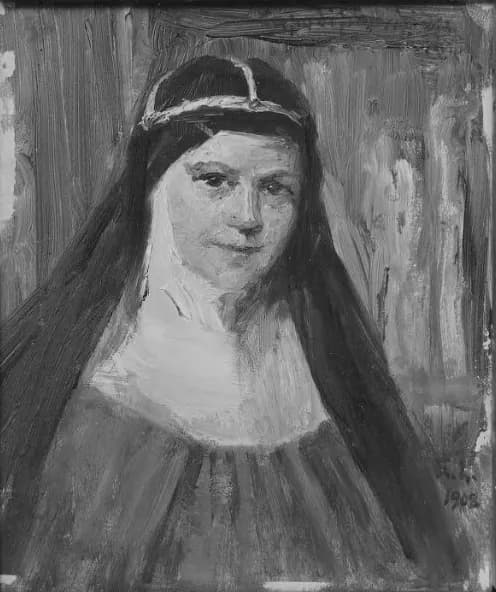
- Feast day
- June 4, as the Bridgettine sisters keep it 5; Vatican News lists her on April 24, the day she died 4
- Born
- June 4, 1870, at Faglavik in the province of Alvsborg, Sweden, the fifth of thirteen children, and baptized into the Church of Sweden 1
- In America
- Trained as a nurse at Roosevelt Hospital in New York and nursed the sick in their homes 1
- Received into the Church
- August 15, 1902, by conditional baptism at the Convent of the Visitation in Washington 1
- Founded
- On November 9, 1911, refounded the Order of the Most Holy Saviour of Saint Bridget in Rome, with three English postulants 16
- Recognized
- Among the Righteous Among the Nations at Yad Vashem, for sheltering Jewish families in Rome 7
- Died
- In Rome, in the early hours of April 24, 1957 1
Saint Mary Elizabeth Hesselblad was a Swedish Lutheran who went to America to support her family, trained as a nurse in New York, and was received into the Catholic Church in Washington in 1902. 1 Nine years later, in Rome, she refounded the order of her countrywoman Saint Bridget, and during the Second World War she hid Jewish families in its house, for which Yad Vashem counts her among the Righteous Among the Nations. 17
A large family in Sweden
She was born on June 4, 1870, in the village of Faglavik in the province of Alvsborg, the fifth of thirteen children of Augusto Roberto Hesselblad and Cajsa Pettesdotter Dag. 1 The next month she was baptized into what the Holy See's biography calls the Reformed Church of Sweden, in her parish at Hundene. 1 The family was not secure. "Economic difficulties forced the family to move on several occasions," the biography says, and she grew up in a series of places rather than one. 1
The Catholic Standard, reporting from her order in Rome, traces the start of her search to the Gospel of John, where Christ prays that his followers may be one. 5 Her order puts it in its own words: from childhood the image of "one fold under one shepherd" drove her search for the truth. 6
A nurse in New York
She left home to earn money for her family. The Holy See dates this to 1886 and says she worked first at Karlsborg in Sweden and then in the United States; the Catholic Standard has her emigrate at sixteen, which agrees, while the order's timeline gives 1888 for her departure for America. 156
In New York she went to nursing school at Roosevelt Hospital and then gave herself to nursing the sick in their homes. 1 The biography is frank about the cost: the work meant constant sacrifice, "which did not do her health any good, but certainly helped her soul to flourish." 1 Her health stayed poor for the rest of her life.
It was the patients who brought the question of the Church to her door. The biography credits "the contact she had with so many sick catholics and her thirst for truth" with keeping her search alive. 1 The Catholic Standard adds that she took part in various charitable groups and denominations before concluding that she was called to the Catholic Church, and that the final confirmation came during a Corpus Christi procession in Brussels in 1900, when, as the sisters tell it, she heard Jesus say: "it is me for whom you search." 5
Conversion in Washington
On August 15, 1902, the feast of the Assumption, she received conditional baptism in the Convent of the Visitation in Washington from the Jesuit Father Hagen (the biography gives his name in Italian, Giovani Giorgio), who became her spiritual director. 1 She wrote of the moment afterward: "In an instant the love of God was poured over me. I understood that I could respond to that love only through sacrifice and a love prepared to suffer for His glory and for the Church." 1 Two days later she received the Eucharist, and then she left for Europe. 1
In Rome she was confirmed, and the biography says she "clearly perceived that she was to dedicate herself to the unity of Christians." 1 She also visited the church and house where Saint Bridget of Sweden had lived and died in 1373, and came away with words she took as addressed to her: "It is in this place that I want you to serve me." 1 The Catholic Standard places that visit in 1903, when she was in Rome with two Catholic friends. 5
She went back to the United States. Despite her health, she "left everything," and on March 25, 1904, she settled in Rome at the Casa di Santa Brigida, where the Carmelite nuns then living in the house took her in. 1 In 1906 Pope Pius X allowed her to take the habit of the Order of the Most Holy Saviour of Saint Bridget and to profess vows as a spiritual daughter of the Swedish saint. 1
Refounding the Bridgettines
The order Bridget founded had dwindled after the Reformation, and in Italy among other places it was in slow decline. 6 Hesselblad's first plan was to gather a Roman community from the old monasteries that survived, and she visited the few Bridgettine houses left in Europe to try. 1 The biography records that the journeys brought "joys, disappointments and no concrete help." 1
What happened instead was a new branch. On November 9, 1911, she received three young English postulants and with them refounded the order in Rome, with a particular mission to pray and work for the unity of Scandinavian Christians with the Catholic Church. 16 Her order lists the foundations that followed: Sweden in 1923, Switzerland in 1924, England, and in 1935 Vadstena, the town of Bridget's first monastery, after an absence of some 350 years. 6 In 1931 the Holy See gave her permanent use of the church and house of Saint Bridget on the Piazza Farnese, which became the center of the order, and in 1937 her sisters went to India. 1
To her sisters she kept returning to one goal. She asked them to pray constantly that there be one flock and one shepherd, "adding, 'This is the prime goal of our vocation.'" 1 The order today counts some 600 sisters in 57 houses. 56
The war years
During and after the Second World War, the Holy See's biography says, she "performed great works of charity on behalf of the poor and those who suffered because of racial laws," promoted a movement for peace among Catholics and non-Catholics, and received people of other faiths under her roof with "great respect for the religious freedom" of each. 1 Among the people she cared for, it names "the persecuted Jewish people." 1
L'Osservatore Romano is more specific. During the years of the racial laws, it writes, "she gave refuge to many Jewish families, saving them from the Shoah," and "her name is also among the Righteous among the Nations at Yad Vashem in Jerusalem." 7 The order she had refounded in the convent on the Piazza Farnese, in the house that had been Bridget's, became a refuge. 17
Illness, a hard last chapter, and death
Her physical suffering never let up, and the biography says it went "hand in hand with her moral suffering." 1 The last years were the heaviest, when the Holy See prepared a canonical visitation of her order while her health declined. 1 She died in Rome in the early hours of April 24, 1957, and the Vicariate of Rome opened her cause almost at once. 1
John Paul II beatified her in St. Peter's Square on April 9, 2000, and Pope Francis canonized her there on June 5, 2016, together with the Polish priest Stanislaus of Jesus and Mary Papczynski, before a delegation from Sweden. 236 In his homily Francis said of the two: "They remained deeply united to the passion of Jesus, and in them the power of his resurrection was revealed." 2
What is Saint Elizabeth Hesselblad the patron saint of?
None of the sources used here names a patronage for her. The Holy See's biography, Vatican News, her order and the Catholic Standard describe her as a foundress, a convert and a worker for Christian unity, and stop there. 1456 Devotional websites sometimes list her as patron of nurses, which would fit her years at Roosevelt Hospital, but no authoritative source consulted says so, and this page does not supply one.
What the sources do give is a cause. Her order calls her "pilgrim of unity," and the Holy See says her particular mission was prayer and work for the unity of Scandinavian Christians with the Catholic Church. 16
Saint Elizabeth Hesselblad's feast day
The Bridgettine sisters celebrate the feast of Saint Maria Elizabeth Hesselblad on June 4, her birthday, as the Catholic Standard reports. 15 Vatican News, in its Saint of the Day calendar, lists her instead on April 24, the anniversary of her death in 1957. 4 Both dates are in use, and this page records both.
Praying with Saint Elizabeth Hesselblad
Her conversion took years and happened at work. The biography credits prayer, personal study and devotion to the Mother of the Redeemer, and also the many sick Catholics she nursed in New York while she was earning money to send home. 1 The search took her through other churches and charities before it ended at a convent chapel in Washington. 51
What she did with the conversion is unusual. A Swedish Lutheran who became a Catholic might have turned her back on where she came from; she spent the rest of her life praying for it, and refounded a Swedish saint's order for that purpose. 16 The Catholic Standard reports the sisters' view that she first tried to soothe prejudice between Catholics and Lutherans and later understood that the goal was "unity but not uniformity." 5
Much of her plan failed. The old monasteries gave her no help, her health never held, and the end of her life was overshadowed by an inquiry into the order she had built. 1 She wrote in 1904: "Dear Lord, I do not ask to see the path. In darkness, in anguish and in fear, I will hang on tightly to your hand." 1
And in the war she opened her door to people who were being hunted. 7 Her life gives no formula for that. It shows a nurse and a contemplative, a woman who prayed for one flock and one shepherd, sheltering families of another faith from the Shoah in the house of Saint Bridget. 17
Saint Mary Elizabeth Hesselblad, pray for us.
Sources
- 1.Office for the Liturgical Celebrations of the Supreme Pontiff, "Maria Elisabetta Hesselblad (1870-1957)," biography for her beatification, April 9, 2000, The Holy See.
- 2.Pope Francis, Homily at the Holy Mass and Canonization of the Blesseds Stanislaus of Jesus and Mary and Maria Elisabeth Hesselblad, St. Peter's Square, June 5, 2016.
- 3.Holy See Press Office, "The Pope canonises Stanislaus of Jesus and Mary, and Mary Elisabeth Hesselblad," Daily Bulletin, June 6, 2016.
- 4."St. Mary Elizabeth Hesselblad, Foundress of the Bridgettines," Saint of the Day, 24 April, Vatican News.
- 5.Benjamin Mersch and Thong Nguyen, "Bridgettine sisters continue the work of their founder," Catholic Standard (Archdiocese of Washington), July 23, 2021.
- 6.Order of the Most Holy Saviour of Saint Bridget, "Santa M. Maria Elisabetta Hesselblad" (English page), and the order's home page, brigidine.org.
- 7.Bianca Stancanelli, "Queens and peasant women," Women Church World, L'Osservatore Romano, November 6, 2021.
Saints to turn to next
Others in this collection who are turned to for some of the same things.
- Saint Josephine Bakhitac. 1869 - February 8, 1947Suffering and illnessConversionCouragePrayer
- Saint Teresa Benedicta of the CrossOctober 12, 1891 - August 9, 1942ConversionSuffering and illnessCouragePrayer
- Saint Bernardo TolomeiMay 10, 1272 - August 20, 1348PrayerCourageSuffering and illness
- Saint Catherine of Siena1347 - 1380CouragePrayerConversion