Saint Elisha
Ninth century BC
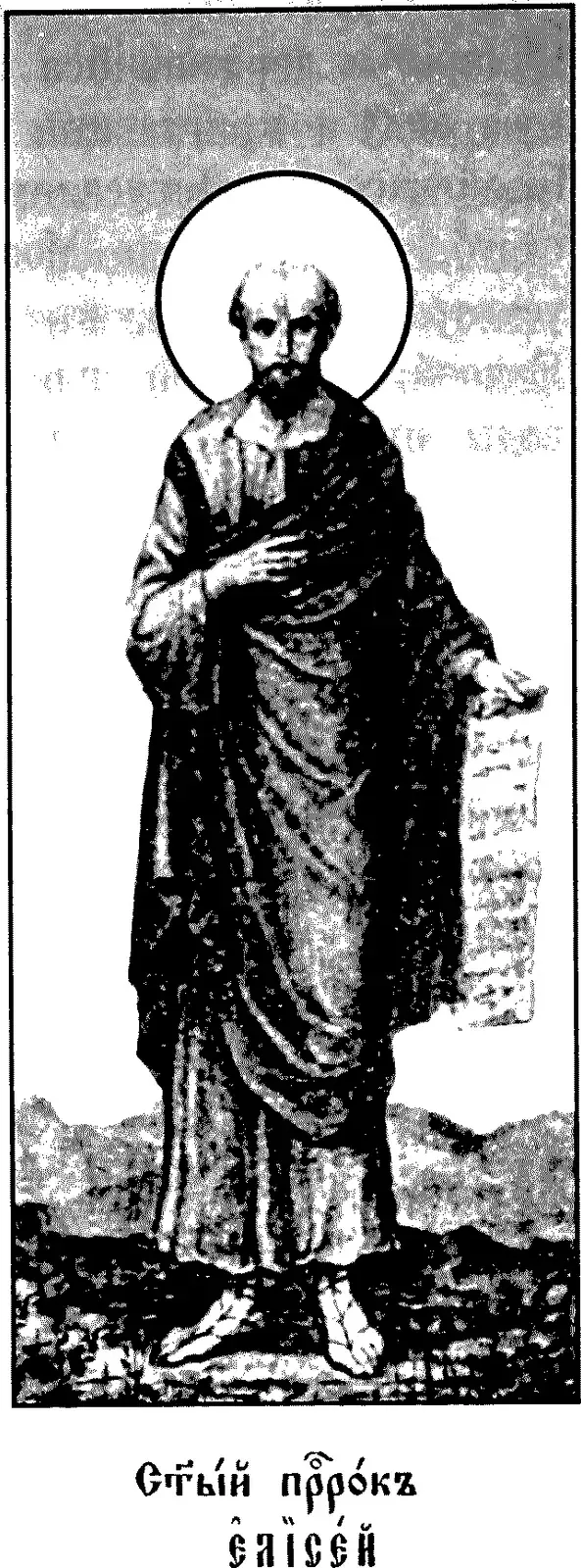
- From
- Abelmeula, the son of Saphat 5; Abel Meholah, south of Beth-shan, of a well-to-do family, says Catholic.net 13
- Lived
- In the northern kingdom of Israel, a prophet from the reign of King Joram to the days of King Joash 23; about 850 to 800 BC, says Catholic.net 13
Saint Elisha was the disciple and successor of the prophet Elijah, called from behind a plow in the ninth century before Christ and left holding his master's mantle when Elijah was taken up in the chariot of fire. 16 A Carmelite life of him finds his miracles more numerous and more striking than Elijah's, though not his personality or his religious influence, and among them is the healing of Naaman the Syrian, the one miracle of his that Christ himself recalled. 113 The Church commemorates him on June 14, and the Roman Martyrology says that although he left no written prophecies, the wonders he worked for foreigners foretold the salvation to come for all people. 3
Called from the plow
On Horeb, after the flight from Jezebel, God told Elijah to anoint "Eliseus the son of Saphat, of Abelmeula" to be prophet in his place. 5 Elijah went and found him plowing "with twelve yoke of oxen," and cast his mantle over him. 5
Elisha asked only to say goodbye. He killed his yoke of oxen, boiled the meat over the wood of the plow and gave it to the people, then "followed Elias, and ministered to him." 15
A double portion of the spirit
Elijah set out on his last journey from Galgal to Bethel, to Jericho and to the Jordan, and three times told Elisha to stay behind; three times Elisha answered, "As the Lord liveth, and as thy soul liveth, I will not leave thee." 16 Asked what he wanted before they were parted, Elisha said, "I beseech thee that in me may be thy double spirit." 6 Challoner and Catholic.net both read it as the double share due to an eldest son. 613
Then, as they walked and talked, "a fiery chariot, and fiery horses parted them both asunder: and Elias went up by a whirlwind into heaven." 6 Elisha cried out, "My father, my father, the chariot of Israel, and the driver thereof," and tore his clothes in two. 6 He picked up the fallen mantle, struck the Jordan with it and asked, "Where is now the God of Elias?" 6 The waters parted again, and the sons of the prophets watching from Jericho said, "The spirit of Elias hath rested upon Eliseus." 126
His first acts as a prophet were a healing and a curse. 1 At Jericho he threw salt into a bad spring and the waters were healed. 16 On the road to Bethel a crowd of boys jeered at him, "Go up, thou bald head," and when he cursed them in the name of the Lord, two bears came out of the forest and mauled forty-two of them. 6 Daniel Duffy, in the 1909 Catholic Encyclopedia, reads it as a warning to the calf-worshipers of Bethel; Challoner's note says the curse came from zeal and divine inspiration, not from revenge. 16
The man of God
Duffy says that the whole course of his life shows he inherited Elijah's wonder-working power. 1 katolsk.no adds that his servant Gehazi told the stories. 2 A prophet's widow, about to lose her two sons to a creditor, filled every vessel she could borrow from a little oil, enough to pay the debt and live on the rest. 17 In a famine he made a pot of poisonous stew wholesome by throwing meal into it. 17
At Sunam a wealthy woman fitted out a little room for him to stay in when he passed through. 17 She asked for nothing; it was his servant who pointed out that she had no son and her husband was old, and she bore one at the time he had foretold. 17 When the boy was older he died on her knees at noon. 7 She rode to Mount Carmel, caught hold of the prophet's feet and would not let go. 7 Gehazi went ahead and laid Elisha's staff on the child's face without effect; Elisha came himself, shut the door, prayed, and stretched himself on the boy until the child "gaped seven times, and opened his eyes." 7 Challoner records Saint Augustine's reading: the staff was the Old Law, which could not give life, and Elisha coming in person was "a figure of Christ." 7
Naaman the Syrian
Naaman, commander of the army of the king of Syria, was a leper. 8 On the word of a captive Israelite girl he came to the king of Israel, who tore his garments in alarm. 8 Elisha sent word to let the man come to him, "and let him know that there is a prophet in Israel." 18 He did not come to the door himself, but sent a messenger telling Naaman to wash seven times in the Jordan, and Naaman went away in a rage at being sent to a foreign river. 8 His own servants talked him round, and he washed, and "his flesh was restored, like the flesh of a little child." 18
Naaman came back and said, "In truth, I know there is no other God in all the earth, but only in Israel." 18 Elisha refused every gift he pressed on him. 8 When Gehazi ran after the Syrian and took silver in his master's name, Naaman's leprosy passed to him. 8 Duffy notes that this is the healing Christ recalled at Nazareth: "there were many lepers in Israel in the time of Eliseus the prophet: and none of them was cleansed but Naaman the Syrian." 1 The Martyrology's summary of his life singles out the wonders he worked for foreigners, reading them as a sign of the salvation coming for all people. 3
Kings and armies
Elisha prophesied in the northern kingdom at a time when katolsk.no says the worship of Baal and Astarte had spread through Israel, and he held the people to the one God. 2 He warned the king of Israel more than once of Syrian ambushes. 1 When the king of Syria sent an army by night to seize him at Dothan, his servant woke to find the city surrounded. 9 "Fear not," Elisha said, "for there are more with us than with them," and prayed that the young man's eyes be opened; he saw "the mountain was full of horses, and chariots of fire round about Eliseus." 9 Then he had the soldiers struck blind, led them into Samaria, and told the king to feed them and send them home. 19
He also carried out the last of the commissions given to Elijah on Horeb, foretelling to Hazael that he would be king of Syria. 15 He sent one of the sons of the prophets to anoint Jehu king of Israel, with the command to cut off the house of Ahab. 1 Duffy sums him up as "ever bold before kings, ever kindly towards the lowly." 1
His death, and the tomb at Samaria
When Elisha lay dying, King Joash came down and wept over him, using the words Elisha had once cried after Elijah: "O my father, my father, the chariot of Israel and the guider thereof." 610 "And Eliseus died, and they buried him." 110
A burial party, surprised by raiders from Moab, threw a body into Elisha's tomb, and when it touched his bones the dead man came to life and stood up. 110 katolsk.no calls it an early witness to the power of relics. 2 Duffy closes with Sirach: "In his life he did great wonders, and in death he wrought miracles." 1
The tomb was shown in later centuries at Samaria, which Herod had renamed Sebaste. 11 Saint Jerome, describing the pilgrimage of his friend Paula through the Holy Land, wrote that "there lie the prophets Elisha and Obadiah and John the Baptist." 11 The 1897 Roman Martyrology echoes him: Elisha rests at Samaria with the prophet Abdias, and his grave, "says St. Jerome, makes the demons tremble." 4
Elisha and the Carmelites
After Bethel, Scripture says, Elisha "went to mount Carmel, and from thence he returned to Samaria," and the woman of Sunam found him there. 67 Benedict Zimmerman, in the 1908 Catholic Encyclopedia, describes the sons of the prophets as men living a kind of community life under superiors, the most famous being Elijah and Elisha, the latter connected with Carmel "by prolonged residence on the holy mountain." 12 katolsk.no likewise calls Elisha a kind of superior of the sons of the prophets on Carmel. 2
Zimmerman names Chrysostom, Basil, Gregory Nazianzen and Jerome among the Fathers who held up the two prophets as models of religious perfection. 12 The Carmelites long claimed both prophets as founders, which modern historians reject, dating the order to the twelfth century. 1213 Catholic.net, printing a Carmelite life, says Carmel has always regarded him as its second spiritual father. 13
What is Saint Elisha the patron saint of?
Saint Elisha's feast day
Saint Elisha's feast day is June 14. 23 The 1897 English Roman Martyrology entered "At Samaria, in Palestine, of St. Eliseus, prophet" under that day, and the current Martyrology, as the Italian bishops print it, keeps the commemoration of Saint Elisha at Samaria or Sebaste on the same date. 34 katolsk.no says the Carmelite general chapter of 1399 established his feast on June 14. 2 The Carmelites themselves, according to the life Catholic.net prints, kept that date until the liturgical reform after the Second Vatican Council, and now celebrate him together with Elijah on July 20. 13
Praying with Saint Elisha
Elisha's call came in the middle of a working day, in a field, with a prophet's cloak thrown over his shoulders. 5 He closed his old life at a table, cooking his oxen on the wood of his plow and feeding the people before he went. 15 Then he served Elijah, and Scripture records nothing more of him until the day his master was taken. 56
At the Jordan he would not leave Elijah, though told three times to stay behind, and what he asked for was a share in his master's spirit. 6 His first words after the chariot vanished were a question, "Where is now the God of Elias?", asked with Elijah's mantle in his hands at the edge of the river. 6
His prayer at Dothan was not that the danger would go away, but that his frightened servant might see what was already there. 9 The Martyrology's summary of his life dwells on the wonders he worked for foreigners, and sees in them a promise to all people. 3 In the stories themselves the people he helped have faces: a Syrian general, a widow in debt, a mother who would not let go of his feet. 78
Saint Elisha, pray for us.
Sources
- 1.Daniel Duffy, "Eliseus," The Catholic Encyclopedia, Vol. 5 (New York: Robert Appleton Company, 1909).
- 2."Den hellige profeten Elisja (800-t f.Kr.)," Den katolske kirke (katolsk.no), Catholic Diocese of Oslo (in Norwegian).
- 3.Roman Martyrology, entry for June 14, "Sant'Eliseo, profeta," as printed in "Santo del giorno," Conferenza Episcopale Italiana (in Italian).
- 4.The Roman Martyrology, June 14 (Baltimore: John Murphy Company, 1897).
- 5.3 Kings (1 Kings) 19, Douay-Rheims Bible, Challoner revision, with Challoner's notes.
- 6.4 Kings (2 Kings) 2, Douay-Rheims Bible, Challoner revision, with Challoner's notes.
- 7.4 Kings (2 Kings) 4, Douay-Rheims Bible, Challoner revision, with Challoner's notes.
- 8.4 Kings (2 Kings) 5, Douay-Rheims Bible, Challoner revision, with Challoner's notes.
- 9.4 Kings (2 Kings) 6, Douay-Rheims Bible, Challoner revision, with Challoner's notes.
- 10.4 Kings (2 Kings) 13, Douay-Rheims Bible, Challoner revision, with Challoner's notes.
- 11.Saint Jerome, Letter 108, to Eustochium, section 13, trans. W. H. Fremantle, G. Lewis and W. G. Martley, Nicene and Post-Nicene Fathers, Second Series, Vol. 6 (1893).
- 12.Benedict Zimmerman, "The Carmelite Order," The Catholic Encyclopedia, Vol. 3 (New York: Robert Appleton Company, 1908).
- 13."Eliseo, Santo," Santoral, Catholic.net, from carmelnet.org (in Spanish).
Saints to turn to next
Others in this collection who are turned to for some of the same things.
- Saint Agnes of Montepulcianoc. 1268 - April 1317PrayerWork and vocationDiscernment
- Saint Andrew Avellino1521 - November 10, 1608DiscernmentWork and vocationPrayer
- Saint Benedict of Anianec. 750 - February 11, 821DiscernmentPrayerWork and vocation
- Saint Benedict of Nursiac. 480 - March 21, 547PrayerWork and vocationDiscernment