Saint Eleutherius of Spoleto
d. c. 590
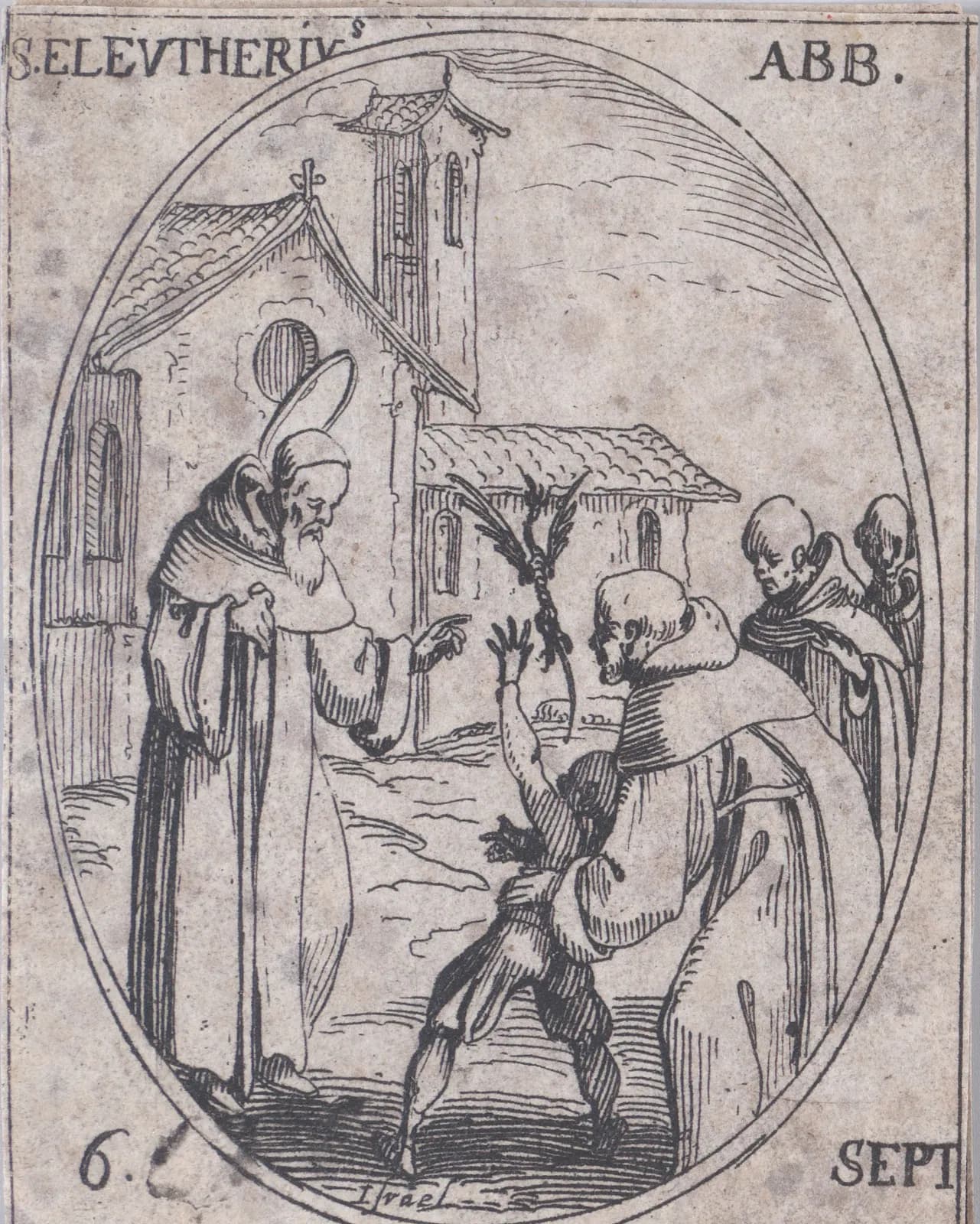
Saint Eleutherius was abbot of the monastery of Saint Mark outside Spoleto in the sixth century, and spent his last years as a monk in Rome, in the house of Gregory the Great. 12 Gregory, who wrote about him in his Dialogues, calls him "a man of such simplicity and compunction" that his tears could obtain "many things of almighty God." 1 He tells one story against his friend, about a moment of pride, and one about himself, about a fast he could not keep until Eleutherius prayed for him. 1
An abbot of Spoleto
Almost nothing is known of Eleutherius outside what Gregory wrote. 12 Gregory introduces him as "father of the Abbey of the Evangelist St. Mark, which is in the suburbs of the city of Spoleto." 1 katolsk.no, the Norwegian bishops' saints database, says he lived in Italy in the sixth century and calls him a Benedictine. 2 The Spanish Catholic portal Catholic.net describes him the same way, as abbot of Saint Mark the Evangelist at Spoleto, and as a contemporary, acquaintance and friend of Gregory. 5
Gregory wrote the four books of his Dialogues in 593, about the holy men and women of Italy, and he leaned on people he trusted for his material. 1 Eleutherius was one of them. In the chapter on Isaac, a Syrian monk who had settled near Spoleto, Gregory writes, "Many things also I had by the relation of the reverent man Eleutherius," who had known Isaac well, and that Eleutherius's own way of life gave credit to his words. 1
Another story came from him as an eyewitness. Gregory says "old father Eleutherius" told it and "was himself a witness of the truth thereof." 1 A young woman of a good family in Spoleto had taken the religious habit against her father's wishes, and he had left her only six little pieces of land. 1 Other young women joined her. Eleutherius went one day to give her some spiritual exhortation, and while they sat talking, a farmhand came in from her land with a present and was suddenly seized by an evil spirit. 1 The nun commanded it to leave, and it did. 1 Eleutherius is the reason the story survives.
The boy at the abbey
Gregory gives Eleutherius a chapter of his own in the third book of the Dialogues. 1 He begins with what the monks of Spoleto said: that "by his tears he raised up one that was dead." 1 katolsk.no repeats that he is said to have restored a dead man to life. 2 Gregory does not tell that story. He tells instead one that Eleutherius, "being demanded by me, did with great simplicity confess." 1
Traveling one day, and finding nowhere else to stay the night, Eleutherius lodged at a convent of nuns. 1 They had a little boy with them whom an evil spirit tormented every night, and they asked the visitor to keep the child with him overnight. 1 In the morning they asked how the night had gone. Eleutherius was surprised by the question and said he had noticed nothing. 1 The nuns told him what usually happened and begged him to take the boy home to his monastery, because they could not bear to watch. 1 He did, and for a long time the boy lived there untroubled. 1 katolsk.no tells it slightly differently, saying Eleutherius had freed the child before taking him into the abbey. 2
Then, Gregory says, the old man was "immoderately glad," and said in front of his monks: "The devil did dally with those sisters: but now he hath to do with the servants of God, he dare not come near this boy." 1 He had hardly finished the sentence when the boy was seized again, in front of all of them. 1
Eleutherius wept, and went on weeping for a long time. When his monks came to comfort him, he answered: "Believe me," quoth he, "none of you shall this day eat any bread, unless this boy be dispossessed." 1 He lay down in prayer with the whole community, and they stayed there until the boy was freed, so completely that the evil spirit never troubled him again. 1 katolsk.no describes it as a confession of his pride followed by a fast and prayer of the whole house. 2
The Dialogues are written as a conversation between Gregory and a companion named Peter, and Peter draws the obvious conclusion: "I verily suppose that he sinned a little in vain glory." 1 Gregory agrees, and adds a gentler reading of what happened: "seeing he could not alone bear the burthen of that miracle, it was divided amongst the rest of his brethren." 1
Holy Saturday in Saint Andrew's
At some point Eleutherius left Spoleto for Rome. Gregory says simply that he "lived long time together with me in this city in my monastery, and there ended his days." 1 katolsk.no says he gave up his office as abbot and lived for many years in Gregory's monastery of Sant'Andrea as an ordinary monk. 2 That monastery was Gregory's own family home on the Caelian Hill, which he had turned into a monastery dedicated to Saint Andrew when he became a monk, probably in 574; he was its abbot from about 586 until his election as pope in 590. 4 Huddleston notes that Gregory's austerities there "probably caused the weak health from which he constantly suffered in later life." 4
The second story is about that weakness. Gregory writes that while he was in the abbey he was so ill that he often fainted, and that unless he ate something continually he felt his life slipping away. 1 Easter was at hand, and he could not keep the fast of the vigil, a fast that "not only old persons, but even children" kept. 1 He says he was "more afflicted with grief, than grieved with mine infirmity." 1
So he took Eleutherius quietly into the oratory and asked him to pray that he might have the strength to fast that day. 1 Gregory writes that "with humility and tears he fell to his prayers," and that when he came out, Gregory's stomach was so strong that he did not think of food at all. 1 By evening he felt he could have fasted until the next day, and he began, he says, "to doubt whether I had eaten or no." 1 katolsk.no tells the same story and calls it Easter Eve. 2
Gregory draws his own conclusion. Having felt the force of Eleutherius's prayer in his own body, "I made no doubt but those things also were true which in other places he did, though myself was not then present." 1
The grace of tears
The chapter on Eleutherius leads straight into one of Gregory's best-known passages. Peter, struck by what he has heard about "that reverent man Eleutherius, and his great grace of compunction," asks to be taught about compunction itself. 1 Gregory answers that there are two kinds: "the soul that thirsteth after God is first sorrowful in heart for fear, and afterward upon love." 1 First it weeps for its sins and fears punishment; then, when long sorrow has worn the fear away, it weeps because it is still kept from the joys of heaven. 1
The Roman Martyrology keeps the same two words for him that Gregory used. Its entry for September 6 remembers Eleutherius as the abbot of Spoleto whose simplicity and compunction of heart Pope Saint Gregory the Great praised. 3
What is Saint Eleutherius the patron saint of?
None of the sources consulted names a patronage for Saint Eleutherius of Spoleto. 123 He is remembered at Spoleto, where katolsk.no says his body was brought from Rome, and through Gregory's Dialogues, which have kept his name for fourteen centuries. 12 The Roman Martyrology names him by his city, Spoleto in Umbria, which sets him apart from the other saints of the same name. 3
Saint Eleutherius's feast day
Saint Eleutherius of Spoleto's feast day is September 6, the day on which the current Roman Martyrology enters him. 23 katolsk.no says he died about 590 in Rome and that his body was moved to Spoleto on a September 6, and it notes that April 18 is also given for him. 2 The September 6 date is the one this page follows.
Praying with Saint Eleutherius
Gregory chose to tell the one story about Eleutherius that does him least credit, and he heard it from Eleutherius himself. 1 A holy old abbot said something proud in front of his monks, and a child suffered for it in front of everyone. 1 The abbot did not explain it away. He wept, and he would not let the house eat until the boy was free. 1
The repair was not his alone. The whole community lay down to pray with him, and Gregory reads that as the point: the burden was too heavy for one man and was shared among his brothers. 1
The same man, older and living in another man's monastery, prayed in tears for a sick friend who could not keep the Easter fast. 12 Gregory remembered him for simplicity and for tears, and the Church's calendar remembers him for the same two things. 13
Saint Eleutherius of Spoleto, pray for us.
Sources
- 1.Gregory the Great, Dialogues, Book III, chapters 14, 21, 33 and 34, translated by "P. W." (Paris, 1608), re-edited by Edmund G. Gardner (London: Philip Lee Warner, 1911); transcribed by Roger Pearse.
- 2."Den hellige Eleuterius av Spoleto (d. ~590)," Den katolske kirke (katolsk.no), Catholic Diocese of Oslo (in Norwegian).
- 3.Roman Martyrology, entry for September 6, "Sant'Eleuterio, abate," as printed in "Santo del giorno," Conferenza Episcopale Italiana (in Italian).
- 4.Gilbert Huddleston, "Pope St. Gregory I ('the Great')," The Catholic Encyclopedia, Vol. 6 (New York: Robert Appleton Company, 1909).
- 5."Eleuterio, Santo," Catholic.net (in Spanish).
Saints to turn to next
Others in this collection who are turned to for some of the same things.