Saint Edward the Martyr
c. 962 - March 18, 978 or 979
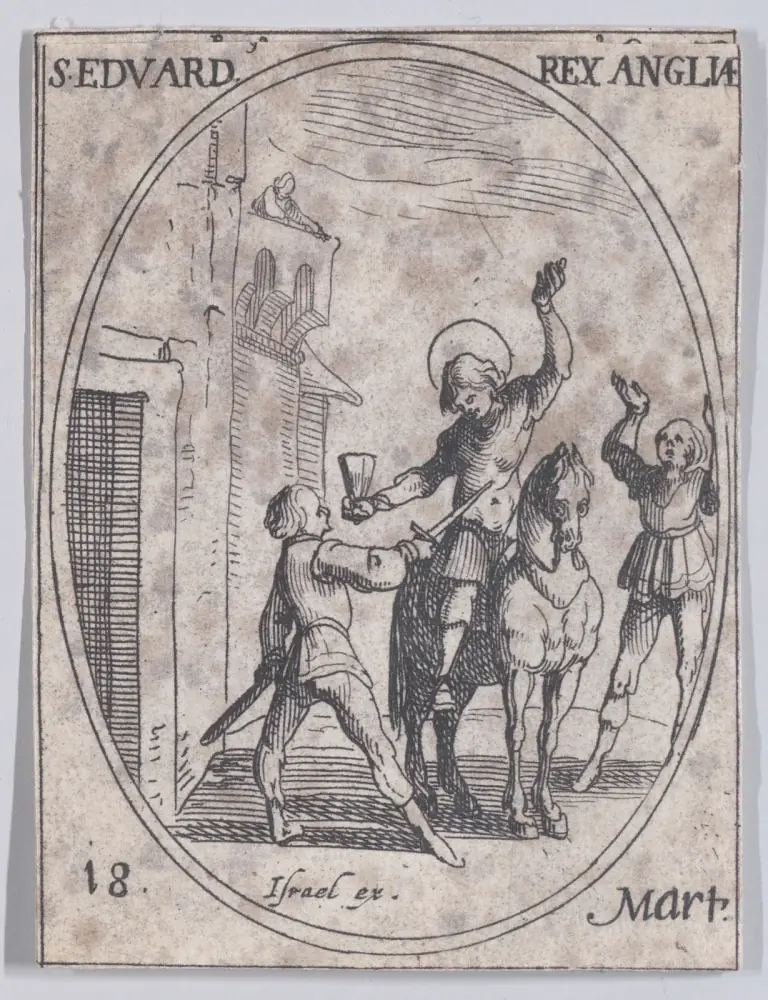
Saint Edward the Martyr was king of England for less than four years. He came to the throne in 975 at thirteen, over the opposition of his stepmother, and was stabbed at her gate at Corfe in Dorset as he sat on his horse, drinking. 12 The Church keeps his feast on March 18, the day he died. 16
The son of Edgar
Edward was the son of King Edgar, called the Peaceful, and was born about 962. 14 He was the uncle of the better-known Saint Edward the Confessor, which is why the Italian saints' dictionary Santi e Beati takes the trouble to number them: this is Edward II, the Confessor Edward III. 14 His mother, Santi e Beati says, was Edgar's first wife, Ethelfleda, who died not many years after his birth, and he was baptized by Saint Dunstan. 4
Edgar married again. His second queen, Elfrida, gave him a son, Ethelred. 14 The Norwegian bishops' saints database, katolsk.no, explains why that mattered. Edgar had not been crowned while Edward's mother was alive, and two years before he died Dunstan crowned him with Elfrida as king and queen. Ethelred was therefore the son of a crowned queen, and Edward was not. 3
Edgar died in 975. Edward was thirteen; Ethelred was seven. 123 Elfrida wanted the crown for her own son, and a party gathered behind her. 12 Dunstan, the clergy and most of the nobles stood by Edward as the elder son, the Witan acknowledged him, and Dunstan crowned him. 13 katolsk.no says the coronation was at Winchester; Santi e Beati dates it to July 8, 975. 34
A boy on the throne
On the young king himself, the sources read for this page do not agree. The Catholic Encyclopedia says that he had already given promise of "high sanctity" and won his people's affection by his virtues. 1 Butler goes further: "his ardor in the pursuit of all virtues is not to be expressed," and he calls him "the miracle of princes." 2 He also says that Edward treated his stepmother with dutiful respect and his half brother with tender affection, whatever she did against him. 2
katolsk.no and Santi e Beati, in almost the same words, say the opposite: that for all his youth he had a dreadful temper and a tendency to violence, and that it did not endear him to anyone. 34 This page cannot settle the question and does not try.
The reign was short and troubled. Santi e Beati describes a reaction against the monasteries that Dunstan had built up, led by Alfhere of Mercia, who set about plundering and destroying them. 4 The Catholic Encyclopedia names the same Alfhere as one of Edward's chief opponents. 1
At the gate of Corfe
The killing came after three and a half years. 12 Butler tells it this way. Tired from hunting in a forest near Wareham, the king rode to his stepmother's house at Corfe, in the Isle of Purbeck, and asked to see his young brother at the door. "The treacherous queen caused a servant to stab him in the belly while he was stooping, out of courtesy, after drinking." 2 The Catholic Encyclopedia has him drinking "a glass of mead offered him at the castle gate" while still on horseback. 1
He spurred his horse and rode off. Butler says he "fell off dead"; the encyclopedia says he fell and was dragged by the stirrup, and katolsk.no that one foot slipped and he was dragged by the other, leaving a trail of blood through the woods. 123 His body was thrown into a marsh, and the encyclopedia and Butler both say it was found by a pillar of light. 12
The Catholic Encyclopedia, Butler and Santi e Beati date the murder to March 18, 979. 124 katolsk.no gives 978, and puts a question mark against the day. 3 It also paraphrases the Anglo-Saxon Chronicle: the king was struck down in the evening at Corfe and buried at Wareham with no royal honors, and no worse deed had been done among the English since they first came to Britain; men murdered him, but God honored him. 3
Who was to blame
Butler and the Catholic Encyclopedia lay it squarely on Elfrida. 12 katolsk.no is more careful. According to the biographer of Saint Oswald of Worcester, it says, a plot was laid to kill the sixteen-year-old king; the story also went that he was stabbed by the men of his half brother Ethelred. 3 It was William of Malmesbury, writing in the twelfth century from an eleventh-century Passion, who made the stepmother the villain of the piece. 3 No one was ever brought to trial. 3
Santi e Beati agrees that the chronicles all speak of murder, and that Malmesbury and Oswald's biographer blame Ethelred's supporters, Elfrida above all. Given Alfhere's hostility, it adds, the conspiracy against the young king probably reached a good deal further. 4 Ethelred, ten years old, became king, and Butler calls his reign "weak and unfortunate." 23
Wareham, Shaftesbury and after
He was buried first at Wareham. katolsk.no says Elfrida ordered the burial outside consecrated ground and without royal ceremony. 13 Three years later the body was found whole and was carried to the abbey at Shaftesbury; the Catholic Encyclopedia says the translation was made by Dunstan together with Alfhere, the old opponent. 12 Many miracles were reported at the tomb. 123 Butler adds that his lungs were kept at a village called Edwardstow and the long thin knife that killed him at Faversham, until the monasteries were suppressed. 2
Elfrida, Butler says, was "awaked by the stings of conscience, and by the voice of miracles," built the monasteries of Wherwell and Ambresbury, and ended her life in penance at Wherwell. 12 Santi e Beati calls her taking the veil a legend. 4
Shaftesbury Abbey was destroyed in 1539. katolsk.no says Edward's remains had been hidden to keep them from desecration, and that bones found in an excavation in 1931 were identified as his. After a long dispute they went to a Russian Orthodox community at Brookwood in Surrey, where they were enshrined in 1984. 3
Why a martyr
Edward was not killed for refusing to deny Christ, and katolsk.no says frankly that there is little ground for the title. 3 The Catholic Encyclopedia gives the reason it stuck: the violence of his death, the fact that the party against him was the party of the irreligious, and his own defense of the Church. 1 katolsk.no and Santi e Beati both use the old phrase for it: he died per testimonium caritatis heroicis, by a witness of heroic charity. 34 The 1897 English edition of the Roman Martyrology records simply that he "was assassinated by order of his treacherous step-mother, and became celebrated for many miracles." 5
What is Saint Edward the Martyr the patron saint of?
None of the sources consulted for this page names Saint Edward the Martyr as the patron saint of anything, and the page does not supply a patronage. 1234 katolsk.no describes how he is shown in art: a young king with a scepter or a sword, holding a cup, sometimes with a dagger or a falcon, for his last hunt. 3
Saint Edward the Martyr's feast day
Saint Edward the Martyr's feast day is March 18, the day of his death. 12 The Catholic Encyclopedia says he is given the title of martyr on that day in all the old English calendars and in the Roman Martyrology. 1 The 1897 Martyrology enters him on March 18, and so does the current Roman Martyrology as the Italian bishops print it: near the town of Wareham in England, Saint Edward, king of the English, killed while still young by the treachery of his stepmother's hirelings. 56
katolsk.no adds two feasts of his translation, on June 20 and February 13, and says he is kept today in the Diocese of Plymouth. 3
Praying with Saint Edward
Very little in this story is about what Edward did. He was a boy put on a throne by other people, and killed by other people for the same reason. 13 The sources cannot even agree whether he was a gentle youth or a violent one. 134
What the Church remembered was the manner of his death. He rode to his stepmother's door without an escort, asked to see his brother, and took a drink at her gate. 124 Whatever else he was, he was killed by his own family while trusting them.
The story does not end in justice. Nobody was tried. 3 The boy who inherited the crown was ten years old, and the reign that followed was a misery. 23 The Martyrology keeps only the treachery and the miracles. 5
Butler's account turns at the end to the queen herself, building two monasteries and dying in one of them in penance. 2 Whether she took the veil or not, that is where the old writers chose to leave her.
Saint Edward the Martyr, pray for us.
Sources
- 1.George Phillips, "St. Edward the Martyr," The Catholic Encyclopedia, Vol. 5 (New York: Robert Appleton Company, 1909).
- 2.Alban Butler, "St. Edward, King and Martyr," March 18, in The Lives of the Fathers, Martyrs, and Other Principal Saints, Vol. I (New York, 1895), Project Gutenberg eBook #20450.
- 3."Den hellige kong Edvard Martyren (~962-978)," Den katolske kirke (katolsk.no), Catholic Church in Norway (in Norwegian).
- 4."Sant' Edoardo II il Martire, Re d'Inghilterra," Santi, beati e testimoni (santiebeati.it) (in Italian).
- 5.The Roman Martyrology, March 18 (Baltimore: John Murphy & Co., 1897).
- 6.Roman Martyrology, entries for March 18, Santo del giorno, Conferenza Episcopale Italiana (in Italian).
Saints to turn to next
Others in this collection who are turned to for some of the same things.
- Saint Bridget of Swedenc. 1303 - July 23, 1373Marriage and familySuffering and illness
- Saint Clotildec. 474 - June 3, 545Marriage and familySuffering and illness
- Saint Elizabeth of Portugal1271 - July 4, 1336Marriage and familySuffering and illness
- Saint EustaceMartyred at Rome, in 118 by tradition; other accounts give 140 or 188Marriage and familySuffering and illness