Saint Dionysius, Pope
Died December 26, 268
- Origin
- Unknown; probably Greek, says katolsk.no 2; "previously a monk," says the Liber Pontificalis 8
- Pope
- July 22, 259, to December 26, 268, say Kirsch and the Holy See 14; elected July 22, 260, says katolsk.no 2; July 2, 259, to December 26, 269, says Butler 9; the 25th pope in the Holy See's list 4
- Known for
- Rebuilding the Roman Church after Valerian's persecution; a doctrinal letter on the Trinity; ransoming captives in Cappadocia 123
Saint Dionysius was bishop of Rome from 259 to 268, chosen after the Roman see had stood empty for about a year because Valerian's persecution made an election impossible. 1 He took over a shattered Church, saw its buildings and cemeteries handed back under the emperor Gallienus, and put its administration in order again. 12 He is remembered for a letter on the Trinity that the Council of Nicaea's defenders still quoted, and for sending money from Rome to ransom Christians carried off from Cappadocia. 167
A Roman presbyter
Nothing is known of his birth. 1 katolsk.no thinks he was probably Greek and says he had once been a hermit; the Liber Pontificalis calls him "previously a monk, whose family we have not been able to ascertain." 28 By the 250s he was a leading presbyter of the Roman Church. 12
He first appears in the letters of his namesake, Dionysius, bishop of Alexandria, during the quarrel between Pope Stephen I and Cyprian of Carthage over whether converts baptized by heretics must be baptized again. 15 The Alexandrian wrote on the question to "our beloved fellow presbyters, Dionysius and Philemon, who formerly had held the same opinion as Stephen." 5 Eusebius, who kept the letters, says the fourth of them was addressed to Dionysius of Rome, "who was then a presbyter, but not long after received the episcopate of that church," and that the bishop of Alexandria plainly thought him "a learned and admirable man." 5 Later, under Pope Sixtus II, Dionysius received another letter from Alexandria, about a certain Lucian whom nobody can now identify. 15
katolsk.no adds that the future pope at first shared Stephen's hard line, breaking communion with churches that rebaptized, but seems to have softened under Sixtus. 2
Elected after the persecution
Sixtus II was martyred on August 6, 258. 12 Kirsch says the violence of the persecution then made it impossible to elect anyone, and the see was vacant for nearly a year; katolsk.no adds that all seven deacons had died with Sixtus, so the presbyters governed the Church alone. 12 Dionysius was raised to the office, Kirsch says, on July 22, 259, once the persecution had begun to subside, and the Holy See gives the same date. 14 katolsk.no notes a different view: that Rome waited for news that Valerian had been captured by the Persians, and elected Dionysius on July 22, 260. 2 Butler has July 2, 259. 9
Valerian's son Gallienus stopped the persecution and allowed the bishops to take back their places of worship and, by a further decree, "the so-called cemeteries." 5 Kirsch says the edict gave the Church a legal existence, and that Dionysius used the peace to bring the Roman Church's administration back into order. 1 The Liber Pontificalis records the result in one sentence: "He assigned churches and cemeteries to the priests and appointed parishes in the diocese." 8 Loomis, its translator, follows Duchesne in reading this as the parish organization of the city, with each church given its own cemetery, and the boundaries of the dioceses around Rome drawn. 8 katolsk.no, which describes the same work, calls Dionysius one of the most important Roman bishops of the third century. 2
The letter on the Trinity
Around 260 the bishop of Alexandria wrote against the Sabellians, who taught that the Father and the Son were one person under two names. 1 In pressing the distinction he expressed himself, Kirsch says, "with inexactness" about the Word and the Father, and some Christians of Alexandria reported him to Rome for treating the Son as a creature. 12 Dionysius called a synod at Rome, which condemned Sabellius again, and issued a doctrinal letter in his own name and the council's. 1
Athanasius copied part of it into his defense of Nicaea a century later. The pope rebuked those who "divide and cut to pieces and destroy that most sacred doctrine of the Church of God, the Divine Monarchy, making it as it were three powers and partitive subsistences and god-heads three." 6 With equal force he turned on those who called the Son a work: "A blasphemy then is it, not ordinary, but even the highest, to say that the Lord is in any sort a handiwork." 6 His conclusion held both truths together: "thus both the Divine Triad, and the holy preaching of the Monarchy, will be preserved." 6
With the public letter went a private one, asking his brother bishop to explain himself; katolsk.no calls it tactful. 12 Dionysius of Alexandria answered with an Apologia, made clear he was no tritheist, and the matter seems to have ended there. 12 Butler records Athanasius's testimony that the bishops at Nicaea, defending the faith, used expressions they had received from earlier pastors, especially from Dionysius of Rome and his namesake of Alexandria. 9 katolsk.no calls the exchange a prelude to Nicaea and the Arian crisis. 2
Ransom for Cappadocia
The Roman Church had long helped Christians in distress far from Rome, and Dionysius kept it up. 12 When raiders sacked Caesarea in Cappadocia and carried off its people, he wrote to console the church there and sent messengers with a large sum to buy the captives back. 19 Kirsch says the raiders were Goths; katolsk.no says Persians. 12
More than a century later Basil the Great, by then bishop of that same Caesarea, wrote to Pope Damasus asking for help in a new crisis and reminded him of it. "The illustrious and blessed bishop Dionysius, conspicuous in your see as well for soundness of faith as for all other virtues," Basil wrote, "visited by letter my Church of Caesarea, and by letter exhorted our fathers, and sent men to ransom our brethren from captivity." 7 The current Martyrology sums up the same years: after Valerian's persecution he consoled the afflicted with his letters and his presence, redeemed prisoners from their torments, and taught the foundations of the faith to those who did not know them. 3
The last years
The last time he appears in the record, he is being written to. A synod at Antioch deposed its bishop, Paul of Samosata, who taught that Christ was not truly God, and sent its circular letter to "Dionysius, bishop of Rome, and Maximus of Alexandria." 25 katolsk.no doubts the pope ever received it, since he died at the end of 268. 2 Eusebius says Dionysius died after nine years in office and was succeeded by Felix. 5
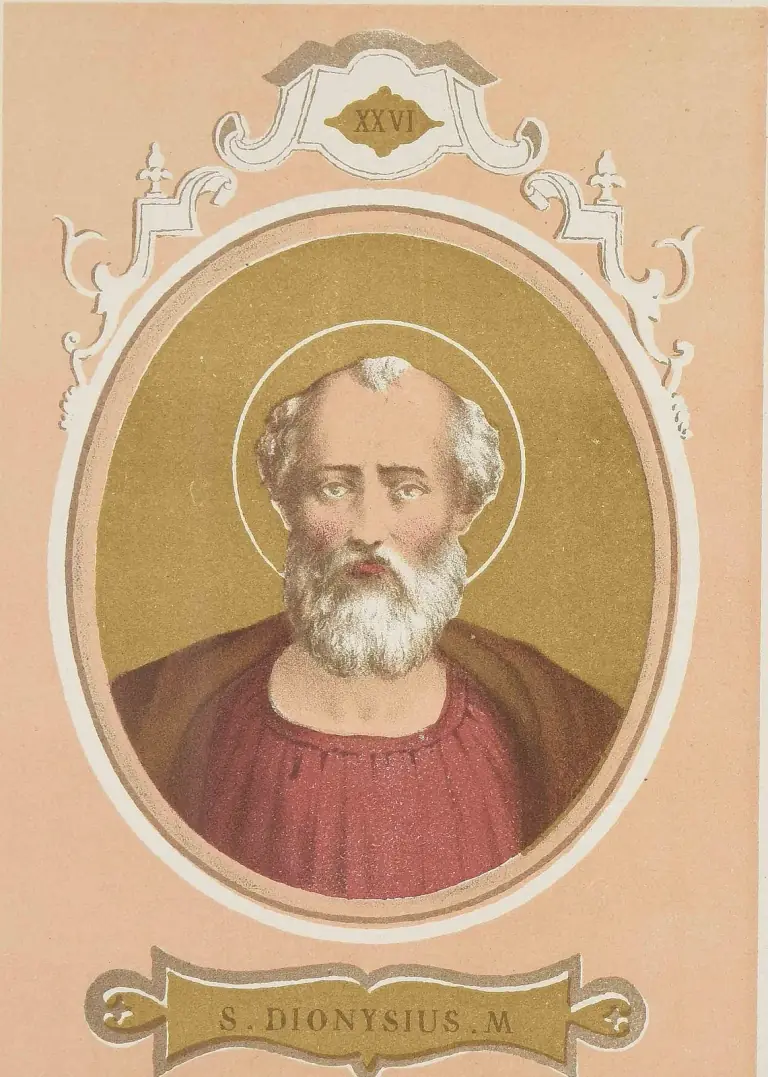
He was buried in the papal crypt of the Catacomb of Callistus on the Via Appia. 12 katolsk.no is firm that, whatever later tradition said, he was not a martyr: the Liberian catalog of 354 places him among the bishops buried and not among the martyrs. 2 The Liber Pontificalis, in Loomis's translation, records his burial without any martyrdom, and the 1897 English Martyrology entered his "decease" on the Appian Way. 810 The nineteenth-century portrait at the top of this page still labels him "M.," for martyr.
What is Saint Dionysius the patron saint of?
Saint Dionysius's feast day
Saint Dionysius's feast day is December 26. 23 The current Roman Martyrology, as the Italian bishops print it, commemorates him that day at the Catacomb of Callistus on the Via Appia, among the saints who follow the feast of Saint Stephen the protomartyr. 3 The 1897 English Martyrology also entered him on December 26, as did Butler. 910 Kirsch gives his death as December 26 or 27, 268; the Liber Pontificalis puts his burial on December 27. 18
Praying with Saint Dionysius
He was chosen for a Church that had just watched its bishop and deacons killed and had gone a year without a bishop because no one could safely meet to elect one. 12 His work was not dramatic. He sorted out which priest had which church and which cemetery, and drew the boundaries of the dioceses around Rome. 8
He was also asked to judge a greater theologian than himself, and he did it in two letters: a public one that said clearly what the Church believes, and a private one that asked a brother bishop what he had meant. 12 katolsk.no says the bishop of Alexandria died at peace with the Church. 2
Basil remembered him for what he sent. When Caesarea's people were in captivity, the bishop of Rome sent men with money to bring them home, and a hundred years later the church that had been helped still told the story. 7
Saint Dionysius, Pope, pray for us.
Sources
- 1.J.P. Kirsch, "Pope St. Dionysius," The Catholic Encyclopedia, Vol. 5 (New York: Robert Appleton Company, 1909).
- 2."Den hellige pave Dionysius (-268)," Den katolske kirke (katolsk.no), Catholic Diocese of Oslo (in Norwegian).
- 3.Roman Martyrology, entry for December 26, "San Dionigi, papa," as printed in "Santo del giorno," Conferenza Episcopale Italiana (in Italian).
- 4."Dionysius," The Supreme Pontiffs, The Holy See.
- 5.Eusebius of Caesarea, Church History, Book 7, chapters 5, 7, 9, 13 and 30, trans. Arthur Cushman McGiffert, Nicene and Post-Nicene Fathers, Second Series, Vol. 1 (1890), at New Advent.
- 6.Athanasius of Alexandria, De Decretis (Defense of the Nicene Definition), 26, trans. John Henry Newman, rev. Archibald Robertson, Nicene and Post-Nicene Fathers, Second Series, Vol. 4 (1892), at New Advent.
- 7.Basil the Great, Letter 70, to Damasus, trans. Blomfield Jackson, Nicene and Post-Nicene Fathers, Second Series, Vol. 8 (1895), at New Advent.
- 8.The Book of the Popes (Liber Pontificalis), trans. Louise Ropes Loomis (New York: Columbia University Press, 1916), "Dionysius (259-268)."
- 9.Alban Butler, "St. Dionysius, Pope, C.," The Lives of the Fathers, Martyrs, and Other Principal Saints, Vol. 12, December 26 (Derby: Thomas Richardson and Son).
- 10.The Roman Martyrology, October 9 and December 26 (Baltimore: John Murphy Company, 1897).
Saints to turn to next
Others in this collection who are turned to for some of the same things.
- Saint AgathoDied January 10, 681DiscernmentStudy and teaching
- Saint Angela MericiMarch 21, 1474 - January 27, 1540Study and teachingDiscernment
- Saint Augustine of HippoNovember 13, 354 - August 28, 430Study and teachingDiscernment
- Saint Bonaventure1217 or 1221 - July 15, 1274Study and teachingDiscernment