Saint Desiderius of Langres
Died in the fourth or early fifth century
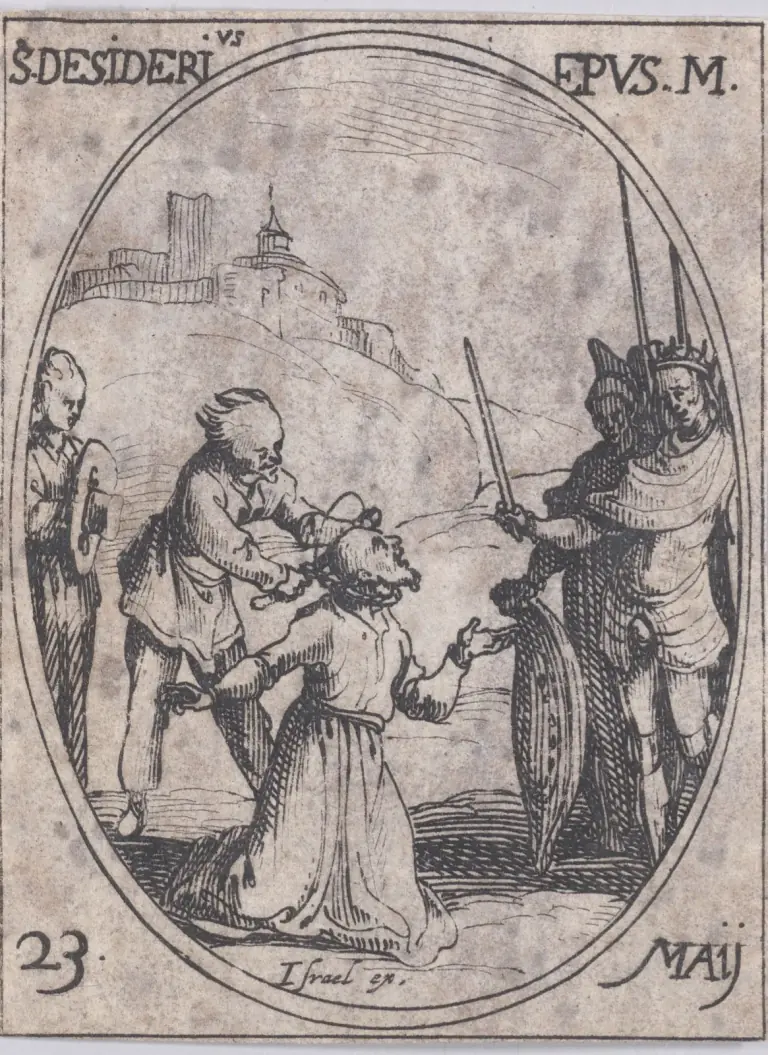
- Recorded
- A Desiderius signs among the bishops of Gaul in Athanasius's list 6; Duchesne identifies him in the document of 346 5
- Died
- Beheaded at Langres during a barbarian invasion 13; about 407, says the Catholic Encyclopedia 4; about 355, says Catholic.net 7; Butler gives two datings, under Gallienus or in 411 2
- Patron of
- The city of Langres; invoked in difficult childbirth 7
Saint Desiderius was the third bishop of Langres, in Gaul, who went out to meet a barbarian army that was ravaging his people, asked its king to spare them, and was beheaded on the spot. 123 He was bishop in the middle of the fourth century, when his name appears among the bishops of Gaul who stood with Saint Athanasius, but which invasion killed him the sources cannot agree. 567 The Roman Martyrology keeps him on May 23. 1
A name on the list of Langres
Langres kept a catalog of its bishops, and Louis Duchesne printed it from three medieval copies in his survey of the bishops of ancient Gaul. 5 It opens with Senator, then Justus, then "S. Desiderius episcopus," the first name in the list to carry the title of saint. 5 Georges Goyau, writing on the diocese for the Catholic Encyclopedia in 1910, reports Duchesne's view that these three were the first bishops of Langres, so that the see must have been founded about the middle of the fourth century. 4
There is one piece of contemporary evidence. Saint Athanasius, defending himself against the Arians, copied out the names of the bishops who had assented to the Council of Sardica's judgment in his favor, and among those "from Gaul" stands a Desiderius. 6 Duchesne takes him to be the bishop of Langres, and dates the adherence of the Gaulish bishops to 346. 5 Catholic.net, following Antonio Borrelli, puts it more strongly: Desiderius took part in the Council of Sardica in 343 and signed it, and his name is also in the acts of the so-called council of Cologne of 346. 7
Everything else about him comes from a Life written at Langres at the beginning of the seventh century by a cleric named Warnachaire, some two hundred and fifty years after the event. 57 Catholic.net adds traditions that he came from near Genoa and was chosen bishop in some miraculous way, without saying more. 7
His death
The 1897 English edition of the Roman Martyrology tells the story in a few lines. Desiderius, "seeing his people maltreated by the Vandal army, repaired to the king to offer supplications in their behalf. Being forthwith condemned to decapitation, he readily presented his neck, and being struck with the sword, died for the sheep committed to his charge." 3 The current Martyrology, as the Italian bishops print it, keeps the same account with a careful "as is handed down": he went to the Vandal king to plead for his oppressed people, was killed at once on the king's order, and offered himself calmly for the flock entrusted to him. 1
Alban Butler tells it more briefly and without the king. When "certain pagan barbarians ravaged that part of Gaul," Desiderius "accompanied with his clergy, went out to meet them; but was massacred with his followers, and fell a victim to save his flock." 2 He opened the entry with the Good Shepherd, who lays down his life for his sheep. 2
Langres added a legend of its own. Catholic.net reports that after he was beheaded he picked up his head and walked back into the city through a gap that opened in the rock to let him pass, and that the opening is still shown. 7 He is one of the saints called cephalophores, the head-bearers, of whom France has several. 7
Which invasion?
Warnachaire's Life blames the Vandals, and the Martyrology follows it. 35 Goyau, reporting Duchesne, accordingly dates the martyrdom "about 407." 4 Duchesne himself was less sure. He gives the Life's date of 407, but since the bishop's name already stands in a document of 346, he concluded that if there is anything to be drawn from the tradition, it must refer to an earlier invasion. 5
The older writers had already disagreed. Butler records that the medieval chronicler Sigebert placed the death in the invasion of "Chrocus, the German king, under Gallien," while Tillemont preferred 411, "when the Alans, Sueves, and Vandals plundered that country." 2 Borrelli's article, on Catholic.net, notes that Warnachaire names the invader Chrocus, and that the real Chrocus led the Alamanni between 298 and 307, too early for a bishop of the 340s. 7 It suggests the German invasion of 355 to 357, which the emperor Julian drove back, and dates the death about 355. 7 No source settles it, and the page leaves all three readings standing.
Valerius and the others
Desiderius did not die alone. The 1897 Martyrology says that "with him suffered many of his flock, who are buried in the same city," and Butler that he was "massacred with his followers." 23 One of them has a name. Goyau lists among the saints of the diocese "St. Valerius (Valier), a disciple of St. Desiderius, martyred by the Vandals in the fifth century." 4 The current Martyrology remembers him on October 22 as Saint Valerius, deacon of the Church of Langres, killed by pagans in the territory of Besançon. 8
Two bishops named Desiderius
There is a second Desiderius in the same part of Gaul, and for centuries the two shared a day. Desiderius of Vienne rebuked Queen Brunhilda, was sent into exile, and was then stoned on her orders. 9 The 1897 Martyrology lists both on May 23, Langres first, then "St. Desiderius, bishop of Vienne, who, being overwhelmed with stones by order of king Theodoric, was crowned with martyrdom." 3
Duchesne explains how that happened. Warnachaire gives no feast day for the bishop of Langres, and the oldest text of the Hieronymian Martyrology, the Auxerre copy of about 595, has none either. 5 Ado assigned him May 23, which was already the day of Desiderius of Vienne in Bishop Léger's book of the bishops of Vienne and in the Echternach manuscript of the Hieronymian Martyrology. 5 Catholic.net calls it a copyist's mistake of the eleventh century, repeated by others afterward. 7 The current Martyrology has separated them, keeping Langres on May 23 and moving Vienne to May 26. 19
What is Saint Desiderius of Langres the patron saint of?
Saint Desiderius is the patron of the city of Langres, where many churches of the diocese are dedicated to him and a Benedictine priory once kept his tomb, according to Catholic.net. 7 The same article says he is held an intercessor in difficult childbirth and a witness to the truth of an oath, and that a confraternity founded in his honor in 1354 counted kings and princes among its members. 7 It is the only source consulted that names a patronage. 7 The chief patron of the diocese is Saint Mammes, to whom the cathedral is dedicated. 4
Saint Desiderius of Langres's feast day
The feast of Saint Desiderius of Langres is May 23, the day on which the current Roman Martyrology records his passion. 1 Butler and the 1897 Martyrology kept the same day. 23 Duchesne notes that the Bern manuscript of the Hieronymian Martyrology gives February 11, and that Langres in his time celebrated him on May 23, following Ado and Usuard. 5 Catholic.net reports the February date as the Hieronymian Martyrology's, and says that the city of Langres also keeps January 19, the anniversary of the translation of his relics in 1315. 7
Praying with Saint Desiderius
What is left of Desiderius is one act. A bishop saw his people being harmed by men he could not fight, went out to the man in charge, and asked. 13 The older Martyrology says he presented his neck "readily," and the current one that he offered himself serenely. 13 Nothing in either account suggests the king listened.
Butler read it as the good shepherd laying down his life for his sheep, and the older Martyrology says much the same: he "died for the sheep committed to his charge." 23 The old accounts do not say that his death saved anyone. Butler says he "fell a victim to save his flock," and some of that flock died beside him. 23
For the rest, his history is a list: a name among the bishops of Gaul who sided with Athanasius, a place in the catalog of Langres, and a day on the calendar that for centuries he shared with another saint. 356 His city remembered the story, and Valerius, a deacon of his church, with it. 48 The current Martyrology keeps it too, with a careful "as is handed down" in front of it. 1
Saint Desiderius of Langres, pray for us.
Sources
- 1.Roman Martyrology, entry for May 23, "San Desiderio, vescovo," as printed in "Santo del giorno," Conferenza Episcopale Italiana (in Italian).
- 2.Alban Butler, "St. Desiderius, Bishop of Langres, Martyr," The Lives of the Fathers, Martyrs and Other Principal Saints, Vol. V (D. & J. Sadlier, 1864), EWTN Library.
- 3.The Roman Martyrology, May 23 (Baltimore: John Murphy Company, 1897).
- 4.Georges Goyau, "Langres," The Catholic Encyclopedia, Vol. 8 (New York: Robert Appleton Company, 1910).
- 5.Louis Duchesne, Fastes épiscopaux de l'ancienne Gaule, Vol. 2, 2nd ed. (Paris: Fontemoing, 1910), "Langres," pp. 183-186 (in French).
- 6.Athanasius, Apology Against the Arians, 50, trans. M. Atkinson and A. Robertson, Nicene and Post-Nicene Fathers, Second Series, Vol. 4 (1892), New Advent.
- 7.Antonio Borrelli (santiebeati.it), trans. Xavier Villalta, "Desiderio de Langres, Santo," with the Roman Martyrology entry for May 23, Catholic.net (in Spanish).
- 8.Roman Martyrology, entry for October 22, "San Valerio, diacono," as printed in "Santo del giorno," Conferenza Episcopale Italiana (in Italian).
- 9.Roman Martyrology, entry for May 26, "San Desiderio, vescovo" (of Vienne), as printed in "Santo del giorno," Conferenza Episcopale Italiana (in Italian).
Saints to turn to next
Others in this collection who are turned to for some of the same things.