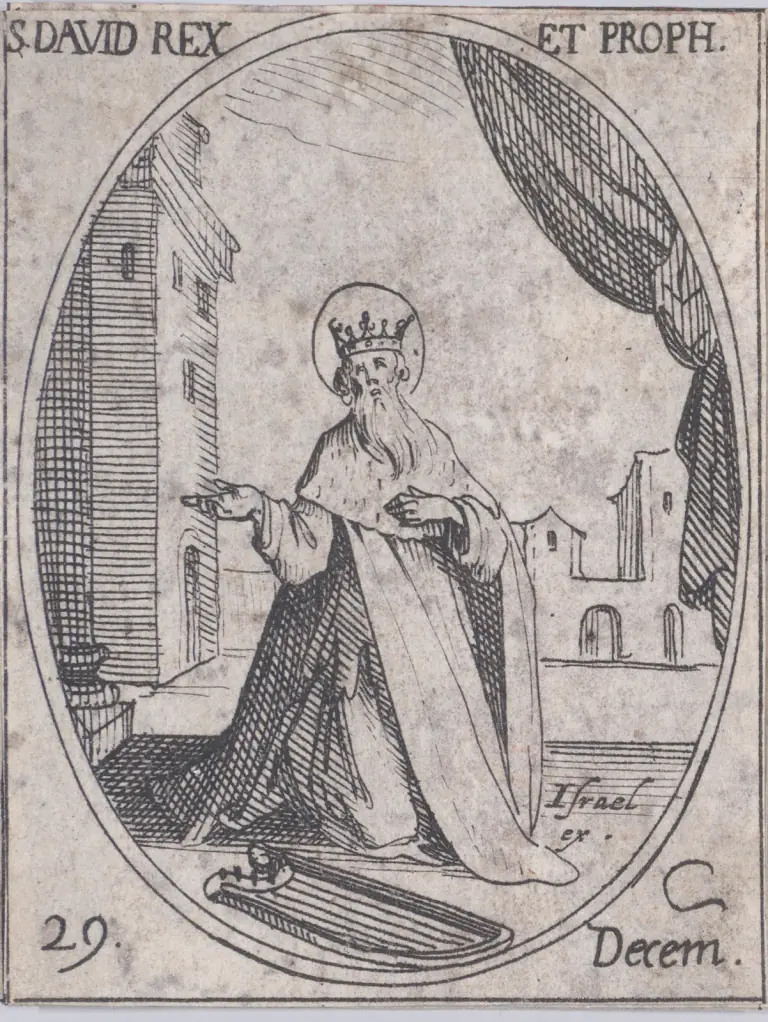
Saint David, King and Prophet
About 1085 - 1015 B.C., by the older chronology
- Born
- At Bethlehem, the youngest son of Jesse, of the tribe of Judah 1
- King
- Of Judah at Hebron for seven and a half years, then of all Israel at Jerusalem for thirty-three 1
- Dates
- Born 1085, reigned 1055 to 1015 B.C. by the usual chronology; recent writers put the reign 30 to 50 years later 1
- Died
- At about seventy; buried on Mount Zion 1
- Not to be confused with
- Saint David of Wales, the sixth-century bishop kept on March 1
Saint David was the second king of Israel, the shepherd boy from Bethlehem who killed Goliath, made Jerusalem his capital and brought the Ark of the Covenant there. 1 He was an adulterer and, at one remove, a murderer, and his repentance, the Catholic Encyclopedia says, "has made him for all time the model of penitents." 1 The Church honors him as king, psalmist and prophet, an ancestor of Christ, and commemorates him on December 29. 124
Known only from Scripture
John Corbett, writing on David in the 1908 Catholic Encyclopedia, begins with a limit: "Our knowledge of David's life and character is derived exclusively from the pages of Sacred Scripture," the books of Samuel, Kings, Chronicles and Ruth, and the titles of many Psalms. 1 He was the great-grandson of Boaz and Ruth and the youngest of the eight sons of Jesse, a small landholder of the tribe of Judah at Bethlehem, where David was born. 1
His dates are uncertain. By the usual chronology, Corbett says, David was born in 1085 and reigned from 1055 to 1015 B.C., but writers working from the Assyrian inscriptions had moved his reign 30 to 50 years later. 1
The shepherd and the giant
He first appears tending his father's sheep near Bethlehem, "ruddy and beautiful to behold and of a comely face." 1 The prophet Samuel was sent to anoint him in place of Saul, whom God had rejected for disobedience, though his own family seems not to have grasped what the anointing meant. 1
He came to court to play the harp for Saul when an evil spirit troubled the king. 1 Later, sent to the army with provisions for his brothers, he heard Goliath of Gath challenge Israel to single combat and volunteered, "with God's help," to fight him; his victory routed the Philistines. 1 Scripture seems to tell his arrival at court twice, and Corbett weighs the explanations offered for it before preferring the simplest: the second time, Saul was asking only about David's family. 1
The victory won him the friendship of Saul's son Jonathan, a place at court, and marriage to Saul's daughter Michal. It also won him the king's jealousy. 1 Saul twice tried to kill him and at last ordered his death, and for the rest of the reign David lived as an exile and an outlaw. 1
Outlaw and king
The years of flight were hard and not always edifying. David gathered a band of about four hundred men at the cave of Adullam, "some of them his relations, others distressed debtors and malcontents," which grew to six hundred. 1 Twice Saul was at his mercy, and twice he spared him. 1 In the end he took service with the Philistine king of Gath and raided neighboring tribes from the town of Ziklag, "sparing neither man nor woman," while telling his overlord that the raids were against Israel. 1 When Saul and Jonathan fell on Mount Gilboa, David mourned them in the elegy that survives in the first chapter of Second Samuel. 1
At thirty he went up to Hebron by God's command and was anointed king of Judah. 1 Seven and a half years of civil war with Saul's house followed before all Israel accepted him. 1 He then took the Jebusite city of Jerusalem and made it his capital, "the city of David." 1
The Ark and the promise
David meant Jerusalem to be the religious center of his people as well as the political one. He brought the Ark of the Covenant there and housed it in a new tent. 1 When he proposed to build a temple for it, the prophet Nathan told him that God had reserved the work for his son; instead, God promised to build David a house and establish his kingdom forever. 1
The current Roman Martyrology sums up his life around that promise. David, son of Jesse the Bethlehemite, found favor with God and was anointed with holy oil by the prophet Samuel to rule over Israel; he brought the Ark of the Lord's Covenant into Jerusalem, and the Lord swore to him that his line would last forever, because from it Jesus Christ would be born according to the flesh. 2 The Catechism notes that the Temple, "the house of prayer that David wanted to build," was the work of Solomon. 4
Bathsheba, Uriah and Nathan
At the height of his power, while his army was in the field against the Ammonites, David committed adultery with Bathsheba and arranged the death of her husband Uriah, then married her. 1 Corbett notes that "a year elapsed before his repentance," and that his contrition was so sincere that God pardoned him while announcing the penalties that would follow. 1 "The spirit in which David accepted these penalties has made him for all time the model of penitents." 1
John Paul II, speaking of Psalm 51, the Miserere, recalled that "the Jewish tradition placed the psalm on the lips of David, who was called to repentance by the severe words of the prophet Nathan," and that later sinners made it their own prayer too. 5 It is, he said, "the most intense and commonly used penitential psalm," prayed in the Liturgy of the Hours at Lauds every Friday. 5
The penalties came within his own house. His son Amnon committed incest and was murdered by his brother Absalom; Absalom, recalled from exile and restored without repenting, had himself proclaimed king at Hebron and drove his father out of Jerusalem. 1 Corbett says Scripture tells the flight "with great simplicity and pathos." 1 Absalom was killed in the battle that followed, and David returned. 1 Later his pride in ordering a census brought a pestilence, which was stayed when the angel was about to strike Jerusalem; David was told to offer sacrifice on the threshing floor that would become the site of the Temple. 1
He died at about seventy, after Nathan and Bathsheba secured the succession for Solomon, and was buried on Mount Zion. 1 Corbett notes that Saint Peter spoke of his tomb as still standing on the day of Pentecost. 1
Psalmist and prophet
His skill in music is recorded in First Samuel and in Amos, and poems of his are kept in Second Samuel. 1 Corbett says his connection with the Psalms "was so taken for granted in later days that many ascribed the whole Psalter to him." 1 Benedict XVI, introducing the Psalms in 2011, said that the Jewish tradition attributes "most of them to King David." 3
Benedict described him as "a complex figure who went through the most varied fundamental experiences of life": shepherd, then king and pastor of the people of God; "a man of peace, he fought many wars." 3 "He always remained a seeker of God even though he sinned frequently and seriously," the pope said, so that "with all his weaknesses" he was a king "after the heart of God," that is, "a passionate man of prayer, a man who knew what it meant to implore and to praise." 3
The Catechism calls him "par excellence the king 'after God's own heart,' the shepherd who prays for his people and prays in their name," whose submission, praise and repentance "will be a model for the prayer of the people." 4 In the Psalms, it says, "David, inspired by the Holy Spirit, is the first prophet of Jewish and Christian prayer." 4 Corbett makes the same point about prophecy from Scripture: David says of himself, "The spirit of the Lord hath spoken by me," and Saint Peter calls him a prophet in Acts. 1
Christians have also read David's life as a figure of Christ's. Corbett lists the Fathers' comparisons: Bethlehem is the birthplace of both, the shepherd points to the Good Shepherd, the five stones chosen against Goliath to the five wounds, and the betrayal by his counselor Ahithophel and the crossing of the Kidron to the Passion. 1 Benedict called him "a messianic figure, an Annointed One of the Lord, in whom, in a certain way, the mystery of Christ is foreshadowed." 3
What is Saint David the King the patron saint of?
Saint David the King's feast day
Saint David the King's feast day is December 29. Corbett wrote in 1908 that David "is honoured by the Church as a saint" and that "he is mentioned in the Roman Martyrology on 29 December." 1 The current Roman Martyrology, as the Italian bishops print it, keeps the commemoration of Saint David, king and prophet, on that day. 2 The Martyrology enters it as a commemoration. 2
Praying with Saint David the King
The Bible does not tidy David up. Corbett notes that it "records David's sins and weaknesses without excuse or palliation, but it also records his repentance." 1 Both are in the story at full length: the generosity to Saul and the raids from Ziklag, the Ark carried into Jerusalem and the man sent to die so that his wife could be taken. 1
What the Church holds up is not that he was good but that he kept turning back. Benedict XVI put it simply: he "always remained a seeker of God even though he sinned frequently and seriously." 3 The Catechism makes his repentance, along with his praise and his submission to God, a model for the prayer of the whole people. 4
Pardon did not mean the consequences were lifted. Corbett is clear that the penalties Nathan announced came, through his own sons, and that the measure of David is the way he bore them. 1 Benedict says he "accepted a destiny marked by suffering." 3
Most readers meet him first in the Psalms. Benedict called them "a school of prayer," words God has given so that we can speak to him with them, and every Friday the Church's morning prayer returns to the psalm tradition places in David's mouth after Nathan's rebuke. 35
Saint David, King and Prophet, pray for us.
Sources
- 1.John Corbett, "King David," The Catholic Encyclopedia, vol. 4 (New York: Robert Appleton Company, 1908).
- 2.Roman Martyrology, entry for December 29, "San Davide, re e profeta," as printed in "Santo del giorno," Conferenza Episcopale Italiana (in Italian).
- 3.Benedict XVI, General Audience of June 22, 2011, on the Psalms, Libreria Editrice Vaticana.
- 4.Catechism of the Catholic Church, 2578-2580, "David and the prayer of the king," Libreria Editrice Vaticana.
- 5.John Paul II, General Audience of October 24, 2001, on Psalm 50 (51), Libreria Editrice Vaticana.
Saints to turn to next
Others in this collection who are turned to for some of the same things.