Saint David Lewis
1616 - 1679
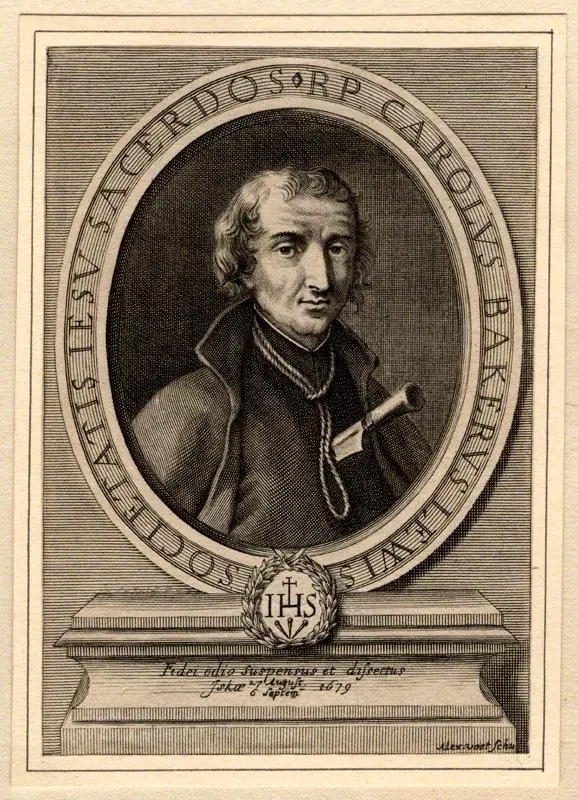
Saint David Lewis was a Welsh Jesuit who served the Catholics of South Wales and Monmouthshire in secret for about thirty years, traveling at night, and was known as the Father of the Poor. 12 Arrested in the panic over the invented Popish Plot, he was condemned for being a priest and hanged at Usk on August 27, 1679, telling the crowd, "A Roman Catholic I am; a Roman Catholic priest I am." 12 His feast is August 27. 46
Abergavenny, Paris and Rome
He was born in Monmouthshire, at Abergavenny, in 1616 according to the Catholic Encyclopedia and the Jesuits in Britain, in 1617 according to Challoner. 123 His father, Morgan Lewis, was headmaster of the Royal Grammar School there and a lax Catholic, later converted; his mother, Margaret Pritchard, was a devout one. 2 The Jesuit Collections page at Stonyhurst describes a family that compromised, as many did: David went to his father's school, which conformed to the state religion, while his younger brothers and sisters were taught the faith secretly at home by their mother. 3
The sources tell his conversion two ways. The encyclopedia says that in his sixteenth year he spent three months in Paris as companion to the son of Earl Rivers, and was received into the Church there by a Father Talbot, S.J. 2 Challoner says he was brought up a Protestant until about nineteen, and was reconciled to the Church while a student of law. 1 The Jesuits in Singapore give the year as 1635. 4
After his parents died he went to Rome, and in November 1638 he was admitted to the English College. 12 He was ordained priest in 1642, and entered the Jesuit novitiate at Sant'Andrea, in 1644 by the encyclopedia's date and in 1645 by Challoner's. 124 Sent to England in 1647, he was quickly recalled and made spiritual father to the students in Rome, then went home for good in 1648. 24
Father of the Poor
He was assigned to South Wales and worked there for the rest of his life: twenty-eight years by the encyclopedia's count, thirty-one by Challoner's. 12 The current Roman Martyrology says that for more than thirty years he celebrated the sacraments in secret in his homeland and helped the poor. 6 The Jesuits in Singapore add that he was twice superior of his district. 4
Challoner remembers him as "a zealous seeker after the lost sheep, fearless in dangers, patient in labours and sufferings, and so charitable to his indigent neighbours, as to be commonly called the father of the poor." 1 The encyclopedia says that to avoid the persecutors he made long and dangerous journeys at night, so as to visit the faithful under cover of darkness. 2
The Popish Plot
In the summer of 1678 Titus Oates came forward with his invented story of a Jesuit plot to kill King Charles II, and Parliament offered new rewards for the capture of priests. 2 In Monmouthshire, the Jesuit Collections page says, John Arnold, a member of Parliament and justice of the peace, offered a bounty of £200 for any priest brought in. 3 The encyclopedia calls Arnold a magistrate "who had hitherto professed friendship" for Lewis. 2
The Jesuit Collections page names the people who gave him up: William James, who had been his servant for at least four years, and his wife Dorothy. 3 He was taken before dawn on Sunday, November 17, 1678, in a small house at Llantarnam, by six armed men sent by two justices, Challoner says. 1 At Abergavenny he was shown to the people as "the pretended Bishop of Llandaff," one of Oates's inventions, and he was then held in Monmouth jail, locked in alone, paying for his own room. 12
In January 1679 he was moved through the snow to Usk. On the way the escort stopped at Raglan, and there he learned that a fellow Jesuit, Walter Price, lay dying nearby after being hunted from barn to barn; Lewis could only send him his blessing. 1
Trial at Monmouth
Nothing tied him to the plot, so he was charged under the statute of 27 Elizabeth, which made it high treason for a man ordained abroad as a Catholic priest to return to England and exercise his ministry. 12 The encyclopedia dates the trial to March 16, 1679; Challoner says the assizes opened at Monmouth on March 28 and he was tried the next day. 12 Five or six witnesses swore they had seen him say Mass. 1 Dorothy James, the Jesuit Collections page says, was the chief of them, and Lewis himself recorded her threat that she would wash her hands in his heart's blood. 3
He was found guilty and sentenced to death. 12 He was not executed at once but taken to London, to Newgate, and confronted with Oates and the other informers, who could charge him with nothing. 1 Lord Shaftesbury, Challoner says, suggested that he might save his life by revealing a plot or by conforming. Lewis's answer, given in his last speech, was plain: "discover plot, I could not, for I knew of none; and conform I would not, for it was against my conscience." 1
The gallows at Usk
He was sent back to Wales and executed at Usk on August 27, 1679. 12 Challoner prints most of what he said to the crowd. "I believe you are here met not only to see a fellow-native die, but also with expectation to hear a dying fellow-native speak." 1 He denied any part in the plot and prayed for the king. Then: "A Roman Catholic I am; a Roman Catholic priest I am; a Roman Catholic priest of that religious Order called the Society of Jesus, I am; and I bless God who first called me." 1
He forgave by name everyone who had brought him there: the neighbors who betrayed him, the men who took him, the justices who committed him, and above all "my capital persecutor who hath been so long thirsting after my blood." 1 To the Catholics present he said, "fear God, honour your King; be firm in your faith." 1 His last words were "Sweet Jesus, receive my soul." 14
The Jesuit Collections page says the large, sympathetic crowd would not let the mutilation that the sentence required begin until he was dead, and that he was buried in the graveyard of the priory church at Usk. 3 The current Martyrology records that he was hanged as a priest under King Charles II. 6
Canonization
The cause of David Lewis, under the name "David Lewis, alias Charles Baker," was introduced in 1886. 2 He was canonized by Paul VI on October 25, 1970, one of the Forty Martyrs of England and Wales. 35 In his homily that day Paul VI said that these martyrs wished to be loyal to their country and its rulers in everything civil, and that many of them died praying for the king and for the very people responsible for their deaths. 5
What is Saint David Lewis the patron saint of?
Saint David Lewis's feast day
Saint David Lewis's feast day is August 27, the day of his death. The current Roman Martyrology, as the Italian bishops print it, enters him on that day at Usk in Wales. 6 The Jesuits in Singapore keep August 27 as his feast. 4
He was canonized with the other Forty Martyrs of England and Wales on October 25, 1970. 5
Praying with Saint David Lewis
For three decades he was a priest by night: long journeys in the dark, Mass in farmhouses, the sacraments given in secret to people who could be fined or jailed for receiving them. 126 The name the poor gave him says what else filled those years. 12
He was betrayed by people close to him, a servant of years and a magistrate who had called himself a friend. 23 At the gallows he forgave them, and wished his chief persecutor heaven. 1
He was offered his life twice over, for a plot he could have invented or a conscience he could have set aside. 1 He refused both and said why in a sentence: he knew of no plot, and conforming was against his conscience. 1
His speech names what he died for without ornament. He was condemned for saying Mass, hearing confessions and giving the sacraments, and so, he said, he died for his religion. 1
Saint David Lewis, pray for us.
Sources
- 1.Richard Challoner, "Charles Baker, alias David Lewis, Priest, S.J.," in Memoirs of Missionary Priests, revised by John Hungerford Pollen (New York: P. J. Kenedy and Sons, 1924), pp. 556-561, Internet Archive.
- 2.Sydney Smith, "Ven. Charles Baker," The Catholic Encyclopedia, Vol. 2 (New York: Robert Appleton Company, 1907), New Advent.
- 3."Canonised 1970: St David Lewis SJ," Jesuit Collections, Stonyhurst College, Jesuits in Britain.
- 4."August 27th: Saint David Lewis, SJ," The Jesuits in Singapore.
- 5.Paul VI, Homily for the canonization of forty martyrs of England and Wales, October 25, 1970 (in Italian and English), vatican.va.
- 6.Roman Martyrology, entry for August 27, Santo del giorno, Conferenza Episcopale Italiana (in Italian).
Saints to turn to next
Others in this collection who are turned to for some of the same things.