Saints Cyrus and John
Died about 303
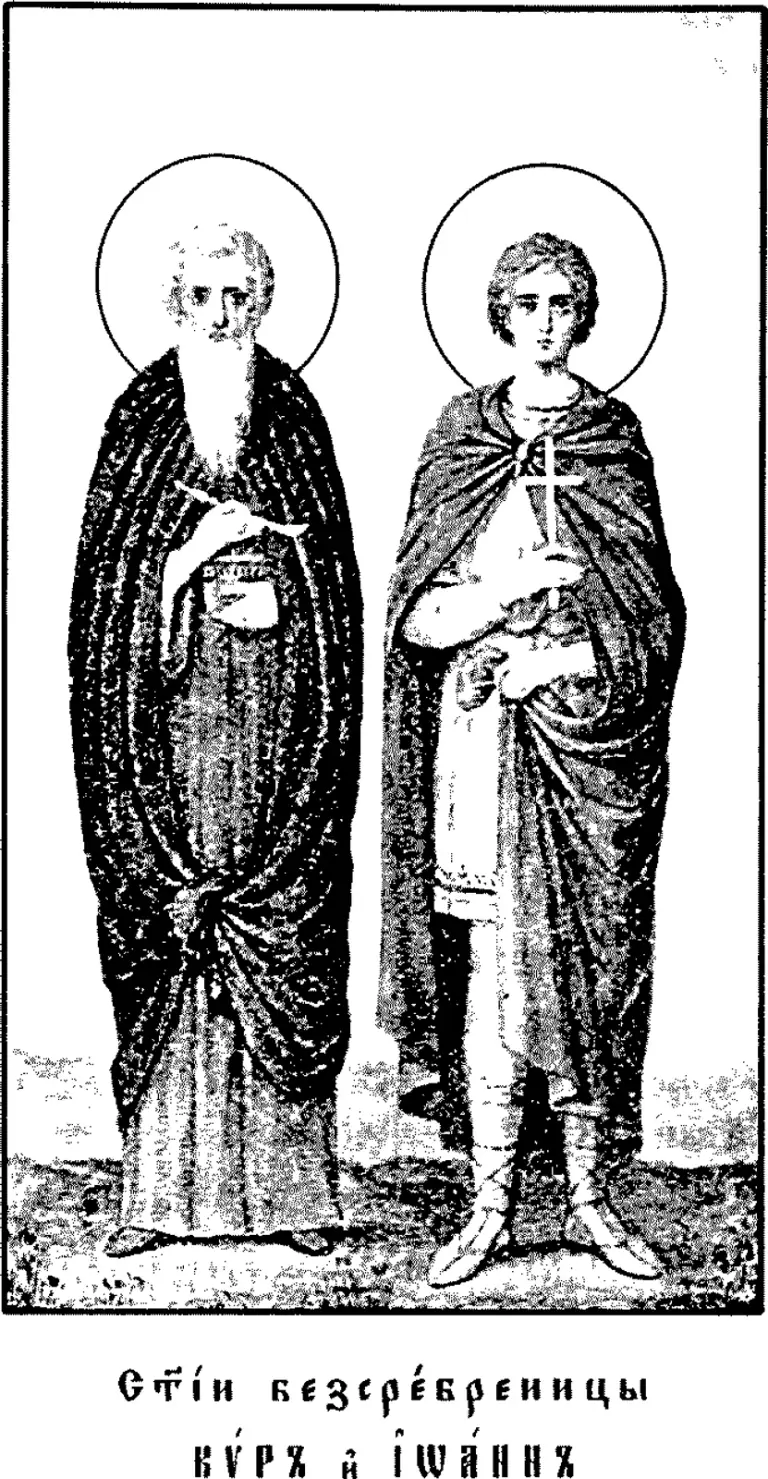
- Shrine
- Menuthis, near Canopus, where Cyril of Alexandria moved their relics in 414; the place is now Abukir 13
- Relics
- At Santa Passera in Rome (Balestri, Butler); now at the Gesù Nuovo in Naples (santiebeati) 123
- Patronage
- None of a group stated; patrons of Portici, Grottaglie, Marineo and Nocera Superiore in Italy 3
Saints Cyrus and John were martyred at Alexandria under Diocletian, about 303: Cyrus a physician who treated the sick without taking money, John a soldier who came to Egypt to join him. 13 They were beheaded after going to encourage a mother and her three young daughters on trial for the faith. 12 A century later their relics made a seaside village near Alexandria one of the great healing shrines of the East, and the place is still called Abukir, from "Abba Cyrus." 13 Their feast is January 31. 4
What is known
Very little, and the sources say so. Balestri's article in the Catholic Encyclopedia begins: "Of the birth, parents, and first years of the saints we know nothing." 1 Its principal source is a eulogy written in the seventh century by Sophronius, patriarch of Jerusalem. 1 Caraffa calls the main facts about them vague and generic, resting on uncertain testimony and mixed with legend. 3
Balestri adds something striking. Before Cyril of Alexandria found and moved their relics in the fifth century, "it seems that the names of the two saints were unknown; certain it is that no written records of them existed." 1 Everything written about them comes after the shrine.
The physician and the soldier
Cyrus practiced medicine in Alexandria. He treated the sick for nothing, and used the chances his work gave him to win his patients from paganism. 12 He and John were surnamed thaumatourgoi anargyroi, wonder-workers who take no silver, because they healed the sick without payment. 1 Balestri says the room where he saw patients was later made into a church of the Three Children, Ananias, Azarias and Misael; Caraffa notes that this was being shown to visitors in Alexandria, and thinks the story of the physician grew up once the cures at his tomb had made him famous as a healer. 13
Denounced to the prefect, he fled to Arabian Egypt, to a town by the sea called Tzoten, where he shaved his head, took the monastic habit and gave up medicine for a life of prayer. 1 Caraffa likewise says he became a monk after practicing medicine. 3
John was a soldier. Balestri says he held high rank, and the Arabic Synaxarium adds that he was close to the emperor. 1 Hearing of Cyrus, he went to Jerusalem to fulfill a vow and from there to Egypt, where he joined him. 1 Where he was born is not agreed. The Synaxarium makes both men Alexandrians; other documents, Balestri says, make John a native of Edessa; Butler calls him "an Arabian." 12
Athanasia and her daughters
In the persecution of Diocletian a Christian woman named Athanasia and her three daughters were arrested at Canopus and taken to Alexandria. 1 Balestri gives the girls' names and ages: Theoctista, fifteen; Theodota, thirteen; and Theodosia, eleven. 1 Caraffa names them differently, as Theodosia (or Theodota), Theoctista and Eudoxia; Butler names only the mother and says the eldest was fifteen. 23
Cyrus and John feared, Balestri writes, that the girls were young enough to give way under torture, and went to strengthen them. 1 They were arrested themselves. Butler describes what followed: they were "cruelly beaten: their sides were burnt with torches, and salt and vinegar poured into their wounds in the presence of Athanasia and her daughters, who were also tortured after them." 2
All were beheaded. Balestri says the six died together, on January 31; Butler says the four women died first, and Cyrus and John "a few days after." 12 Caraffa dates the deaths to about 303. 3
The shrine at Menuthis
Their bodies were laid in the church of Saint Mark at Alexandria, and were still there in the time of Cyril, patriarch from 412 to 444. 13 At Menuthis, near Canopus, there was a pagan temple famous for oracles and cures, which drew even some Christians. Caraffa says it was a temple of Isis, already destroyed, but that its cult had outlived it. 13 To end it, Cyril moved the relics of Cyrus and John to Menuthis on June 28, 414, placing them in the church his predecessor Theophilus had built there. 1 Caraffa says Cyril preached at the translation, and that his sermons survive. 3
It did not work at once; Caraffa says paganism there needed stronger measures later. 3 But by the sixth century, he writes, the church had become one of the most celebrated sanctuaries of the Eastern world, a rival to the shrine of Cosmas and Damian at Constantinople. The sick lay on the floor of the basilica at night, and the saints were said to tell them in their sleep what remedies to use; heretics, Caraffa adds, were not cured until they returned to the Catholic Church. 3
Early in the seventh century Sophronius, himself cured of an eye complaint there, collected seventy of the miracles, recording the names of those healed. Caraffa observes that he often accepted the testimony with extreme credulity. 3 The sanctuary probably fell at the time of the Arab conquest. Its memory survives in the name of the place: Abukir is the Arabic form of "Aba Cyrus." 3
Santa Passera
The relics came to Rome. A manuscript cited by the antiquarian Bosio says they were brought under Pope Innocent I by two monks; Cardinal Mai, followed by Balestri, assigns them instead to 634, under Pope Honorius. 1 They were laid in a small church on the Via Portuense, and the inscription over the door of its crypt reads, in Latin, that here lie the bodies of Cyrus and John, which great Alexandria once gave to Rome. 1
Butler explains the church's odd name. Cyrus was known as Abbacyrus, which Butler calls a Chaldaic word meaning "the Father Cyr," and Roman speech wore it down until the church was known as Sant' Apassara. 2 Balestri gives the same history for three churches in Rome once dedicated to "Abbas Cyrus," all of which became Santa Passera. 1 The santiebeati entry says the relics are now in Naples, in the church of the Gesù Nuovo. 3
What are Saints Cyrus and John the patron saints of?
None of the sources consulted for this page names Saints Cyrus and John as patron saints of a profession or a cause, and the page does not supply one. santiebeati lists them as patrons of four Italian towns: Portici, Grottaglie, Marineo and Nocera Superiore. 3
Saints Cyrus and John's feast day
The feast day of Saints Cyrus and John is January 31, when the current Roman Martyrology commemorates them at Alexandria as martyrs who were beheaded after many torments. 4 Balestri says the Copts keep the same day, the sixth of their month Emsir, as do the Greeks and the Roman Martyrology; Butler gives the Coptic date as the eighth of Mechir, and says the Syrians, Egyptians, Greeks and Latins all honor them. 12
The Greek Church also keeps the finding and translation of their relics on June 28, the anniversary of Cyril's translation to Menuthis. 1
Praying with Saints Cyrus and John
They did not go to Alexandria to die. They went because three girls of eleven, thirteen and fifteen were about to be tortured, and two grown men thought the children might break. 1 Butler says the men were tortured in front of them. 2
Cyrus was a doctor who would not take money from the sick. 1 The name given to him and John, the wonder-workers who take no silver, remembers that before anything else. 1
Their story is mostly lost. What survives is a shrine where people slept on a floor hoping to be healed, and the name of a town. 13 The sources do not pretend to know more, and neither does this page.
Saints Cyrus and John, pray for us.
Sources
- 1.Giuseppe Balestri, "Sts. Cyrus and John," The Catholic Encyclopedia, Vol. 4 (New York: Robert Appleton Company, 1908).
- 2.Alban Butler, "SS. Cyrus and John, MM.," January 31, in The Lives of the Fathers, Martyrs, and Other Principal Saints, Vol. I (New York, 1895), Project Gutenberg eBook #20450.
- 3.Filippo Caraffa, "Santi Ciro e Giovanni, martiri," Santi, beati e testimoni (santiebeati.it) (in Italian).
- 4.Roman Martyrology, entries for January 31, Santo del giorno, Conferenza Episcopale Italiana (in Italian).
Saints to turn to next
Others in this collection who are turned to for some of the same things.