Saint Cyriacus
d. c. 303 or 309
- Historical record
- A martyr Cyriacus is attested by the Depositio Martyrum of 354; the Acts are fiction 12
Saint Cyriacus was a Roman martyr of the last great persecution, remembered as a deacon and as one of the Fourteen Holy Helpers, the group of saints Catholics have long called on in trials and suffering. 15 His existence is vouched for by a calendar of Roman martyrs drawn up in 354; nearly everything else told about him is not. 12 Pius Parsch, describing his famous Acts, called their details "pure fiction," and the Norwegian bishops' saints database calls them historically worthless. 12
What is known
The firm evidence is short. The Depositio Martyrum, the list of Roman martyrs' anniversaries compiled in 354, appears to prove that Cyriacus was an authentic martyr, honored at Rome from the earliest times on August 8. 1 Catholic Culture, quoting Parsch, agrees that "the existence of a martyr with this name seems well attested by the trustworthy Depositio Martyrum of 354." 2 katolsk.no adds that the only other thing known for certain is that he and his companions were buried near the seventh milestone of the road to Ostia. 1 In 1915 an early Christian cemetery was found at that milestone. 1
The current Roman Martyrology, as the Italian bishops print it, gives him one line: at Rome, at the seventh mile of the Via Ostiense, the holy martyrs Cyriacus, Largus, Crescentian, Memmia, Juliana and Smaragdus. 3 katolsk.no points out that those names look suspiciously like those of another Roman group once kept on August 12. 1 Pope Honorius I seems to have built a church over the grave in the seventh century. 1
Even his name has two explanations. Catholic Culture says that Largus and Smaragdus, two Roman martyrs, were first buried on the Ostian Way and later moved to a church near the Baths of Diocletian built by a Christian named Cyriacus, and that "the cult of St. Cyriacus has been joined to that of the two martyrs." 2 katolsk.no, from the other direction, says the Cyriacus who founded the Roman meeting place called the titulus Cyriaci may have been a different man from the martyr. 1
The legend of the deacon
The Acts make him a deacon who, with Largus and Smaragdus, helped the Christians condemned to forced labor on the great baths Diocletian was building in Rome. 1 The monks of Silverstream Priory, who tell the story as a devotional life, add that he was a Roman nobleman who gave his wealth to the poor, and that he served under Popes Marcellinus and Marcellus. 6 katolsk.no says the three were ordained deacons around 300 by one or the other of those popes. 1
Thrown into prison by Maximian, Diocletian's co-emperor, Cyriacus healed the blind in Jesus' name. Diocletian heard of it, and when his daughter Artemia was possessed by an evil spirit he sent for the deacon, who drove it out and baptized her. 12 The emperor, says katolsk.no, was amazed but did not believe, and left Cyriacus and his helpers in peace. 1 One version has the demon foretell that it would drive Cyriacus to Babylon, and soon afterward he was summoned to Persia to free King Sapor's daughter Jobia in the same way. He baptized her, the king and four hundred and thirty others, and came home to Rome, where Diocletian had given him a house. 126
Then, in Diocletian's absence or after his abdication, Maximian had him arrested. 1 In Parsch's summary, "he was arrested, chained, and dragged to prison. Four days later he was taken from confinement, drenched with seething pitch, and tortured on the rack; in company with Smaragdus and twenty other Christians he finally was beheaded on the Via Salaria near the gardens of Sallust." 2 A priest named John buried them on the Via Salaria, and on August 8 Pope Marcellus moved them to land owned by a Christian woman, Lucina, on the road to Ostia. 1
Why the Acts are doubted
The scholars took the story apart long ago. katolsk.no reports that the Bollandists doubted Artemia's baptism, since Diocletian's daughter was called Valeria, and that Cardinal Baronius doubted the journey to Persia, since there was no king named Sapor there in Diocletian's time. 1 The chronology does not hold either: Maximian ruled until 305, but the story makes Cyriacus a deacon under Marcellus, who was pope in 308 and 309, so katolsk.no argues that 309 fits better than the usual 303. 1
The Acts also absorbed other stories. J.P. Kirsch, writing on Pope Marcellus I in the 1910 Catholic Encyclopedia, notes that a fifth-century "Passio Marcelli" is included in the legendary account of the martyrdom of Saint Cyriacus, and judges its story of Marcellus condemned to tend horses at an imperial post station "probably legendary." 4 Parsch's conclusion is that "the remaining details in the above account are pure fiction," though the story may still "bring to mind that endless series of heroic souls who suffered for Christ." 2
His relics and the Holy Helpers
In the ninth or tenth century the relics were brought into the city. The old Martyrology placed them in the church of Santa Maria in Via Lata, and the Silverstream monks say his body rests there still. 16 Pieces traveled north. katolsk.no records an arm taken to Bamberg Cathedral in the tenth century at the wish of the emperor Otto I, and the other arm brought in 1049 to the abbey of Altdorf in Alsace, where it survived the French Revolution. 1 In 1994 Cardinal Camillo Ruini, vicar of Rome, gave a vial of his blood to the shrine of Torre le Nocelle, in the province of Avellino. 16
katolsk.no thinks the translation to Bamberg is probably why he came to be counted among the Fourteen Holy Helpers, the group of saints invoked together in illness and distress. 15 He is one of the least known of them, and in Old Bavaria he was sometimes replaced by Saint Leonard. 1 Until the 1969 reform of the calendar, the Holy Helpers as a group were kept on August 8, his own day. 2
What is Saint Cyriacus the patron saint of?
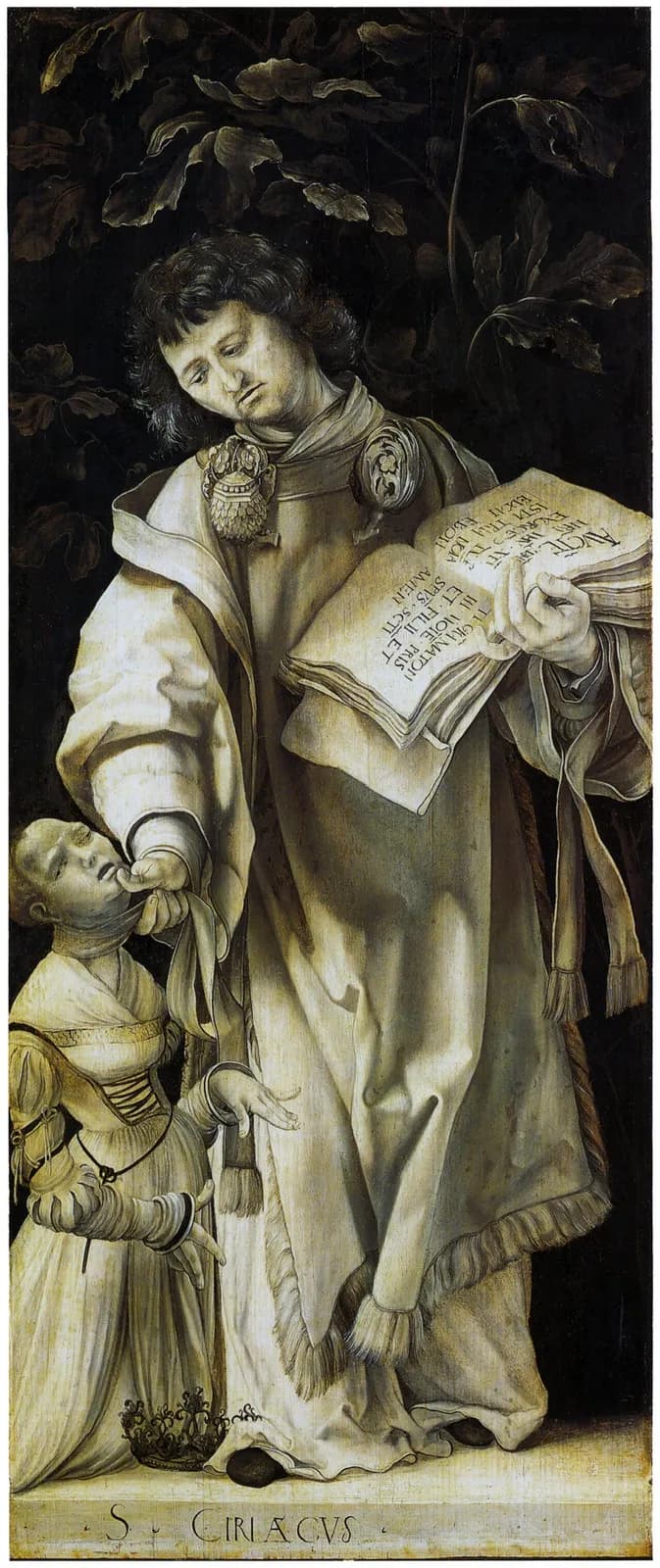
Saint Cyriacus is invoked against diabolical possession and diseases of the eye, and for those in temptation, "especially at the time of death." 25 The Silverstream monks call him a patron of deacons and of exorcists. 6 katolsk.no adds forced laborers and people doing heavy work, and childhood illnesses, and names him patron of Ciriè near Turin and of Torre le Nocelle. 1 He is shown as a deacon, with a book, a palm, a sword, and a dragon or devil underfoot, or beside the kneeling Artemia, as in the Grünewald panel at the top of this page. 15
Saint Cyriacus's feast day
Saint Cyriacus's feast day is August 8, the date of his second burial, on which he has been kept since 354. 12 He was once also entered on March 16, the date of his death in the legend; the current Martyrology keeps only August 8, with six names. 13 The 1969 reform removed the feast from the general calendar and left it to local calendars. 1 The Orthodox keep him on July 7. 1
On Ibiza, August 8 is a solemnity. The Diocese of Ibiza keeps it as the feast of San Ciriaco, martyr, patron of the island, on the anniversary of the Catalan conquest of 1235, with a Mass in the cathedral and a procession to the little chapel of San Ciriaco. The diocese says the day was first dedicated to Saint Thecla, and that San Ciriaco began to take her place in the sixteenth century. 7
Praying with Saint Cyriacus
A name in a calendar from 354 and a grave by the road to Ostia: that is what history leaves of him. 12 Everything else, the exorcisms, the emperor's daughter, the Persian king, came later, and the people who knew the sources best did not pretend otherwise. 12
What the legend did with that name is still worth noticing. It made him a deacon, in an age when, as the Silverstream monks put it, deacons were occupied with preaching, the liturgy and the care of the poor and sick, and it set him among prisoners doing forced labor, bringing them what help he could. 16 The Church's devotion grew from there. He became the saint people called on against the powers of darkness and the temptations of the last hour. 25
He is one of the Holy Helpers almost nobody can name. 1 For centuries people asked him for help anyway, in Bamberg and Alsace, on Ibiza and in Italy, without needing to know much more about him than that he died for Christ. 167
Saint Cyriacus, pray for us.
Sources
- 1."De hellige Cyriacus, Largus, Crescentian, Memmia, Juliana og Smaragdus," Den katolske kirke (katolsk.no), Catholic Diocese of Oslo (in Norwegian).
- 2."August 8," Liturgical Year calendar, Catholic Culture (Trinity Communications), with an excerpt from Pius Parsch, The Church's Year of Grace.
- 3.Roman Martyrology, entry for August 8, "Santi Ciriaco, Largo, Crescenziano, Memmia, Giuliana e Smaragdo, martiri," as printed in "Santo del giorno," Conferenza Episcopale Italiana (in Italian).
- 4.Johann Peter Kirsch, "Pope St. Marcellus I," The Catholic Encyclopedia, Vol. 9 (New York: Robert Appleton Company, 1910).
- 5."Fourteen Holy Helpers," Catholic Activity, Catholic Culture (Trinity Communications).
- 6."A Deacon Exorcist and Martyr," Vultus Christi, Benedictine Monks of Perpetual Adoration, Silverstream Priory, August 8, 2012.
- 7."La solemnidad de San Ciriaco cierra las fiestas patronales de Ibiza el día de la conquista," Obispado de Ibiza (in Spanish).
Saints to turn to next
Others in this collection who are turned to for some of the same things.