Saints Justa and Rufina
Martyred at Seville in 287, or in 303
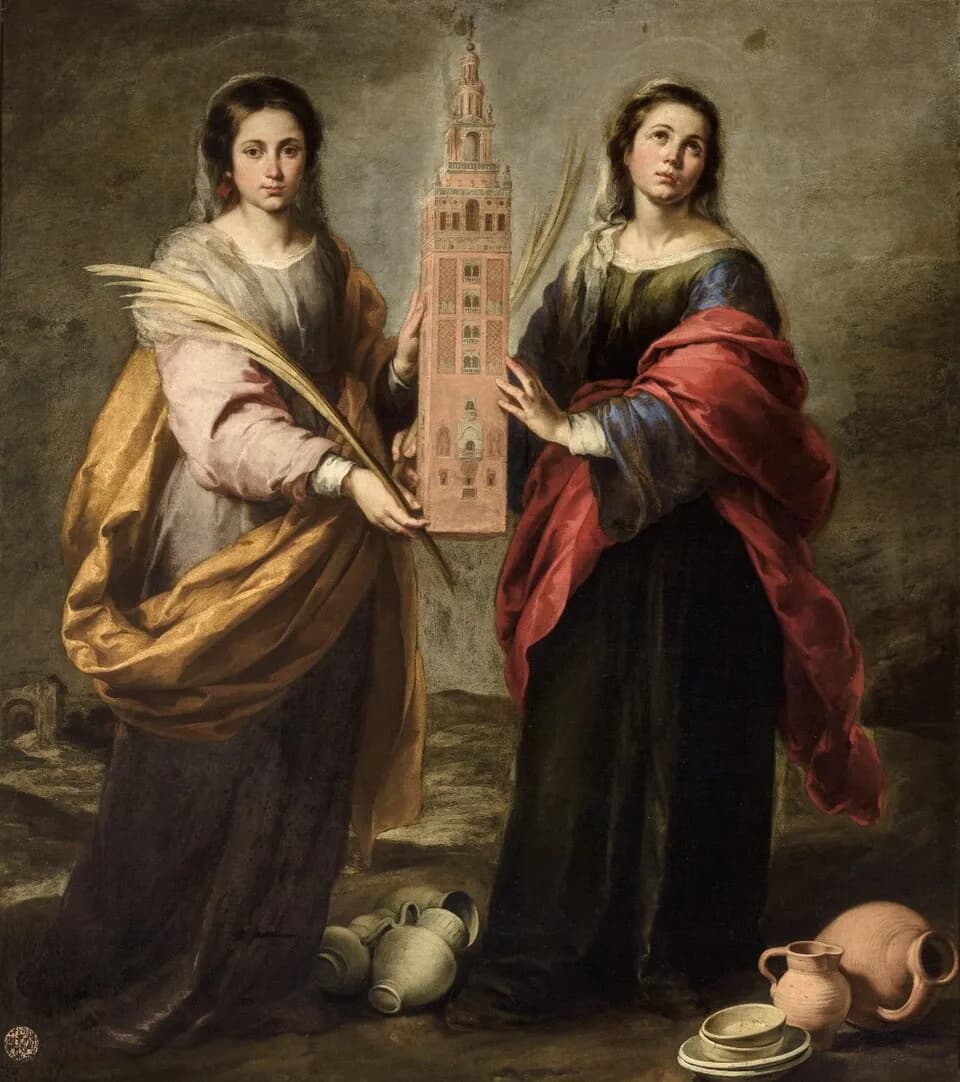
- Feast day
- July 17 in Seville and in the current Roman Martyrology 348; July 19 in the 1912 Catholic Encyclopedia and elsewhere in Spain 13
- Died
- Under the governor Diogenianus: 287 by the archdiocese's account, 303 by the 1912 encyclopedia's 238
- In art
- Shown with palms and clay pots, holding the Giralda between them 5
Saints Justa and Rufina were two potters of Roman Seville who would not give an offering to a pagan goddess or adore her idol, and died for it under the governor Diogenianus. 238 Seville keeps them as patrons of the city, and since the early sixteenth century its painters have shown them in much the same way: two young women with palm branches and clay jars, holding up the cathedral tower. 35
Two potters of Hispalis
What can be said of their lives fits in a sentence, and the Archdiocese of Seville says it in one: they were young women born in Roman Hispalis who worked as potters. 3 The 1912 Catholic Encyclopedia, in its article on Seville, likewise speaks of "Sts. Justa and Rufina, the potters," as if the trade were part of their names. 2 The archdiocese admits how thin the record is. Little is known of the two women, it says, and apart from oral tradition the first written references to them date from several centuries after they died. 5
The story that survives is about a pagan festival. The cortege of the goddess Salambo, whom the archdiocese's pages call Salambona or Salambó, demanded a donation from the sisters, and they refused it. 23 The encyclopedia puts the refusal more sharply: they "suffered martyrdom for refusing to adore the idol Salambo." 2 In the version the archdiocese retells when it describes Goya's painting of them, they threw the image to the ground and it broke. 6
Prison, torture and death
The current Roman Martyrology keeps its entry short. It says that the two virgins were arrested at Seville by the governor Diogenianus and put through cruel torments, prison and hunger among them, and that Justa died in prison while Rufina, for confessing her faith in the Lord, had her neck broken. 8 The archdiocese's calendar of saints tells it nearly the same way, with one difference: Justa died in prison from what she had suffered, and Rufina had her throat cut a little later. 4
The year is not agreed. The archdiocese dates the martyrdom to 287. 3 Ramón Ruiz Amadó, writing on Seville in the 1912 encyclopedia, says it was "in 303," and uses it to fix the name of the city's bishop at the time, Sabinus. 2 The diocesan calendar says only that it was at the end of the third century. 4
One more scene belongs to what the archdiocese itself calls the legend of the martyrdom. Rufina was taken to the circus to be eaten by lions, and the lions were gentle with her and did her no harm. Goya painted one licking her feet. 6
What the old martyrologies show
Johann Peter Kirsch, who wrote the encyclopedia's entry on the saints named Rufina, went back to the earliest lists. He noted that "Only St. Justa is mentioned in the 'Martyrologium Hieronymianum'" and that in the later historical martyrologies "Justina is also mentioned, following the legendary Acts." 1 He called the Acts legendary and still drew a firm conclusion: "There is no doubt that both are historical martyrs of the Spanish Church." 1
So the sources agree on a short list. Two Christian women of Seville died for the faith under Roman rule, their names were kept in the martyrologies, and, in the words of the diocesan calendar, their martyrdom was celebrated all over Spain. 14 The archdiocese adds that the Orthodox Church venerates them as well as the Catholic Church. 3 The idol, the lions and the exact year are carried by legend and tradition, and the sources say as much. 156
The tower between them
The best-known pictures of the sisters put a tower between them. It is the Giralda, the bell tower of Seville Cathedral, and it comes from an earthquake. Chronicles of the earthquake of 1504 record that popular piety credited the saints with keeping the tower from falling, the archdiocese says, and the same was said after the earthquake of 1755. 3 The most familiar image shows them embracing the tower, carrying the palms of martyrdom and the clay vessels of their trade, and always as a pair. 5
The oldest painting of them in Seville is probably a panel in the church of Santa Ana in Triana, attributed to an anonymous painter called the Master of Moguer. One archdiocesan page dates it to 1515 and another to about 1510. 57 It shows the sisters with a view of the whole city, river and bridge of boats included, which the archdiocese reads as a sign that they were already thought of as protectors of Seville. The same page calls them the martyrs of Triana. 7
In 1568 Luis de Vargas painted them in fresco on the north face of the Giralda itself. The frescoes are lost, and the archdiocese says the only way to imagine them is a canvas by Miguel de Esquivel dated 1620. 56 Bartolomé Esteban Murillo took up that composition in 1665 for the high altar of the Capuchin church in Seville. His full-length canvas, now in the city's Museum of Fine Arts, is the one on this page: Justa looks out at the viewer and her sister looks up to heaven, with the tower held between them and pots at their feet. 5 The archdiocese says he painted them as two beautiful and elegant ladies of Baroque Seville. 5
Francisco de Goya painted them for the cathedral in 1817, on a commission from the chapter, and delivered the canvas on January 14, 1818. 6 He moved the tower into the background and put the story in the foreground instead: the pots in their hands, the palms, the broken idol on the ground and the lion at Rufina's feet. 6 The archdiocese's list of others who painted or carved them runs from Francisco Pacheco to Zurbarán, and the statues that Pedro Duque Cornejo made in 1728 still go out in the Corpus Christi procession. 5
What are Saints Justa and Rufina the patron saints of?
Justa and Rufina are patron saints of the city of Seville. The diocesan calendar opens their entry with the words "Patronas de la ciudad de Sevilla" and the archdiocese says that their patronage is recorded in old liturgical texts. 34 They share the rank with the Virgin of the Kings, who is patron of both the city and the archdiocese. 9
Because they made and sold pottery, they are also invoked by potters. ACI Prensa, the Catholic news agency, calls them patrons of potters and of sellers of ceramics. 10 The archdiocese's own pages, which call them the potter saints again and again, speak of their patronage only over the city. 35
Saints Justa and Rufina's feast day
The feast of Saints Justa and Rufina is July 17. That is the day in the calendar of the Archdiocese of Seville, where it ranks as a feast, and the day on which the current Roman Martyrology names them. 348 The archdiocese says that Seville keeps July 17 by the tradition of the old Hispano-Mozarabic liturgy. 3
July 19 is the other date a reader will meet. The 1912 Catholic Encyclopedia found them in the Roman Martyrology of its day on 19 July, and the archdiocese says that other parts of Spain still keep their memorial then. 13 In Seville the cathedral marks July 17 with the Office of Readings, Lauds and Mass in the Royal Chapel, and the saints' own chapel is kept open and decorated with flowers through the week. 3
Praying with Saints Justa and Rufina
They were working women. The archdiocese and the encyclopedia both call them potters, and the painters give them jars and bowls along with the palm. 235 The refusal that cost them their lives was a refusal to pay: the cortege of a goddess demanded a donation, and they would not give it. 3
In the archdiocese's telling they did not go looking for a confrontation. The demand came to them. 3 The Martyrology records what followed without ornament: prison, hunger, torture, and two deaths. 8
The Church has been honest about how little else is known. Kirsch called their Acts legendary in the same breath as he called the two women historical martyrs, and the archdiocese that keeps their feast says plainly that the written record begins centuries late. 15 The devotion has never depended on the details.
Seville gave them a tower to hold. After 1504 the city pictured two potters keeping its cathedral tower upright through an earthquake, and it has gone on picturing them that way. 35 The curator of the cathedral, quoted by the archdiocese, says the paintings were meant to show holiness in two young people. 5
Saints Justa and Rufina, pray for us.
Sources
- 1.Johann Peter Kirsch, "Sts. Rufina," The Catholic Encyclopedia, Vol. 13 (New York: Robert Appleton Company, 1912).
- 2.Ramón Ruiz Amadó, "Seville," The Catholic Encyclopedia, Vol. 13 (New York: Robert Appleton Company, 1912).
- 3."La Archidiócesis de Sevilla celebra la fiesta de las santas Justa y Rufina," Archdiocese of Seville, July 17, 2026 (in Spanish).
- 4."Santoral sevillano," the diocesan calendar of saints, Archdiocese of Seville (in Spanish).
- 5."Santas Justa y Rufina. Una devoción a través del arte," Archdiocese of Seville, July 17, 2018 (in Spanish).
- 6."'Santas Justa y Rufina', de Francisco de Goya," Archdiocese of Seville, July 14, 2020 (in Spanish).
- 7."Santas Justa y Rufina. Real Parroquia de Señora Santa Ana de Triana (Sevilla)," Archdiocese of Seville, July 15, 2025 (in Spanish).
- 8.Roman Martyrology, entry for July 17, as printed in "Santo del giorno," Conferenza Episcopale Italiana (in Italian).
- 9."Actos para honrar a las Santas Justa y Rufina," Archdiocese of Seville, July 9, 2015 (in Spanish).
- 10."Hoy celebramos a las santas Justa y Rufina, patronas de los alfareros y los comerciantes de cerámica," ACI Prensa, July 19, 2025 (in Spanish).
Saints to turn to next
Others in this collection who are turned to for some of the same things.