Saint Claudine Thévenet
March 30, 1774 - February 3, 1837
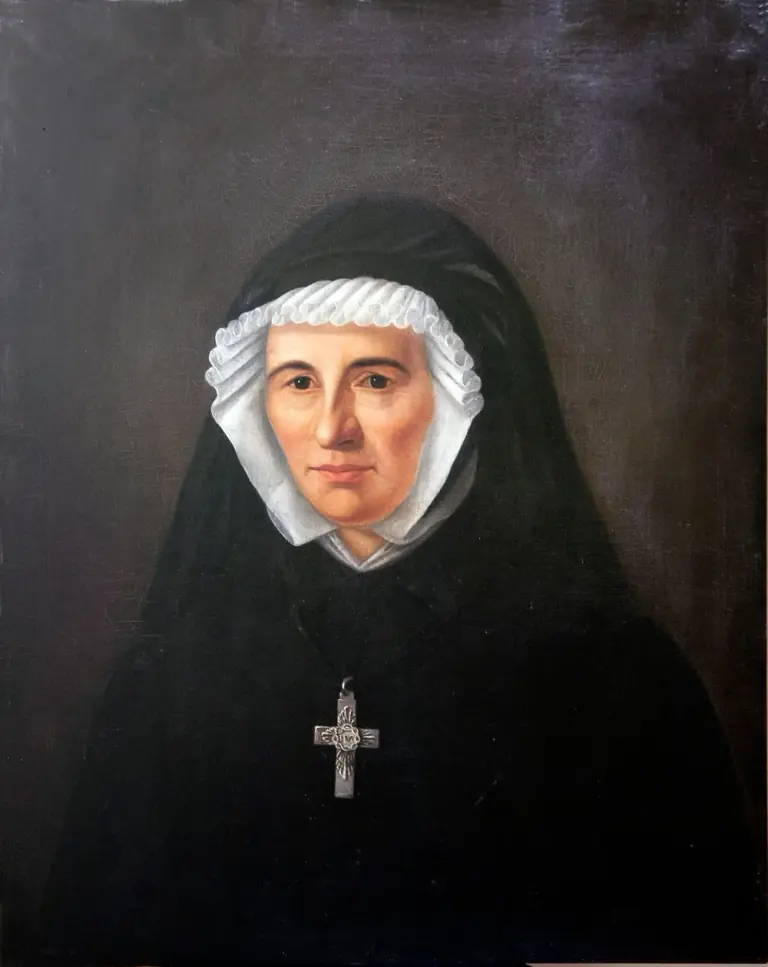
- Beatified
- October 4, 1981, by John Paul II 3
Saint Claudine Thévenet was nineteen when she watched two of her brothers executed in revolutionary Lyon, and their last words to her, "Forgive, Glady, as we forgive," set the course of the rest of her life. 13 She spent it on the children the Revolution had left destitute, and in 1818 founded the Religious of Jesus and Mary to give girls of every class a Christian education, with the poorest first. 12 She died in 1837, was canonized in 1993, and her feast is February 3. 34
Glady
Claudine Thévenet was born in Lyon on March 30, 1774, the second of seven children. 1 At home she was called Glady, and the Vatican's biography says she had a strong influence on her brothers and sisters through her goodness, gentleness and "self-forgetfulness in the desire to make others happy." 1 Until she was fifteen she was educated at the abbey of Saint-Pierre-les-Nonnains in Lyon. 3
The French Revolution broke out the year she left school. 13
The siege of Lyon
In 1793 Lyon was besieged by the government army. Claudine lived through the siege, and after the city fell, in January 1794, two of her brothers were put to death in reprisal. 1 Borrelli dates their deaths to January 5, 1794, among the mass killings at Lyon; John Paul II, in his canonization homily, says they were guillotined. 23 She was there and saw it. 13
Their last words to her were "Forgive, Glady, as we forgive." 1 The Vatican biography says they "remained deep in her heart and her mind and were to change the course of her life." 1 Borrelli records the cost: for the rest of her life she had a constant trembling of the head and a breathlessness like anxiety. 3 John Paul II called it the great trial of her youth, a dark valley through which she gave herself entirely to God, and said her vocation grew from that wound; the heroic forgiveness her brothers inspired turned her toward everyone around her who had been hurt by life. 2
Two children on the church steps
She began to help the poor and the orphans of the city, first alone and then with other young women of her parish. 3 For her, the Vatican biography says, the deepest cause of the people's suffering was that they did not know God, and she wanted above all to make Jesus and Mary known to children and the young. 1
The priest who guided her was Father André Coindre. One day he found two small children shivering on the steps of the church of Saint-Nizier and brought them to Claudine, who took them in without hesitation. 1 From them came the "Providence" of Saint Bruno in Lyon, in 1815. 1 Other women joined her in an association devoted to the Sacred Heart, and elected her president at once; Borrelli dates this association to 1816 and says it began with seven companions. 13
On July 31, 1818, Coindre told some of its members to form a religious community without delay. "God has chosen you," he said to Claudine. 1 On October 6, 1818, the Congregation of the Religious of Jesus and Mary began at Pierres-Plantées on the hill of the Croix-Rousse. 1 In 1820 it moved to Fourvière, facing the famous shrine, onto land bought from the Jaricot family; it was approved by the diocese of Le Puy in 1823 and by Lyon in 1825. 1
The Providences
The first aim was to take in poor girls and keep them until they were twenty, teaching them a trade, the elements of schooling, and the faith. 1 Borrelli says many were trained as silk workers so that they could find employment in the mills of Lyon. 3 The houses for the poorest were called Providences, and John Paul II saw in that name her whole approach: young people had to learn to run a household well, doing the smallest things with the same care and love as the great ones. 2
Claudine and her sisters wanted to do more, and opened a boarding school for girls of wealthier families as well. 1 The congregation's purpose became, in the Vatican biography's words, "the Christian education of all social classes, with a preference for children and young girls and among them the poor." 1
She was firm about that preference. "Be mothers to these children," she told her sisters, "yes, true mothers of both body and soul." 1 She would allow no favorites: "The only preferences I will permit are for the most poor, the most miserable, those who have most defects; those you will love a great deal." 1 John Paul II quoted another of her sayings: the best superior is not the one who hands out the most punishments, but the one who has the gift of preventing the most faults. 2 She told her sisters to let charity be as dear to them as the apple of their eye. 2
Last years
Her last twelve years were hard. Father Coindre died suddenly in 1826, and some of the first sisters in 1828. 1 She had to fight to keep her congregation from being merged with another. 1 In the uprisings of 1831 and 1834 the hill of Fourvière, where her community lived, was a strategic point between the two sides. 1
She went on building, among other things the chapel of the mother house, and began to write the Constitutions of the congregation. 1 Borrelli says her health began to fail in 1835, but she did not spare herself. 3 She was almost finished with the Constitutions when she died, on February 3, 1837, at sixty-two. 1 Her last words were "How good God is." 1
Five years later her sisters reached India, in 1842; Spain in 1850; and Canada in 1855. 1 By the time of her canonization there were more than eighteen hundred Religious of Jesus and Mary in some one hundred and eighty communities on five continents. 1 John Paul II beatified her on October 4, 1981, and canonized her on March 21, 1993, together with Teresa of the Andes; the day before, he had beatified one of her own daughters, Dina Bélanger. 23
What is Saint Claudine Thévenet the patron saint of?
Saint Claudine Thévenet's feast day
Saint Claudine Thévenet's feast day is February 3, the day she died in 1837. 13 The current Roman Martyrology enters her on that day at Lyon, under her religious name, Mary of Saint Ignatius, as a virgin who, moved by charity and strength of spirit, founded her congregation for the Christian formation of young women, above all the poor. 4 The Martyrology as the Italian bishops print it names the congregation the Sisters of the Sacred Hearts of Jesus and Mary; the Vatican biography and John Paul II call it the Religious of Jesus and Mary. 124
Praying with Saint Claudine Thévenet
Her brothers were killed in front of her, and they asked her to forgive. 1 She did, and carried the effects of what she had seen in her body for the rest of her life. 3 Forgiving them did not undo what she had seen.
John Paul II said her vocation came out of that wound. 2 It took the form of two shivering children on a church step, and then of hundreds of girls with nowhere to go. 1
Her rule for her sisters was to be mothers, and to keep their only preferences for the poorest, the most wretched, and the ones with the most faults. 1 Those are the hardest children to love, and she knew it.
At the end, after the Revolution, the deaths of her friends and two more uprisings, what she said was "How good God is." 1
Saint Claudine Thévenet, pray for us.
Sources
- 1."Claudine Thévenet (1774-1837)," biography for the canonization of March 21, 1993, Office for the Liturgical Celebrations of the Supreme Pontiff, vatican.va.
- 2.John Paul II, Homily at the canonization of Claudine Thévenet and Teresa of the Andes, March 21, 1993 (in Italian, with the French original of the passage on Thévenet).
- 3.Antonio Borrelli, "Santa Maria di Sant'Ignazio (Claudina Thevenet), Vergine e fondatrice," Santi, beati e testimoni (santiebeati.it) (in Italian).
- 4.Roman Martyrology, entries for February 3, Santo del giorno, Conferenza Episcopale Italiana (in Italian).
Saints to turn to next
Others in this collection who are turned to for some of the same things.