Saint Chrysogonus
d. 303 or 304
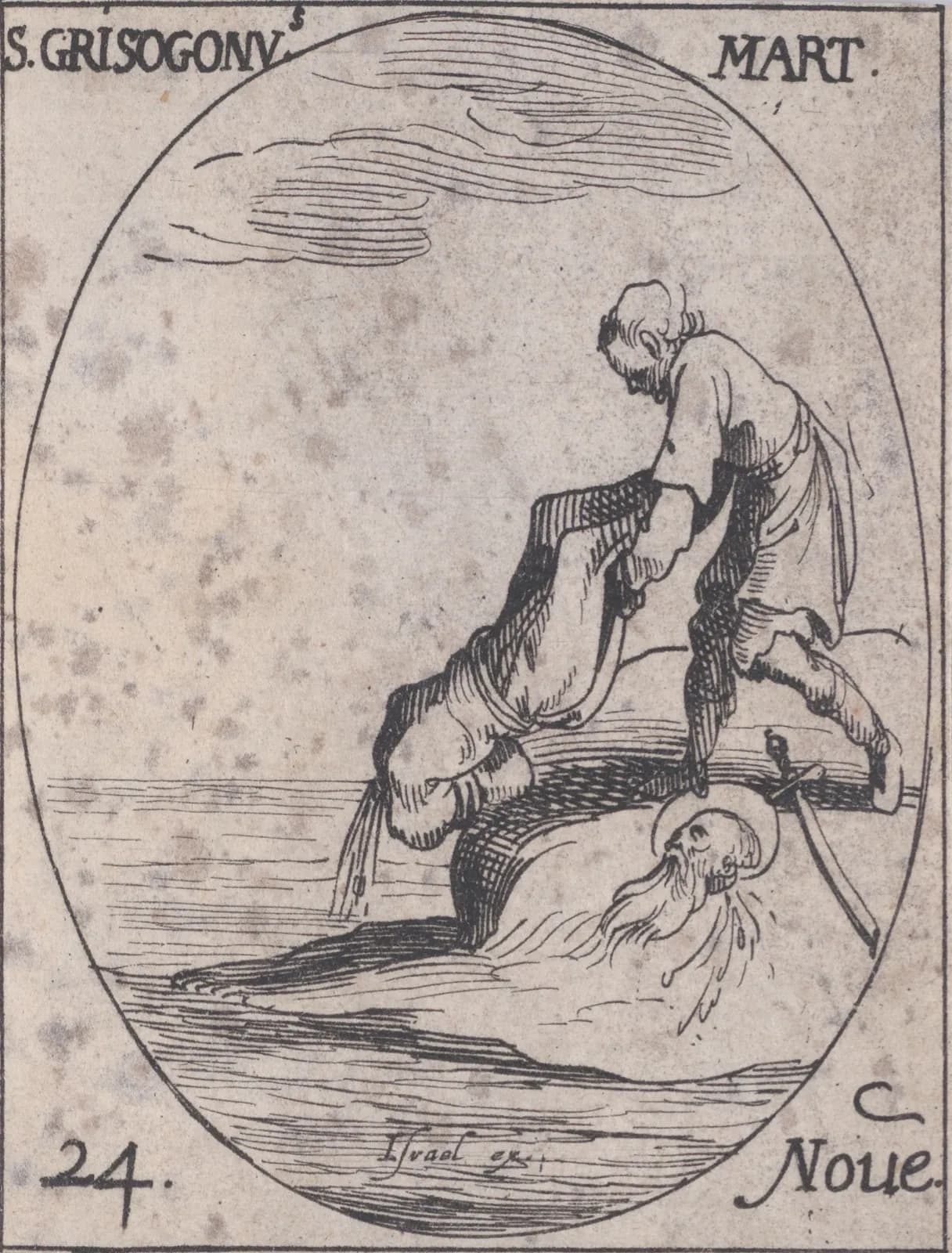
Saint Chrysogonus was a martyr of Aquileia in Friuli, who died probably in the persecution of Diocletian and was buried and venerated there. 14 His cult reached Rome very early: a church in Trastevere has carried his name since at least 499, and his name is said at Mass in the Roman Canon. 15 Nearly everything else told of him, including his friendship with Saint Anastasia, comes from a legend that J. P. Kirsch, in the Catholic Encyclopedia, dates to the sixth century and calls an attempt to explain that church. 1
What is known
Kirsch begins with what can be checked. Chrysogonus suffered at Aquileia, "probably during the persecution of Diocletian," was buried there, and was publicly venerated by the faithful of the region. 1 The so-called Hieronymian Martyrology, an early list of martyrs, names him twice, on May 31 and on November 24, with the note "in Aquileia." 1 Its Echternach manuscript has instead "Romae natale Crisogoni," his feast at Rome, and on November 23 he appears again among the Roman martyrs. 1
Vatican News, after setting out the different stories, comes to the same place: the one sure thing, it says, is that he was martyred for the Gospel by order of Diocletian at Aquileia, and it gives the year as 303. 6 Pius Parsch, quoted on Catholic Culture's page for his feast, gives about 304 and thinks he was probably a native of Aquileia. 5
The church in Trastevere
"Very early indeed," Kirsch writes, "the veneration of this martyr of Aquileia was transferred to Rome, where a titular church, in Trastevere, bears his name to this day." 1 The Titulus Chrysogoni first appears in the signatures of the Roman synod of 499, but Kirsch thinks it probably dates from the fourth century. 1 The Norwegian bishops' saints database (katolsk.no) adds that it is called the titulus Sancti Crisogoni in 521, that it was rebuilt several times, and that the first church was excavated early in the twentieth century, six meters below the floor of the present one. 3 It also says Pope Sylvester I built a church over his grave in the first half of the fourth century, which does not sit easily with Kirsch's burial at Aquileia. 13
Why a Roman church should carry the name of a martyr of Aquileia is the real puzzle. Kirsch gives two possibilities and does not choose. A man named Chrysogonus may have founded it, and because of the name the church was soon devoted to the martyr; or it may have been consecrated to the saint from the beginning "for some unknown reason." 1 In the same encyclopedia he notes that several other titular churches of Rome were named after their founders. 2 katolsk.no reports the first view as the opinion of some, and adds that a legend was then made to identify the founder with the martyr. 3
The current Roman Martyrology still keeps the two together. It commemorates Chrysogonus as a martyr at Aquileia, venerated at Rome in the titular church that bears his name on the anniversary of its dedication. 4 Parsch says that "great honor was paid Chrysogonus by the Church of Rome; his name was inserted in the Canon, and a station church in his honor was erected." 5 Catholic Culture's own summary for the day says simply: "His name occurs in the Canon of the Mass." 5
The legend of Chrysogonus and Anastasia
About the sixth century, Kirsch writes, there arose a legend that made Chrysogonus a Roman and joined him to Saint Anastasia, a martyr of Sirmium whose cult had also been carried to Rome, "evidently to explain the veneration of Chrysogonus in the Roman church that bears his name." 12 In the article on Anastasia he is blunter: "The whole account is purely legendary, and rests on no historical foundations." 2
In the legend Chrysogonus is a Roman official and the Christian teacher of Anastasia, daughter of the nobleman Praetextatus. 12 Thrown into prison in the persecution of Diocletian, he comforts her by letters. 1 katolsk.no says he had converted many to the faith, was her guide and spiritual father, and spent many months in wretched conditions in prison. 3 Parsch has him in prison two years, sustained by Anastasia, who visited the prisoners although her husband Publius made her suffer for her faith. 5
Vatican News gives a fuller version. It makes him a Roman soldier who became a Christian and a priest, and says that because he had served two years as vicar in Rome he was confined in the house of a nobleman, Rufinus, instead of being arrested, and that the whole household came to faith through him. 6 Anastasia, shut up in her own house for her faith, slipped out with the help of an old servant to bring food and comfort to the Christian prisoners, and began the correspondence in which Chrysogonus encouraged her. 6
Then the emperor summoned him to Aquileia. 12 Parsch gives the exchange in direct speech: Diocletian offered to "load you with honors provided you are willing to adore the gods," and Chrysogonus answered, "Only the true God will I adore." 5 Vatican News says he was offered the prefecture and the consulship to give up preaching and renounce his faith. 6 He refused and was beheaded. 156 Vatican News places the execution at Aquae Gradatae, on the Via Gemina, about twelve miles from the city. 6
His body was thrown into the sea, washed ashore, and was buried by an aged priest named Zoilus. 13 Parsch says Zoilus laid it in his house. 5 Vatican News adds that three Christian women, Chione, Agape and Irene, who lived nearby looking after Zoilus, recovered the body, and calls this part "una leyenda muy fantasiosa," a very fanciful legend. 6 The legend puts his death on November 23, Kirsch says; Parsch and Vatican News give November 24. 156
Two other stories
Vatican News reports two more identities. In one, Chrysogonus was a native of Aquileia and a friend of the brothers Cantius, Cantianus and Cantianilla, themselves martyrs under Diocletian. 6 In the other, he was bishop of Aquileia at the end of the third century and the beginning of the fourth. 6 It concludes plainly that the sources from which his life was put together do not agree, adding or leaving out details that cannot be reconciled. 6
Relics and images
katolsk.no says his relics came to Verona in the eleventh century, and that his head and one of his arms are kept in the Roman church and displayed above the high altar. 3 The seventeenth-century gilded ceiling there has a painting by Guercino of the triumph of Saint Chrysogonus. 3 In art he is usually shown as a young knight with lance and shield, the shield marked IHS. 3 Catholic Culture lists his emblems as Roman patrician's robes, a sword and a millstone. 5
What is Saint Chrysogonus the patron saint of?
None of the sources consulted names a patronage for Saint Chrysogonus. katolsk.no says his feast is kept chiefly in his church in Rome. 3
Saint Chrysogonus's feast day
Saint Chrysogonus's feast day is November 24. 134 The current Roman Martyrology commemorates him that day, which katolsk.no says is the anniversary of the dedication of his church in Rome. 34 The Greeks keep him on April 16. 13 katolsk.no adds that in 1969 his feast was removed from the Church's universal calendar and left to local and particular calendars. 3
Praying with Saint Chrysogonus
The record of Chrysogonus is mostly a list of things nobody knows. His office, his home, whether he taught Anastasia, even the day he died are all disputed. 16 What survives is a name, a city and a death: a Christian killed at Aquileia for his faith, and remembered there. 16
That was enough for the Church of Rome. It built or dedicated a church to him, put his name among the martyrs in the prayer at the heart of the Mass, and has said it there ever since. 15
His legend makes him a teacher who kept writing from prison to a Christian woman under pressure at home. 16 It may not be history, and Kirsch is sure it is not. 2 It is the story Rome told to account for the name in its Canon and on its church. 1
Saint Chrysogonus, pray for us.
Sources
- 1.J. P. Kirsch, "St. Chrysogonus," The Catholic Encyclopedia, Vol. 3 (New York: Robert Appleton Company, 1908).
- 2.J. P. Kirsch, "St. Anastasia," The Catholic Encyclopedia, Vol. 1 (New York: Robert Appleton Company, 1907).
- 3."Den hellige Krysogonus av Aquileia ( -~304)," Den katolske kirke (katolsk.no), Catholic Diocese of Oslo (in Norwegian).
- 4.Roman Martyrology, entry for November 24, "San Crisógono, martire," as printed in "Santo del giorno," Conferenza Episcopale Italiana (in Italian).
- 5."November 24," Liturgical Year calendar, Catholic Culture (Trinity Communications), with an excerpt from Pius Parsch, The Church's Year of Grace.
- 6."S. Crisógono, mártir de Aquileia," Santo del día, Vatican News, November 24 (in Spanish).
Saints to turn to next
Others in this collection who are turned to for some of the same things.