Saint Christina of Bolsena
d. early fourth century
- Died
- At Bolsena, on a July 24 between 303 and 309 1; other dates given are about 304 4, 297 5 and 250 7
Saint Christina of Bolsena was a young Christian girl martyred at Bolsena, on the lake of the same name north of Rome, in the persecution of the early fourth century. 14 Her tomb was found in 1880 in the catacomb beneath her basilica, and excavation showed that Christians had come to pray at it from the fourth century to the tenth. 2 The story of her many tortures is another matter: the Norwegian bishops' saints database judges it, like the very similar legend of Christina of Tyre, to be without historical value. 4
What the grave shows
Bolsena is the ancient Volsinii, and its see has been united with Orvieto "from time immemorial." 5 The written evidence for a Christian community there is late: the first sure notice of a bishop of Volsinii comes from 494. 2 The ground is older. Beside her church lies an ancient Christian cemetery, and early Christian inscriptions are, in the words of the 1911 Catholic Encyclopedia, "numerous at Bolsena." 5
In 1880 an excavation in the basilica, joined by Giovanni Battista de Rossi and other leading scholars, uncovered an early Christian burial ground, the martyr's original grave, and part of her relics inside the sarcophagus, which had been broken into. 2 It also found monuments showing that the place was visited for worship from the fourth century to the tenth. According to the basilica, it is this evidence that makes her historical existence certain. 2 Notre Dame's McGrath Institute puts it the same way: whatever the legends, "there is evidence that a maiden named Christina was martyred in Bolsena, Italy, and was venerated by Christians there as early as the fourth century." 8
Her name was also known far away. The basilica says that July 24 already carries her memory in the oldest martyrologies, and that the earliest surviving account of her passion is on a papyrus from Oxyrhynchus in Egypt, from the early fifth century. 2 By the mid-sixth century she was shown in the mosaics of Sant'Apollinare Nuovo in Ravenna, and oratories in her name stood near Saint Paul's in Rome and at Capena and Parma. 2
The legend
The basilica tells the story from her Passio. Christina was eleven or twelve, of the Roman family of the Anicii, and the daughter of Urbanus, prefect of Volsinii, whose duties included hunting down Christians. 1 Perhaps out of compassion for them, she came to know the Christian community and was baptized. Her father shut her up at home with statues of the gods and twelve girls of her own age to win her back. One night she broke the statues, took their gold and jewels, and gave them to the poor of the town. 1
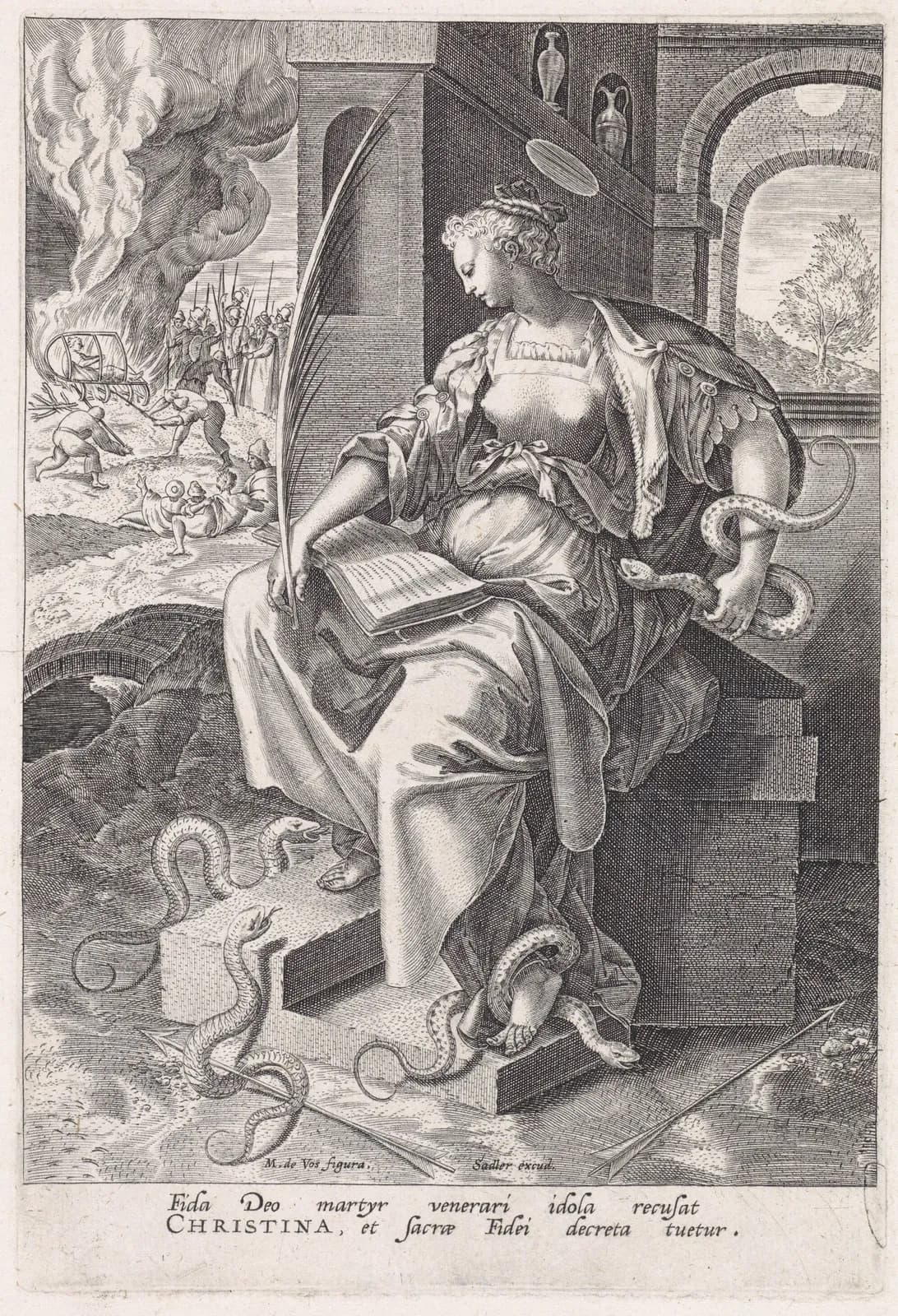
Her father had her whipped in public and tortured on a burning wheel. When that failed he had her tied to a stone and thrown from a boat into the lake, and then, says the basilica, his heart gave out and he died on the shore. 1 The Passio has the stone float up and carry her back to land like a boat. 1 A new governor, Dion, carried on: dragging, mutilation, boiling oil, five days in a furnace, a pit of venomous snakes, all of which she survived. At last she was killed in the arena, struck in the heart by arrows. 1
Les Petits Bollandistes, quoted by Catholic Culture, tell the same story with three persecutors, each succeeding the last, and place her death at Tyro, "a city which formerly stood on an island in the lake of Bolsena in Italy, but has since been swallowed up by the waters." 7 Notre Dame's summary is blunter: "we do not know that any of this story is true." 8
Two Christinas
katolsk.no explains why the story is so hard to trust. Her legend seems simply to be that of Saint Christina of Tyre in Phoenicia, imported from the Eastern Church and adapted to the lake. Both tell of survived tortures and supernatural events, and both, katolsk.no says, are without historical value. 4 It nonetheless judges it likely that the Christina of Tyre is the invention and the Christina of Bolsena the real woman, perhaps under another name. 4 The basilica notes that from the ninth century her passion was copied in hundreds of Greek and Latin versions, and influenced the stories of other virgin martyrs, among them Barbara and Catherine. 2
Her tomb and her relics
Her grave lay in the Christian cemetery outside the town, in the third corridor on the left of the catacomb. 1 A small grotto-church grew up around it soon after the persecutions ended, and a basilica rose nearby, perhaps as early as the end of the fourth century. 12 Standing on the Via Cassia, later the Via Francigena, the shrine became a fixed stop for pilgrims to Rome. The Icelandic abbot Nikulás, passing in 1154, wrote that the saint rested at Bolsena and that her footprints were marked on a stone. 2 katolsk.no says that stone, the one she was meant to be drowned with, is still kept in the church. 4
The relics did not stay put. The encyclopedia says her body was taken in the sixth century to the island of Martana in the lake, and "later returned to the city." 5 The basilica records traditions that her tomb was broken into in the eleventh and twelfth centuries and her relics carried off to Palermo, Sepino, Tuscania, Pisa and other places. 2 Les Petits Bollandistes say her relics "are now at Palermo," and katolsk.no that some are in the church of San Salvatore there. 47 What was left at Bolsena was found in 1880 and moved under the high altar after repeated attempts at theft. 24
Her church is also the site of the Eucharistic miracle of Bolsena. katolsk.no tells it: in 1263 a priest from Prague, troubled by doubts, saw the host bleed at the altar of her grotto, and the stained corporal was carried to Pope Urban IV at Orvieto. 4 The encyclopedia is skeptical, noting that Urban's bull establishing Corpus Christi never mentions it, and that the story "is not supported by strong historical evidence." 5
What is Saint Christina the patron saint of?
Saint Christina is the patron saint of Bolsena, and of archers, millers and sailors. 47 The basilica says these patronages grew up in the Middle Ages, when she was also invoked to drive out demons and to obtain the fruitfulness of people and of the land, and her image settled into its familiar form, with a millstone and arrows. 2 katolsk.no adds Palermo and Torcello near Venice. 4 She is painted with the instruments of her legend: arrows, a millstone, pincers, a knife, serpents and a wheel. 47
Saint Christina's feast day
Saint Christina's feast day is July 24. 36 katolsk.no says it has been kept on that day in the Roman missal since the eighth century, and that the 1969 reform left it to local calendars. 4 At Bolsena it is a solemnity. On the eve, Mass is celebrated at her tomb, decorated with flowers, a custom older than the 1880 excavation and one of the clues that led the archaeologists to dig near the apse. 3 That night and the next morning the town stages the "Mysteries of Saint Christina," living tableaux of her Passio on wooden stages in five squares, a tradition the basilica says has never been interrupted. 3
Praying with Saint Christina
Strip away the floating stone and the furnace, and the legend still has at its center a girl of about eleven who would not give up Christ and a father who would not give up his position. 1 Beneath the legend lies a grave her neighbors kept visiting for six hundred years. 2 The tortures could be multiplied in the retelling. The grave could not.
Bolsena has kept her the way a town keeps a daughter. Every July it carries her statue through the streets and acts out her story in silence on wooden stages, and the basilica speaks of her as belonging to her community almost to the point of identification. 3 Whatever the historians conclude, she has not been allowed to become a stranger there.
The basilica's own account pauses over her father as well as her: a man who may have been angry, and may have been afraid of what Rome would do to his whole family if he spared her. 1 It does not resolve the story into a lesson. A child chose, a parent chose, and one of them is remembered with flowers on her tomb every year.
Saint Christina of Bolsena, pray for us.
Sources
- 1."Santa Cristina," Basilica di Santa Cristina, Bolsena (sanctuary of the Diocese of Orvieto-Todi) (in Italian).
- 2."Origine e diffusione del culto," Basilica di Santa Cristina, Bolsena (in Italian).
- 3."La festa," Basilica di Santa Cristina, Bolsena (in Italian).
- 4."Den hellige Kristina av Bolsena ( -~304)," Den katolske kirke (katolsk.no), Catholic Diocese of Oslo (in Norwegian).
- 5.Umberto Benigni, "Orvieto," The Catholic Encyclopedia, Vol. 11 (New York: Robert Appleton Company, 1911).
- 6.Roman Martyrology, entry for July 24, "Santa Cristina, vergine e martire," as printed in "Santo del giorno," Conferenza Episcopale Italiana (in Italian).
- 7."July 24," Liturgical Year calendar, Catholic Culture (Trinity Communications), with an excerpt from Paul Guérin, Les Petits Bollandistes (1882).
- 8."St. Christina," Our Faith, McGrath Institute for Church Life, University of Notre Dame.
Saints to turn to next
Others in this collection who are turned to for some of the same things.