Saint Cataldus of Taranto
Sixth or seventh century
Saint Cataldus was an Irish monk and bishop, schooled at the great monastery of Lismore, who died at Taranto in the far south of Italy after a pilgrimage to Jerusalem and has been the city's patron ever since. 14 Taranto's cathedral is dedicated to him and keeps his tomb. 16 Nobody can say for certain which century he lived in, and his sources disagree about where he was bishop, how he reached Italy and when his grave was found. 24
Cathal of Lismore
Lismore, beside the river then called the Avonmore in what is now County Waterford, was founded by Saint Carthach in 635 and became, in the words of the 1910 Catholic Encyclopedia, "the greatest centre of learning and piety in all the South of Erin." 14 John Healy, who wrote that article, counts Cataldus as an even more famous saint and scholar than its founder. 1 His Irish name, Healy says, was Cathal, and he seems to have been born at a place called Rathan, not far from Lismore. 1
Healy is frank about where the story comes from. "Our Irish annals tell us nothing of St. Cathaldus," he writes, "because he went abroad early in life," and the particulars come instead from the brothers Morini of Taranto, his adopted home. 1 In their account he was a native of Ireland, born at Rathan; he studied at Lismore and "became bishop of his native territory of Rathan." 1 Catholic.net tells it a little differently. It has him born in Ireland at the beginning of the seventh century, a monk and then abbot of Lismore, and then chosen bishop of Rachau, which it places in what is now Austria. 4
The Roman Martyrology, in its current form, does not choose. It describes him as a bishop and a pilgrim who is believed to have come from Scotland. 3
Shipwrecked at Tarentum
In Healy's telling, Cataldus was "inspired by the love of missionary enterprise" and made his way to Jerusalem; on the voyage home he and his companions were wrecked at Tarentum, "at the heel of Italy." 1 The people there, Healy writes, had forgotten the Gospel preached to them by Saint Peter and Saint Mark and become "practically pagans." Cataldus preached with great fervor and worked many miracles, "so that the Tarentines gave up their sinful ways." 1
Catholic.net's version is quieter. He died at Taranto during a pilgrimage to the Holy Land, was buried in the cathedral, and was forgotten. 4 Taranto later took him for one of its own bishops, it adds, and even for its first bishop, ordained by Saint Peter himself, which Catholic.net calls a mistake. 4 Umberto Benigni's 1912 article on the Archdiocese of Taranto does not settle the matter. He records the local legend that Peter preached in the city and consecrated its first bishop, Amasianus, notes that the first bishop whose date is known is Innocentius in 496, and says only: "It is uncertain whether St. Cataldus belongs to the sixth or the seventh century." 2
The cross in the tomb
What fixed him in Taranto's memory was a grave. Healy says his tomb "was found intact in the cathedral as far back as the year 1110, with his name 'Cathaldus Rachan' inscribed upon a cross therein." 1 Catholic.net dates the discovery to 1094, during the rebuilding of the cathedral after the Saracens had destroyed it, and describes a gold cross engraved with his name and that of his see, kept ever since with the body. 4 It was that cross, Catholic.net says, that made it possible to place him in time at all. 4 Benigni records that the cathedral was built by Draco, archbishop from 1071. 2
From the tomb the cult spread through southern Italy and its islands, Catholic.net says, and in Ireland as well. 4 When John Paul II came to Taranto in October 1989, he spoke to the city about the majestic cathedral dedicated to its celebrated patron, one of the oldest and most famous in Apulia, and celebrated Mass on the anniversary of its consecration, noting that it is dedicated jointly to the Assumption and to Cataldus and has a chapel of its own for him. 56 He spoke of the archbishops of Taranto as the zealous bishops who had sat in the chair of Saint Cataldus. 5
A life in fourteen scenes
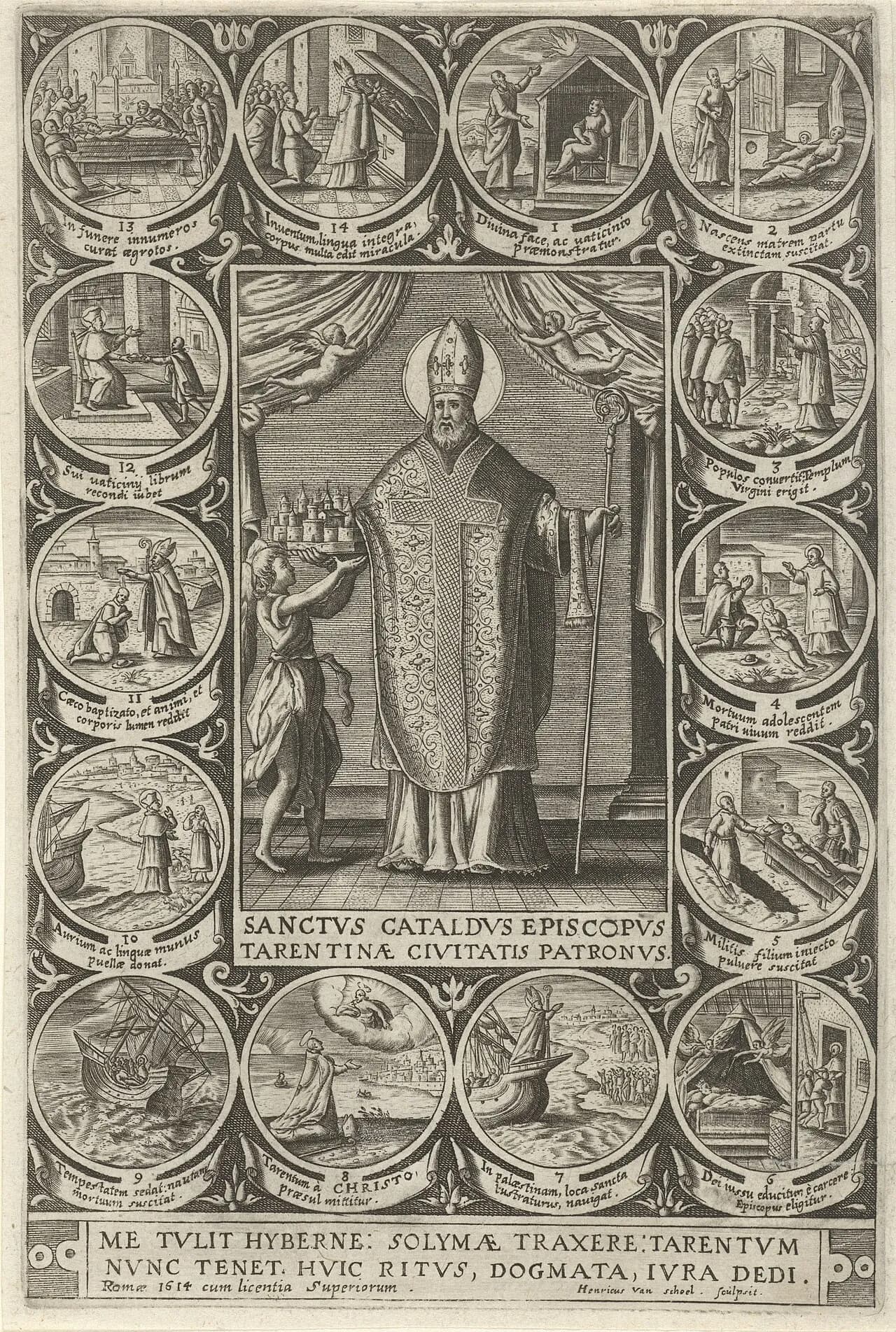
By the seventeenth century the legend had grown well beyond Healy's summary. An engraving made in Rome in 1614 by the printmaker Hendrick van Schoel, now in the Rijksmuseum, sets a standing figure of Cataldus as bishop and patron of Taranto inside a frame of fourteen numbered scenes. 7 Its captions, in Latin, tell the life in order. His birth is foretold by a divine light and a prophecy; as a newborn he raises his mother, who had died giving birth to him; he converts whole peoples and builds a church to the Virgin; he raises a dead youth and a soldier's son. 7 By God's command he is freed from prison and chosen bishop. He sails to Palestine to visit the holy places, and Christ sends him to Taranto as its bishop. 7 He calms a storm at sea, gives hearing and speech to a girl and sight to a blind man he has baptized, and at his funeral heals the sick in crowds. 7 The last scene is the finding of his body, its tongue still whole, and the miracles that followed. 7
A line beneath the figure, written as if in his own voice, sums up the career: Ireland bore him, Jerusalem drew him, and Taranto holds him now, and to Taranto he gave its rites, its doctrine and its laws. 7
What is Saint Cataldus the patron saint of?
Saint Cataldus is the patron saint of Taranto. Healy says the Tarentines "from that day to this have recognized the Irish Cathaldus as their patron saint, and greatly venerate his tomb." 1 John Paul II called him the city's celebrated patron in 1989 and, speaking to its priests, the patron of the archdiocese, much loved and honored by the whole community. 58 No source consulted names him patron of anything else.
Saint Cataldus's feast day
Praying with Saint Cataldus
John Paul II, speaking to the clergy of Taranto, chose the pilgrim. Cataldus's witness mattered, he said, because of his time in the land of Christ and his desire to relive the mysteries of Christ's life and retrace the history of his saving love. 8 The pope told the priests that they too were a people on pilgrimage in the footsteps of Saint Cataldus, and that like the old pilgrims who saw the places where the Son of God lived and came home as missionaries, they had to tell the next generation that Jesus is risen. 8
The uncertainty is part of the picture, and none of the sources hides it. Healy knew that the Irish annals were silent and said so. 1 Benigni would not commit to a century. 2 Catholic.net says outright that Taranto gave him a past that was not his. 4 What survives the doubt is a stranger from the far end of Europe who reached a city that was not his and was buried there, and a city that took him for its own. 14
In Healy's version he went looking for Christ in Jerusalem and found his work, and his grave, on the way home. 1 In Catholic.net's he found only the grave. 4 Either way, Taranto has been asking for his prayers since the tomb was opened more than nine hundred years ago, and in 1989 a pope told its priests that they walk in his footsteps. 148
Saint Cataldus of Taranto, pray for us.
Sources
- 1.John Healy, "School of Lismore," The Catholic Encyclopedia, Vol. 9 (New York: Robert Appleton Company, 1910).
- 2.Umberto Benigni, "Taranto," The Catholic Encyclopedia, Vol. 14 (New York: Robert Appleton Company, 1912).
- 3.Roman Martyrology, entry for May 10, "San Cataldo, vescovo e pellegrino," as printed in "Santo del giorno," Conferenza Episcopale Italiana (in Italian).
- 4."Cataldo de Rachau, Santo," Catholic.net (in Spanish).
- 5.John Paul II, Address to the people of Taranto, October 28, 1989 (in Italian).
- 6.John Paul II, Homily at Taranto, October 29, 1989 (in Italian).
- 7.Hendrick van Schoel, "St. Cataldus van Tarente," engraving, Rome, 1614, object RP-P-1964-2983, Rijksmuseum, Amsterdam (catalog record and image).
- 8.John Paul II, Address to the priests of the Archdiocese of Taranto, October 29, 1989 (in Italian).
Saints to turn to next
Others in this collection who are turned to for some of the same things.