Saints Boris and Gleb
d. 1015
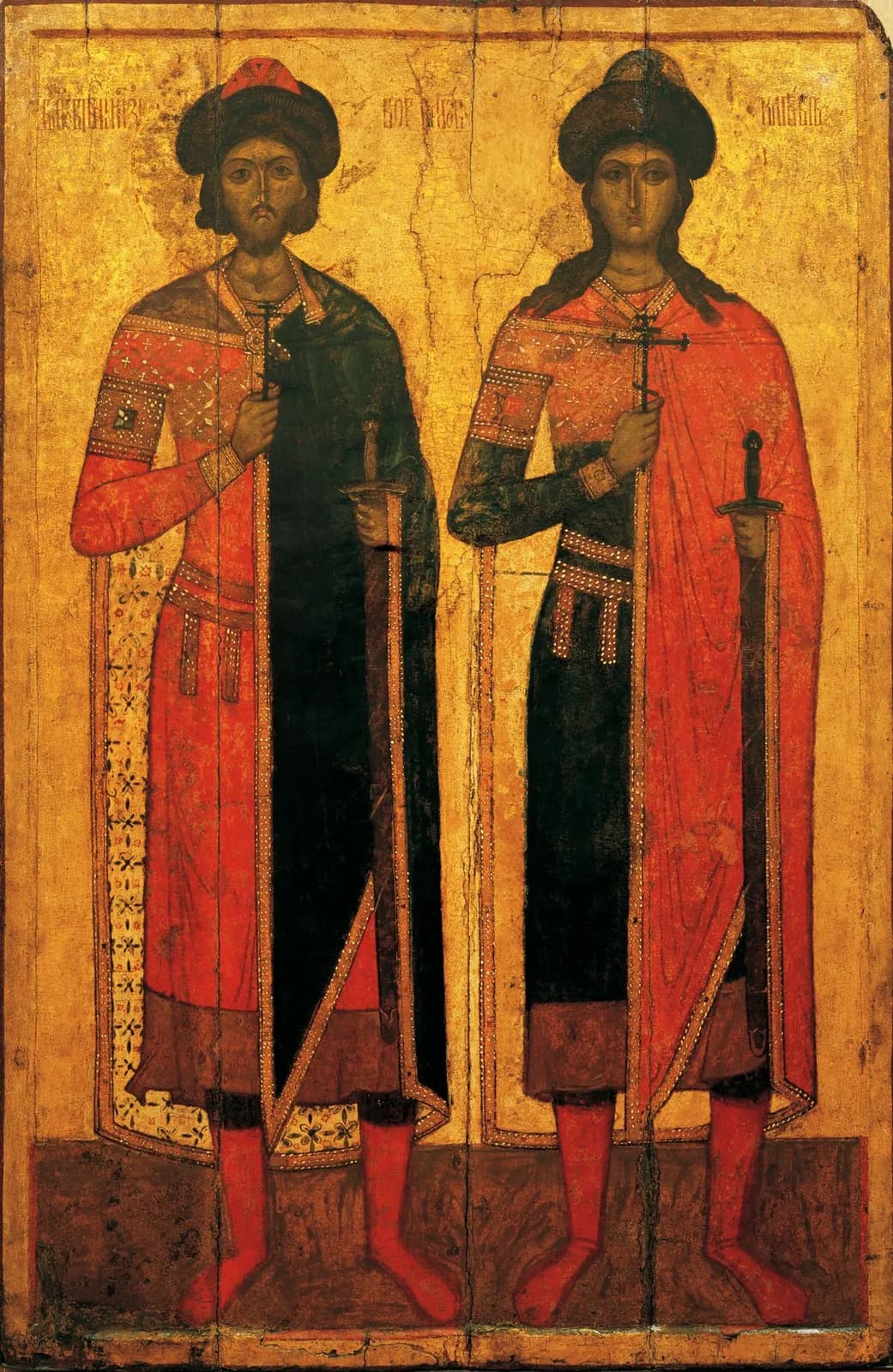
- Baptismal names
- Roman and David 2; the Toronto cathedral's page gives Boris as David and Gleb as Roman 5
- Buried
- Vyshhorod, near Kiev 5
Saints Boris and Gleb were two sons of Saint Vladimir, the prince who brought Christianity to Kiev, and they were killed in 1015 by men sent by their elder brother Sviatopolk. 14 The Roman Martyrology says they chose to die rather than resist him by force. 1 They were the first saints canonized in Kievan Rus', and the Ukrainian Greek Catholic Church still keeps them every July 24. 4
Sons of Vladimir
Their father had been a pagan chieftain with several wives, and Shipman, in the 1912 Catholic Encyclopedia, counts ten sons and two daughters from those marriages. 2 After his baptism in 988 Vladimir married the Byzantine princess Anna and put the other wives away. 2 Shipman writes that Vladimir's wife died in 1011, "having borne him two sons, Boris and Glib (also known as Sts. Roman and David, from their baptismal names)." 2 The page on the website of St. Volodymyr Cathedral in Toronto, a Ukrainian Greek Catholic parish, reverses the names, making Borys David and Hlib Roman, and says only that their mother was a Christian from Bulgaria. 5
Vladimir divided his lands among his sons. 25 The Martyrology calls both brothers princes of Rostov; the cathedral's page gives Rostov to Borys and Murom to Hlib, both near modern Moscow, and says that both worked to spread the faith among the pagans there. 15 Hlib, it adds, has been remembered ever since in the country around Murom and Ryazan as its first preacher of Christianity. 5
Vladimir's last years were troubled by his sons. Shipman tells how Yaroslav, who held Novgorod, refused his father tribute, and how Vladimir died in 1015 on his way north to bring him to heel. 2
Boris on the Alta
Sviatopolk took Kiev at once, and, afraid of his brothers as rivals, decided to kill them. 5 Borys was in the field with his father's troops by the Alta River, the cathedral's account goes, and his men urged him to march on Kiev and take the throne. 5 He refused to break faith with his brother. 5 Sviatopolk wrote to him with news of their father's death and a promise of more land, and sent killers at the same time. 5
They came at night and heard him singing psalms in his tent, so they waited until he lay down. 5 Then they ran him through with spears, along with a Hungarian servant named George who threw himself across his master. 5 Borys was still breathing when they wrapped him in canvas and carried him to Sviatopolk, who sent two Varangians to finish him with a sword. 5 His body was taken secretly to Vyshhorod, outside Kiev, and buried in the Church of Saint Basil. 5
The Martyrology places his death on the river Don near Pereyaslavl. 1 The cathedral's account, followed here, places the camp by the Alta. 5
Gleb near Smolensk
Gleb was next. Sviatopolk sent word asking him to come to their father, who he said was gravely ill. 5 Hlib was near Smolensk when he learned what his brother had done, and he wept and prayed for his father and for Borys. 5 The leader of the killers, a man named Goriaser, ordered Hlib's own cook, Torchin, to kill him. 5 The cathedral's page dates his death September 18, 1015. 5 The Martyrology says he died soon after Boris, on the river Dnieper near Smolensk. 1
Neither brother fought. The Parma eparchy, a diocese of the Ukrainian Greek Catholic Church in the United States, writes that their memory "captured the imagination" of the people of Kievan Rus', "in large measure because of accounts of the calmness and resignation with which they had accepted their deaths." 4 The account of their murders, the Tale and Passion and Glorification of the Holy Martyrs Borys and Hlib, is one of the oldest monuments of Ukrainian literature. 4
Vyshhorod and the canonization
Their brother Yaroslav, Prince of Novgorod, went to war with Sviatopolk and, the Parma eparchy says, presented the war as vengeance for the murders. 4 When he took Kiev in 1019, the cathedral's page continues, he found Hlib's body and buried it at Vyshhorod beside Borys, and miracles began at the tomb. 5 When the church burned, the relics were moved into a new one built in their honor, and the account says that Metropolitan John, opening the tombs, found the bodies white as snow and fragrant. 5 They were moved again in 1072, and in 1115 into a stone church at Vyshhorod; after the Mongols sacked Kiev in 1240, nobody knows where they went. 5
The sources date the canonization differently. Katolsk.no, the site of the Catholic Diocese of Oslo, says that Boris and Gleb were the first saints officially canonized by the Church in Rus', ahead of their father and their great-grandmother Olga, and that Metropolitan John I, who held the see from 1019 to 1035, canonized them. 7 The Parma eparchy says that Yaroslav sought the canonization once he came to power and that it was finally realized about 1068. 4
John Paul II, writing in 1988 for the thousandth anniversary of the baptism of Kievan Rus', saw them behind something larger. The Eastern Slavs, he wrote, have a characteristic devotion to Christ's Passion and a sensitivity to the mystery of suffering, and "Perhaps not unrelated to the growth of this kind of spirituality was the memory of the innocent death of Boris and Gleb, Vladimir's sons, killed by their brother Svyatopolk." 3
What are Saints Boris and Gleb the patron saints of?
None of the sources read for this page names a patronage for Saints Boris and Gleb, and so none is given here. 145 What they do record is the title the Eastern churches give them. They are called passion-bearers, the Toronto cathedral's page explains, "since they did not resist evil with violence." 5 The cathedral adds that a great many of the oldest monasteries and parish churches of Ukraine and Russia are dedicated to them. 5
Saints Boris and Gleb's feast day
The feast of Saints Boris and Gleb is July 24. The current Roman Martyrology enters them on that day, and the Parma eparchy notes that the Ukrainian Catholic Church keeps it on July 24. 14 In 2025 Metropolitan Borys Gudziak celebrated the feast on July 24 in the Church of Saints Borys and Hlib at Senlis, in France, a church he had bought in 2013 while he was serving as bishop there. 6
The Toronto cathedral's page gives August 6 instead, and says that Yaroslav and Metropolitan John set the feast on the day of Borys's death, which was also the day the new church was consecrated. 5 The thirteen days between the two dates are the gap that katolsk.no notes, for Saint Olga, between the old calendar and the new. 7
Praying with Saints Boris and Gleb
Nobody asked Boris to deny Christ. His brother wanted the throne, and Boris had an army that could have taken it. 5 He refused, as the story is told, and sang psalms in his tent until the men came. 5 It is a strange kind of martyrdom, and the Eastern churches found a name of its own for it: passion-bearers, those who did not resist evil with violence. 5
Metropolitan Borys, preaching on their feast, called them "not martyrs for the faith, but martyrs for brotherly love, who bore radical witness to God's love." 6 He set them against their father's world: a pagan conqueror who met the Gospel late, with no record of how, and two sons who were "so captivated by the faith that they followed Christ radically." 6 He told his listeners that the feast is "a testimony to the freshness of experiencing the Gospel in a pagan context," and he said that today's world is once again pagan. 6
Their story does not end well in any worldly sense. They were killed by their own brother's men, one at the hands of his own cook, and the brother who avenged them did it with a war. 45 What the Eastern Slavs took from them, John Paul II suggested, was a way of looking at suffering through the Cross. 3 The Parma eparchy writes that they have remained popular figures in Ukrainian religious thought. 4
Saints Boris and Gleb, pray for us.
Sources
- 1.Roman Martyrology, entry for July 24, "Santi Boris e Gleb, martiri," as printed in "Santo del giorno," Conferenza Episcopale Italiana (in Italian).
- 2.Andrew Shipman, "St. Vladimir the Great," The Catholic Encyclopedia, Vol. 15 (New York: Robert Appleton Company, 1912).
- 3.John Paul II, Euntes in mundum, apostolic letter for the millennium of the baptism of Kievan Rus', January 25, 1988, English translation as published by Catholic Culture.
- 4."Saints Borys and Hlib," St. Josaphat Ukrainian Catholic Eparchy of Parma.
- 5."Saints of Ukraine: Sts. Borys and Hlib," St. Volodymyr Ukrainian Catholic Cathedral, Toronto, after S. V. Bulgakov, Handbook for Church Servers (Kharkov, 1900), translated by Eugene D. Tarris.
- 6."Metropolitan Borys Celebrates Divine Liturgy in Senlis on the Feast of Saints Borys and Hlib," Ukrainian Greek Catholic Church, July 26, 2025.
- 7.Per Einar Odden, "Den hellige Olga av Kiev (~879-969)," katolsk.no, the Catholic Diocese of Oslo (in Norwegian).
Saints to turn to next
Others in this collection who are turned to for some of the same things.