Saint Boniface I
Died September 4, 422
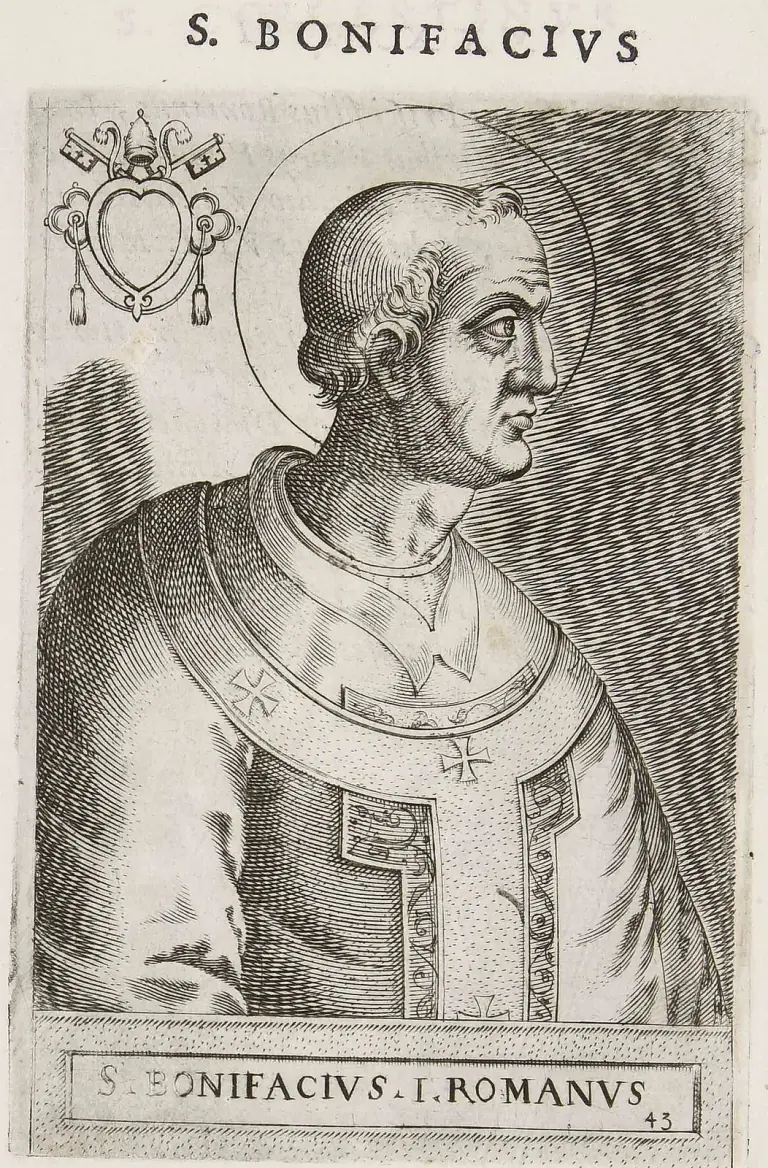
Saint Boniface I was bishop of Rome from 418 to 422, an elderly Roman priest chosen against his will on the day after a faction of deacons had already elected a rival. 14 For months two men claimed to be pope, until the emperor Honorius recognized Boniface and passed a law meant to keep it from happening again. 1 His feast in the current Roman Martyrology is September 4, the day he died; older calendars kept him on October 25. 236
An old priest of Rome
Little is known of Boniface before 418. The Liber Pontificalis, the ancient register of the popes, calls him a Roman and the son of a priest named Iocundus. 4 J.B. Peterson, writing in the Catholic Encyclopedia in 1907, adds that he is believed to have been ordained by Pope Damasus I and to have represented Pope Innocent I at Constantinople around 405. 1 The Norwegian bishops' saints database (katolsk.no) says he was a leading priest of Rome whom Innocent entrusted with important missions to Constantinople. 2
By the time Pope Zosimus died, at the end of December 418, Boniface was old. Peterson describes him as "a priest highly esteemed for his charity, learning, and good character." 1
Two popes in one week
The sources differ by a day on how the week began. katolsk.no has Zosimus dying on December 26 and a faction of deacons, with a few priests, shutting themselves into the Lateran basilica and electing the archdeacon Eulalius on the 27th. 2 Peterson and Loomis's notes to the Liber Pontificalis put Zosimus's funeral on the 27th and the seizure of the Lateran on the same day, as the deacons returned from it. 14
The next day the majority of the priests met in the church of Theodora and elected Boniface, in Peterson's words "much against his will." 1 Loomis has it more plainly: they chose him "in spite of his own protests." 4 Both men were consecrated on Sunday, December 29. Eulalius was ordained in the Lateran by the bishop of Ostia, who had been brought from his sickbed for it; Boniface, Peterson says, in the basilica of St. Marcellus, with nine bishops and some seventy priests. 1 The Liber Pontificalis puts Boniface's ordination in the basilica of Julius, but Loomis notes that this is a mistake: an eyewitness names the church of Marcellus. 4
Rome now had two popes, and the city filled with their partisans. 1 The prefect of the city, Symmachus, was against Boniface; katolsk.no adds that he was a pagan. His report to the emperor Honorius at Ravenna won imperial approval for Eulalius, and Boniface was ordered out of the city. 12 He went, katolsk.no says, under protest. 2
The emperor decides
The clergy of Rome who supported Boniface wrote to Honorius, and the emperor called both claimants before a synod of Italian bishops at Ravenna in February and March of 419. 12 It could not decide. 1 A larger council, with bishops from Gaul and Africa as well, was to meet later that spring, in May by Peterson's account, at Spoleto on June 13 by katolsk.no's. 12 Until then both men were to keep out of Rome, and Achilleus, bishop of Spoleto, was sent to celebrate Easter, which fell that year on March 30. 14
Boniface waited outside the walls, at the cemetery of Saint Felicitas on the Via Salaria, according to the Liber Pontificalis; Eulalius was sent to Antium. 4 Peterson accepts the story with an "it seems," while Loomis notes that it may be legend, suggested by the oratory Boniface later built there. 14
Eulalius did not wait. He came back into Rome on March 18, gathered his supporters, and as Easter approached seized the Lateran again, meaning to preside at the feast himself. 1 Troops had to remove him so that the bishop of Spoleto could celebrate. 14 Honorius would hear no more of his claim. On April 3, 419, the emperor recognized Boniface as bishop of Rome, and on April 10 Boniface entered the city to the acclamation of the people. 12
Peterson reckons the schism at fifteen weeks; Loomis at a little over three months. 14 The Liber Pontificalis says the dissension lasted seven months and fifteen days. 4 Eulalius was given a see, either Nepi or one in Campania; the two versions of the Liber Pontificalis disagree. 14
A law for the next election
Early in 420 Boniface fell seriously ill, and Eulalius's supporters began to stir again. 1 When he recovered he asked the emperor, on July 1, 420, to make some provision against a new schism after his death. 1 Honorius answered with a law: in a contested election neither claimant would be recognized, and a new election would be held. 14 katolsk.no calls it the first attempt to make rules for electing a pope, and says it had no practical effect. 2
Gaul, Africa and Illyricum
Once secure, Boniface spent his short reign on the discipline of the Church. 13 His predecessor had made Patroclus, bishop of Arles, a kind of papal vicar over the provinces of southern Gaul. Boniface undid this and gave the metropolitan bishops back their old rights. 12
From Africa he inherited the case of Apiarius, a deposed priest whom Zosimus had wanted restored. 12 On May 31, 419, the Council of Carthage wrote to Boniface that it could not find among the canons of Nicaea the rules that Zosimus's legates had quoted, which later proved to be canons of Sardica, but that it would keep them until they were checked. 1 Peterson quotes the judgment that the letter "was written in considerable irritation, yet in a studiously moderate tone." 1
In 422 Boniface heard the appeal of Anthony of Fussala, a bishop deposed in Numidia through the efforts of Saint Augustine. Peterson says the pope decided he should be restored if his innocence were established. 1 katolsk.no is harder on Boniface, calling it an indiscretion: he sent Anthony back to Africa with orders that he be reinstated, without having tried the case. 2
In the East, the young emperor Theodosius II issued a law on July 14, 421, placing the churches of Illyricum under the patriarch of Constantinople. 12 Boniface protested to Honorius and persuaded him to urge Theodosius to withdraw it. 1 The law was never enforced, but it stayed in the imperial codes and, in Peterson's words, "caused much trouble for succeeding popes." 12 By a letter of March 11, 422, Boniface forbade the consecration of any bishop in Illyricum whom Rufus, bishop of Thessalonica and the pope's vicar there, did not recognize. 1
Boniface and Augustine
Two letters written by Pelagians had reached Boniface, and both attacked Augustine by name. 15 Boniface gave them to Augustine's friend Alypius, then in Rome, to carry back to Africa. 5 Augustine answered them in four books, Against Two Letters of the Pelagians, and dedicated the work to the pope. 15 katolsk.no adds that Boniface persuaded Honorius to require every bishop to sign the condemnation of Pelagianism issued by Zosimus. 2
The dedication is warm. Augustine had known Boniface only by reputation until Alypius met him: "the more assured was your friendship, the greater became in me the conviction of your holiness. For you, who mind not high things, however loftily you are placed, did not disdain to be a friend of the lowly and to return the love bestowed upon you." 5 He thanks the pope for passing on letters in which he had found his own name "calumniously as well as openly expressed," and he sends the books "not so much for your learning as for your examination and, if perchance anything should displease you, for your correction." 5
Felicitas, and his death
Boniface also renewed an old rule that women should not touch the sacred linens or minister at the burning of incense, and he enforced the laws against ordaining slaves. 14 At the cemetery of Saint Felicitas on the Via Salaria, the place where he had waited out the schism, he built an oratory near the martyr's tomb. 24 Peterson calls Felicitas his favorite saint and says he built it in gratitude for her help. 1
Boniface died on September 4, 422. 127 He was buried on the Via Salaria near the tomb of Felicitas, in the cemetery of Maximus. 13 The Liber Pontificalis gives him a reign of three years, eight months and six days. 4
What is Saint Boniface I the patron saint of?
Saint Boniface I's feast day
Saint Boniface I's feast day is September 4, the day of his death. The Roman Martyrology, as the Italian bishops print it, enters him on that date: at Rome, in the cemetery of Maximus on the Via Salaria, the burial of Saint Boniface I, pope, who resolved many controversies of church discipline. 3 katolsk.no gives September 4 as well. 2
Older books have a different day. Peterson wrote in 1907 that "the Church keeps his feast on 25 October," and the 1897 English edition of the Martyrology has "At Rome, of St. Boniface, pope and confessor" under that date. 16 The Liber Pontificalis records his burial under October 25. 4 katolsk.no notes that October 25 was his former day. 2
Praying with Saint Boniface I
Boniface did not want to be pope. He was old, he protested, and the priests elected him anyway. 14 What followed was nothing he had chosen: a rival consecrated the same morning, a prefect working against him, an order from the emperor to leave his own city. 12
He left. He waited outside the walls while the bishops argued, and the man who would not wait was the one who lost. 14 Afterward, when an illness made him think about his own death, his concern was that the Church of Rome not go through the same thing again. 1
The best portrait of him comes from someone else. Augustine, who knew him through a friend, thanked him for not disdaining "to be a friend of the lowly," and asked him to correct anything in his books that displeased him. 5 Boniface had sent Augustine the letters that slandered him. 15
He built a chapel at the grave of Saint Felicitas, near the place he had waited, and he was buried beside her. 14
Saint Boniface I, pray for us.
Sources
- 1.John Bertram Peterson, "Pope St. Boniface I," The Catholic Encyclopedia, vol. 2 (New York: Robert Appleton Company, 1907).
- 2."Den hellige pave Bonifatius I ( - 422)," Den katolske kirke (katolsk.no), Catholic Diocese of Oslo (in Norwegian).
- 3.Roman Martyrology, entry for September 4, "San Bonifacio I, papa," Santo del giorno, Conferenza Episcopale Italiana (in Italian).
- 4.The Book of the Popes (Liber Pontificalis), I: To the Pontificate of Gregory I, translated with an introduction and notes by Louise Ropes Loomis (New York: Columbia University Press, 1916), chapter XLIV, "Boniface I."
- 5.Saint Augustine, Against Two Letters of the Pelagians, Book I, chapters 1-3, translated by Peter Holmes and Robert Ernest Wallis, revised by Benjamin B. Warfield, Nicene and Post-Nicene Fathers, First Series, vol. 5 (Buffalo: Christian Literature Publishing Co., 1887), as hosted by New Advent.
- 6.The Roman Martyrology, October 25 (Baltimore: John Murphy Company, 1897).
- 7."Boniface I," The Supreme Pontiffs, The Holy See.
Saints to turn to next
Others in this collection who are turned to for some of the same things.