Saint Birinus
c. 600 - December 3, c. 650
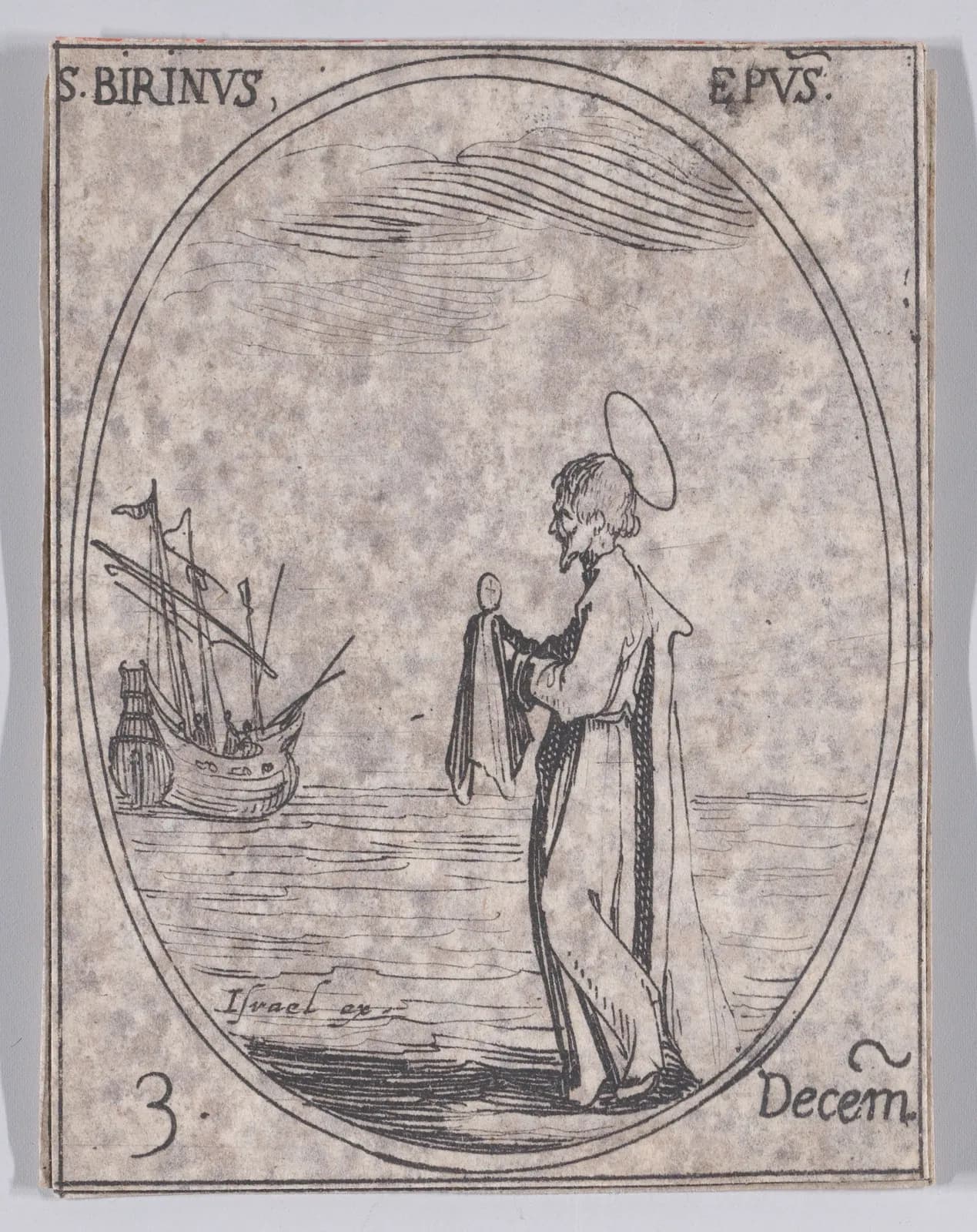
Saint Birinus was the bishop who brought Christianity to the West Saxons. 13 Sent from Italy by Pope Honorius I to preach in the unevangelized heart of England, he landed in 634, found the people of Wessex "most confirmed pagans," and stayed with them instead. 12 He baptized their king, Cynegils, with the saintly King Oswald of Northumbria standing as godfather, and from his see at Dorchester-on-Thames he worked among them until his death about 650. 123
Sent from Rome
Almost nothing is known of where Birinus came from. The 1907 Catholic Encyclopedia gives his date of birth as unknown. 2 The Norwegian bishops' saints database suggests he was born about 600, probably in France or perhaps in Lombardy, and that his name may point to Germanic descent; he is usually described as a Benedictine of the monastery of Saint Andrew in Rome. 3
Bede says he came to Britain "by the advice of Pope Honorius," having promised in the pope's presence "that he would sow the seed of the holy faith in the inner parts beyond the dominions of the English, where no other teacher had been before him." 1 On the way he was consecrated a bishop. Bede and the encyclopedia name the consecrating bishop as Asterius of Genoa; katolsk.no calls him Archbishop Asterius of Milan, consecrating at Genoa. 123 katolsk.no points out that it is not clear why the pope sent a bishop from Italy independently of the church already set up from Canterbury, and that there is no record of any contact between Birinus and Canterbury. 3
The conversion of Wessex
He landed in 634 and meant to go on into the Midlands. 23 But he first came among the Gewissae, the West Saxons, and "finding all there most confirmed pagans, he thought it better to preach the word of God there, than to proceed further to seek for others to preach to." 1 King Cynegils let him preach throughout the kingdom, though it took some time before the king himself was fully converted. 3
Politics helped. Cynegils wanted an alliance with Oswald of Northumbria, the most powerful king of the day, against the Mercians, and Oswald, a Christian, would not ally himself with a pagan. 3 In 635 Cynegils was baptized with his people. 12 Bede tells it with feeling: Oswald, "the most holy and victorious king of the Northumbrians," was there, received Cynegils "as he came forth from baptism," adopted him as his godson, and then married his daughter. 1 The encyclopedia names the daughter, with a question mark, as Cyneburga, and says Oswald's presence "doubtless" helped Birinus in his first conquests. 2
Others followed. Birinus converted the king's son Cwichelm in 636, and Cwichelm's son Cuthred in 639. 23 Many people were baptized by him in his fifteen years in Wessex, and he came to be called its apostle. 3
Bishop of Dorchester
The two kings gave him the city of Dorcic, Dorchester-on-Thames, as his see. 1 The encyclopedia is careful to say this is the Dorchester in what is now Oxfordshire, then the capital of Wessex, and not Dorchester in Dorset. 2 katolsk.no describes it as a thriving Romano-British town on a road and a river, in the middle of dense Anglo-Saxon settlement, and says his first cathedral was a small wooden church. 3 There, in Bede's words, "having built and consecrated churches, and by his labor called many to the Lord, he departed this life, and was buried in the same city." 1
Cynegils died in 642. katolsk.no says his successor, Cenwalh, invited Birinus to establish an important church at Winchester, and that Birinus consecrated a cathedral there in 648, near the end of his life. 3 Several churches in the old Wessex claim him as founder, but katolsk.no says none can be shown to be his with certainty. 3 He died at Dorchester, by tradition on December 3, about 650. 23
The corporal on the water
One story about him has stayed attached to his name. Pope Honorius had given him a corporal, the linen cloth used at Mass, in which he always carried the Blessed Sacrament. 23 According to the account, he walked on the sea to fetch it. 23 The encyclopedia tells the story as showing his "great devotion for the Body of Our Lord," and notes that a writer named Field dismissed this and the other miracles as allegory or invention, while allowing that the chroniclers had drawn on some common source now lost. 2 It is the scene Jacques Callot chose for him in 1636, in the etching at the top of this page.
His relics and his cult
Bede says that "many years after, when Hedda was bishop," his body was moved from Dorchester to Winchester and laid in the church of the apostles Peter and Paul. 1 The encyclopedia dates that translation to 680, katolsk.no to about 690. 23 On September 4 Bishop Ethelwold enshrined the relics in silver and gold, in 972 according to the encyclopedia and in 980 according to katolsk.no. 23 Henry of Blois moved them to a new tomb in 1150. 3
Dorchester did not give him up easily. Early in the thirteenth century the Augustinian canons there claimed to have his relics; an inquiry in 1224, ordered by Pope Honorius III, came to nothing, and katolsk.no says the body shown at Dorchester was certainly not his. Pilgrims nonetheless visited both tombs. 3 The fourteenth-century shrine at Dorchester has recently been restored. 3 The encyclopedia records that "many miracles took place at the discovery of Birinus's relics." 2
His cult centered on Winchester, Dorchester and Abingdon, and the earliest evidence for it is a Winchester calendar of the late ninth century. 3 His name entered the Roman Martyrology late in the sixteenth century. 3 The Catholics of Dorchester built a chapel in his honor in 1849, and a village near Dorchester, Berinsfield, is named after him. 23
What is Saint Birinus the patron saint of?
Saint Birinus's feast day
Saint Birinus's feast day is December 3, the day of his death. The Roman Martyrology records on that day the deposition of Saint Birinus at Winchester, the first bishop of Dorchester, sent by Pope Honorius, who spread the message of salvation among the West Saxons. 4 katolsk.no gives the same date, notes that December 5 is also found, and adds a feast of his translation on September 4. 3 It also says his feast was not in the Sarum calendar and was less widely kept than he deserved. 3
Praying with Saint Birinus
He set out with a plan and a promise to the pope, to go where no one had preached, and he changed the plan at the first landfall. 1 The people where he landed needed the Gospel as much as the people he had meant to reach. 1 He spent the rest of his life on the work that was in front of him.
The conversion of Wessex was tangled up with an alliance and a royal marriage, and Bede does not hide it. 1 He still calls Oswald's part in it "most pleasing and acceptable to God." 1
Whatever happened on the water, the story of the corporal remembers a man who kept the Blessed Sacrament close to him on his travels and would not be parted from it. 23 He gave fifteen years to the West Saxons and was buried among them. 13
Saint Birinus, pray for us.
Sources
- 1.Bede, Ecclesiastical History of the English People, Book III, chapter 7, Internet Medieval Sourcebook, Fordham University.
- 2.Charles Kimball, "St. Birinus (Berin)," The Catholic Encyclopedia, Vol. 2 (New York: Robert Appleton Company, 1907).
- 3."Den hellige Birinus av Dorchester (~600-~650)," Den katolske kirke (katolsk.no), Catholic Diocese of Oslo (in Norwegian).
- 4.Roman Martyrology, entry for December 3, "Deposizione di san Birino," as printed in "Santo del giorno," Conferenza Episcopale Italiana (in Italian).
Saints to turn to next
Others in this collection who are turned to for some of the same things.