Saint Bernardino Realino
December 1, 1530 - July 2, 1616
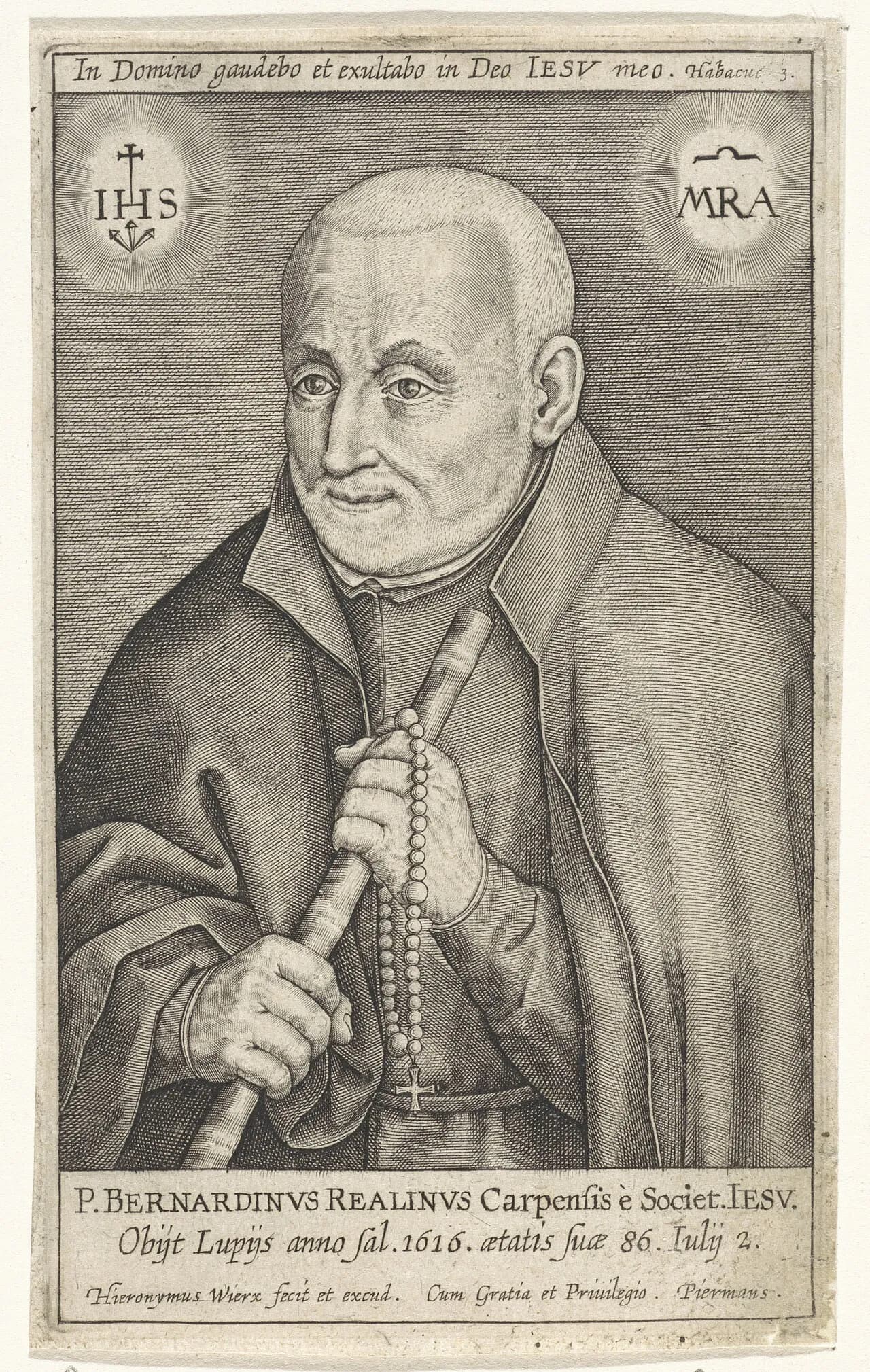
- Before the Jesuits
- Doctor of civil and canon law; podestà (mayor and judge) of Felizzano, Cassine and Castelleone 14
- Religious order
- Society of Jesus, entered October 13, 1564; ordained May 24, 1567 1
- Beatified
- September 27, 1895, by Leo XIII 4
- Patron saint of
- Lecce; secondary patron of the city and Diocese of Carpi; co-patron of the parish of Castelleone 345
- Relics
- The church of the Gesù, Lecce 5
Saint Bernardino Realino was a lawyer and magistrate from Carpi who walked away from a promising public career at thirty-four, became a Jesuit in Naples, and then spent forty-two years in one city, Lecce, hearing confessions, visiting prisoners and the sick, and teaching priests. 14 As he lay dying in 1616, the city's magistrates came to his bed to ask him to be Lecce's patron in heaven. 1 He is one of very few saints a city chose while he was still alive. 35
A student with a temper
He was born at Carpi on December 1, 1530, into a family of the local nobility. 4 Pius XII, addressing the pilgrims who came to Rome for his canonization, described him as the eldest son of a gentleman who served the courts of northern Italy. 3 Like his father, he would go into public service. 5
He studied at Modena and Bologna, wrote commentaries on Catullus, and began in medicine before turning to law. 4 The Jesuits' account says plainly why he switched: he thought a legal career would bring greater advancement and wealth. 1 In 1556 he took his degree in civil and canon law. 4
Pius XII did not tidy up the young man. In the pope's telling he moved between universities, joined the noisy amusements of the students at Modena, and was kept from the edge only by a deep faith and by an honest love he kept hidden in his heart, which also drove him toward the law. 3 He was proud and unbending on a point of honor, and he could not always keep his sword in its sheath. A severe judgment of his prince banished him, though he was welcomed and wanted everywhere else, the pope said, and the stinging setbacks that followed woke his Christian sense. 3
The magistrate
In 1556, at twenty-six, he was given his first public office, as podestà of Felizzano, near Alessandria. The post combined the duties of a mayor with those of a judge. 14 The townspeople found him honest and asked to keep him for a second term. 1 In 1560 he held the same office at Cassine. 4 Then Francesco Ferdinando d'Avalos, marquis of Pescara and the Spanish governor, made him podestà of Castelleone, a town on the edge of the territory of Cremona, on January 10, 1562. 14
Castelleone was in a miserable state, worn down by decades of feuds between its citizens and by the violence of mercenary troops. 4 Bishop Antonio Napolioni of Cremona, speaking there for the four hundredth anniversary of his death, quoted a local historian on a magistrate who was impartial, intolerant of bullying, impatient with drawn-out procedure, and ready to show mercy to an offender who repented. 4 He had the public acts he signed written in the vernacular instead of Latin, so that ordinary people could follow them. 4 At the end of two years the town was for him almost to a man: he had settled their quarrels, quenched their hatreds and removed their rivalries. 4
The success was not filling him. The Jesuits' account says he found worldly honors less interesting than he had expected and began giving his money to the poor. 1 In 1564 the marquis named him superintendent of his estates in the Kingdom of Naples, and he arrived there that June. 14
Naples and a vocation
In August 1564 he fell in with two Jesuit novices and learned that the Society of Jesus had only recently come to Naples. 1 A sermon by a Jesuit preacher moved him enough that he asked the man to hear his confession. The priest recognized the religious leaning in him and asked him to make an eight-day retreat. 1 During it Realino experienced great peace and had a vision of Our Lady telling him to enter the Jesuits. He presented himself to the provincial, who accepted him into the novitiate on October 13, 1564. 1
He asked to be a lay brother. His superiors told him to be ordained instead, and he was, on May 24, 1567, only seven months after his first vows. 1 Soon afterward Francis Borgia, the superior general, made him master of novices in Naples, though he was still studying theology; the Jesuits' account says his prudence and sound judgment made up for what he lacked in formal training. 1 He preached, taught the catechism, heard confessions, and went down to the harbor to visit the slaves on the galleys. 1
He also wanted to go to India. Pius XII, who canonized him alongside John de Britto, the Jesuit martyred in India, said that Realino had dreamed of it, asked to be sent, and never stopped thinking of it. 3 His India, the pope said, turned out to be Lecce. 3
Forty-two years in Lecce
He was sent to Lecce, in Apulia, in 1574. In the Jesuits' account he went to look into the possibility of founding a Jesuit house and college; in Bishop Napolioni's, he was sent to found a church and college. 14 The people responded with enthusiasm. 1 He became rector of the college, and the Modena account credits him with founding and running it. 45
Several times he was ordered to Naples or to Rome. Each time, as he was about to leave, something stopped him - a sudden fever that kept him in bed, or bad weather - and eventually his superiors gave up trying to move him. 1 Pius XII put it more strongly: Providence kept him in Lecce almost by force, and almost by miracle. 3
He preached, heard confessions, counseled clergy, visited the sick and the prisoners, and gave conferences in convents and monasteries. 1 In 1583 he began a sodality for diocesan priests to deepen their own spiritual life and to improve their moral theology, so that they would be better confessors. 1 Bishop Napolioni counts seven congregations that he founded for different ages and conditions of people, among them the sick, sinners, street children, prisoners and the condemned, and says he drew students, educated men and the well-off into caring for the poor in person. 4 Through the priests, nobles, workers and young men of these Marian congregations, Pius XII said, he reached every hidden corner of the city without leaving his post. 3
He loved the place. Pius XII quoted his own name for it: the "nobilissima, devotissima e cortesissima città di Lecce," the most noble, most devout and most courteous city of Lecce. 3
The patron who said yes
His last illness came in June 1616, and the town turned out for it. Crowds gathered outside the Jesuit residence; only men were let in, to kiss his hand and touch devotional objects to him. 2 The magistrates came to him twice to ask that he become the city's heavenly patron. 1 By then he could no longer speak. In the Jesuits' account his sign was taken as agreement; Sacred Space says he nodded; the Modena paper says simply that he answered yes. 125
He died on July 2, 1616, at eighty-six, with his eyes on a crucifix. 25 His last words were "O Madonna, mia santissima" - O my Lady, my most holy one. 2 Bishop Napolioni says the authorities declared him the city's patron at once. 4 Leo XIII beatified him on September 27, 1895, and Pius XII canonized him on June 22, 1947. 4 His relics are venerated in the church of the Gesù in Lecce. 5
What is Saint Bernardino Realino the patron saint of?
Saint Bernardino Realino is the patron saint of Lecce, which asked him for it on his deathbed; Pius XII told its pilgrims in 1947 that he would keep the promise. 13 He is also the secondary patron of the city and Diocese of Carpi, where he was born, and since 1951 co-patron, with Saints Philip and James, of the parish of Castelleone, where he was podestà. 45 No source read here names him patron of a profession or a cause.
Saint Bernardino Realino's feast day
Saint Bernardino Realino's feast day is July 2. The Roman Martyrology enters him on that date, at Lecce, as a priest of the Society of Jesus who shone with charity and kindness, rejected the honors of the world, and gave himself to the care of prisoners and the sick and to the ministry of preaching and confession. 6 The Archdiocese of Modena's paper gives July 2 as his memorial and notes that the Church of Carpi keeps him on July 4. 5
Praying with Saint Bernardino Realino
For most of his first thirty-four years he was a man who expected to rise, and he chose law because he thought it would pay better than medicine. 1 He was good at the work: Castelleone wanted to keep him, and the marquis promoted him. 14 He found the honors thinner than he had hoped and started giving money away before he knew what he would do instead. 1
Then he did not get what he asked for, twice. He asked to be a brother and was made a priest; he asked for India and was sent to a provincial city, where he stayed for the rest of his life while the orders to move kept failing to take effect. 13 Pius XII's phrase for what kept him there was obedience and charity. 3 The skills of the magistrate went with him into the confessional: a judge who preferred settling quarrels to prolonging them, who wrote his decrees so that people could read them, spent the next four decades training priests to be better confessors. 14
And there is the end, which a city asked for. Lecce did not wait for a process in Rome. It came to his bedside with its magistrates and asked him to keep looking after it, and he could only answer with a nod. 12 His last words were to Mary. 2 Praying with him may mean little more than that: asking someone who stayed where he was put, for forty-two years, to stay with the place you have been put.
Saint Bernardino Realino, pray for us.
Sources
- 1.Tom Rochford, SJ, "Saint Bernardino Realino," Saints and Blessed, Society of Jesus (Jesuit General Curia, Rome).
- 2."Saint Bernardino Realino, John Francis Regis, Francis Jerome; Blesseds Julian Maunoir, Anthony Baldinucci, Priests, SJ," Living Space, Sacred Space (Irish Jesuits).
- 3.Pius XII, address to the pilgrims gathered in Rome for the canonization of Saints John de Britto and Bernardino Realino, June 23, 1947, vatican.va (in Italian).
- 4.Antonio Napolioni, Bishop of Cremona, address at Castelleone for the 400th anniversary of the death of Saint Bernardino Realino, January 8, 2017, Diocese of Cremona (in Italian).
- 5.Francesco Gherardi, "Bernardino Realino, il patrono «eletto» da vivo," Modena Nostro Tempo, July 7, 2019, Archdiocese of Modena-Nonantola (in Italian).
- 6.Roman Martyrology, entry for July 2, "San Bernardino Realino, sacerdote," as printed in "Santo del giorno," Conferenza Episcopale Italiana (in Italian).
Saints to turn to next
Others in this collection who are turned to for some of the same things.
- Saint Agnes of Montepulcianoc. 1268 - April 1317Work and vocationDiscernment
- Saint Albert ChmielowskiAugust 20, 1845 - December 25, 1916DiscernmentWork and vocation
- Saint Andrew Avellino1521 - November 10, 1608DiscernmentWork and vocation
- Saint Angela MericiMarch 21, 1474 - January 27, 1540Work and vocationDiscernment