Saint Benjamin the Deacon
Died c. 420 or a few years later
- Persecution
- Begun under Yazdegerd I after the bishop Abdas destroyed a fire temple, and continued by Bahram V 124
- Imprisoned
- Two years, then released at the request of an envoy from Rome 1
- Earliest account
- Theodoret, Ecclesiastical History, Book V, chapter 38 1
- Emblem
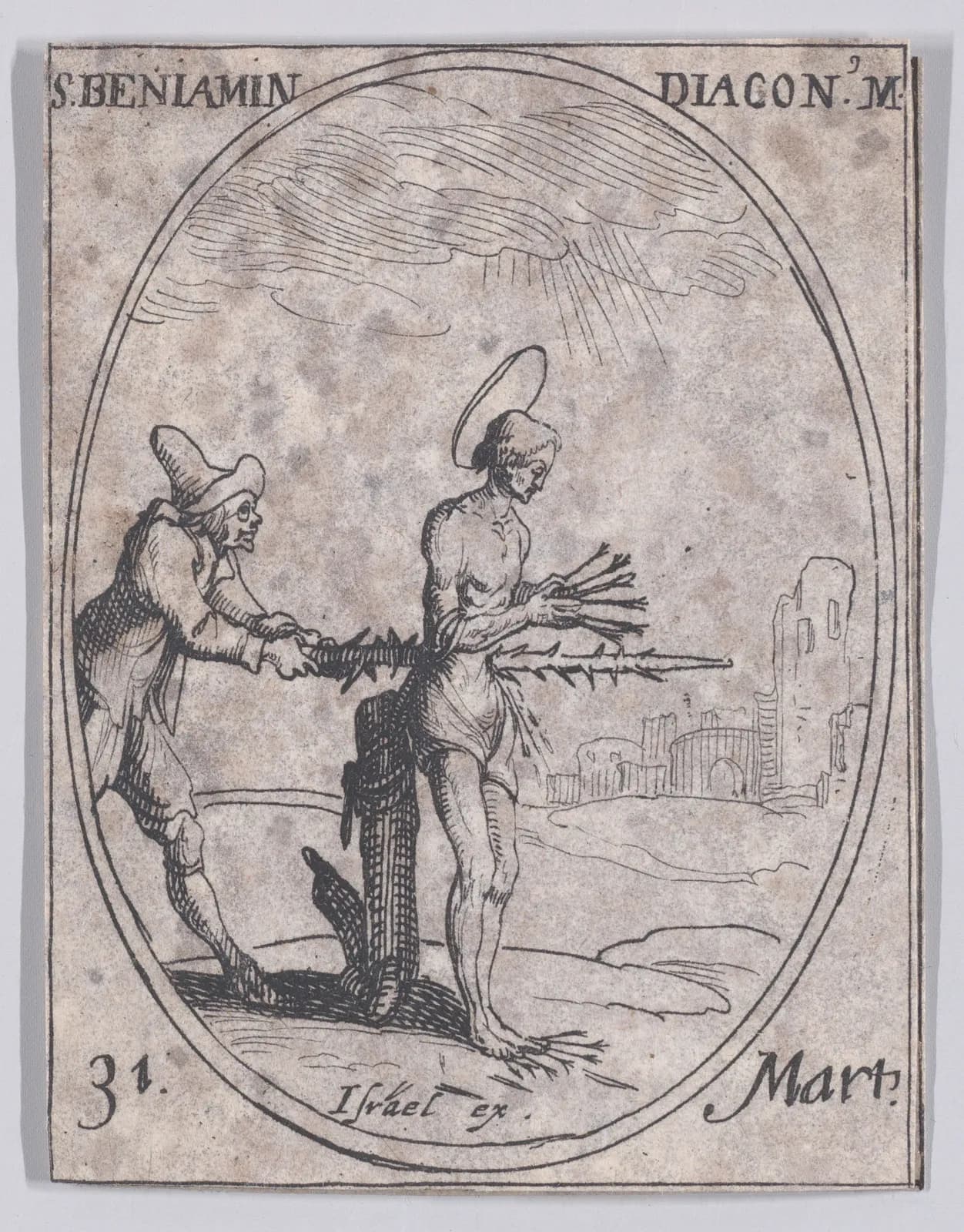
- A deacon with a thorn branch, or with splinters under his nails 2
Saint Benjamin was a deacon in Persia who was imprisoned for his faith and freed on condition that he would stop teaching it, and refused the condition. 1 "It is impossible for me not to impart the light which I have received," he told the Roman envoy who had won his release. 1 He went on preaching, and when the king learned of it he was tortured and put to death, in the persecution that began about 420. 123
A peace that ended
For some years Christians in Persia had lived in unusual freedom. Gabriel Oussani, in the 1911 Catholic Encyclopedia, says that the bishop Maruthas, sent as envoy by the Roman emperor, gained great influence with King Yazdegerd I, who allowed Christianity to spread freely and churches to be built. 4 The peace ended with an act of zeal. 14
Theodoret tells it. A bishop named Abdas, "adorned with many virtues," was "stirred with undue zeal and destroyed a Pyreum," one of the Persian temples of fire. 1 The king sent for him, complained "in moderate language," and ordered him to rebuild it. 1 Abdas refused, and the king had him executed and ordered the churches destroyed. 14 katolsk.no places Abdas at Susa and the temple at Ergol. 2
Theodoret did not approve of the destruction. Paul at Athens, he points out, saw a city given over to idols and destroyed none of its altars, but argued with the people instead. 1 He did approve of the refusal: to rebuild a shrine to fire seemed to him "equivalent to adoring it," and he counted the choice of death over rebuilding "a deed worthy of the martyr's crown." 1
Oussani says the destruction of churches soon became a general persecution, and that when Yazdegerd died in 420 and his son Bahram V succeeded him, it continued; many Christians fled across the frontier into Roman territory, and Bahram's demand for their return was one cause of the war of 422. 4 Theodoret writes that the persecution, kept up by the Magi, was still going after thirty years. 1 katolsk.no says it lasted forty. 2
The deacon Benjamin
Theodoret gives Benjamin as one of a few examples "to serve as examples of the courage of the rest." 1 Before him he tells of Hormisdas, a nobleman stripped of rank and set to drive the army's camels, and of Suenes, a master of a thousand slaves who was handed over as a slave to the lowest of them. 1 Then he turns to the deacon.
The king, he writes, "seized and imprisoned a deacon of the name of Benjamin." 1 Two years later an envoy came from Rome on other business, heard of the imprisonment, and asked the king to release him. 1 The king agreed on one condition: Benjamin must promise not to teach the Christian religion to any of the Magi. 1 The envoy urged him to accept. 1
Benjamin answered with the parable of the talents. "It is impossible for me not to impart the light which I have received," he said, "for how great a penalty is due for the hiding of our talent is taught in the history of the holy gospels." 1 The king was not told of this answer, and Benjamin was set free. 1 He went back to the work, as Theodoret puts it, "seeking to catch them that were held down by the darkness of ignorance, and bringing them to the light of knowledge." 1
The question he put to the king
After a year the king was informed, summoned Benjamin, and ordered him to deny Christ. 1 Benjamin asked him a question: what punishment was due to someone who deserted his allegiance and preferred another? "Death and torture," said the king. 1 Then how, the deacon asked, should one be treated "who abandons his Maker and Creator, makes a God of one of his fellow slaves, and offers to him the honour due to his Lord?" 1
The king was enraged. 1 The Roman Martyrology records the torture briefly: sharpened reeds were driven under his nails. 3 Theodoret describes worse, and says Benjamin "took this torture for child's play." 1 At last the king had him impaled on a knotted staff, "and so the noble sufferer gave up the ghost." 1
Theodoret does not say where he died. The Martyrology places it at Argol in Persia, under Bahram V, whom it calls Vararanes, and katolsk.no names the place as Argul and gives March 31 as the traditional day. 23 The year is uncertain. katolsk.no dates him to about 420 and places the martyrdoms of this persecution in the first two years of Bahram's reign, before the peace of 422 in which Theodosius II made freedom of worship for Persian Christians a condition. 2 Theodoret's own account, with two years in prison and a further year of preaching, covers at least three years. 1
The Church he served
The war that followed went badly for Persia. Oussani says the Romans advanced into Persian territory and besieged Nisibis, raised the siege when Turkish allies came to its relief, and then won a crushing victory that forced the Persians to sue for peace. 4 katolsk.no says Theodosius II made freedom of worship for the Christians of Persia a condition of that peace. 2
Oussani also observes that, for all the distress of those decades, the late fourth and early fifth centuries were a time of growth for the Persian Church and of literary activity, out of which grew a Christian literature in Syriac, the Church's liturgical language in Persia. 4 Benjamin, a deacon whose offense was teaching, belonged to that Church at the moment it was being tested. 14
What is Saint Benjamin the patron saint of?
None of the sources consulted names a patronage for Saint Benjamin. katolsk.no says he is pictured as a deacon holding a thorn branch, or with splinters under his nails, after the manner of his death. 2
Saint Benjamin's feast day
Saint Benjamin's feast day is March 31. 23 The current Roman Martyrology enters him on that day as a deacon at Argol in Persia who would not stop preaching the word of God and was martyred under Bahram V. 3 katolsk.no says the Roman Martyrology has always kept him on March 31, the traditional day of his death, and that the Greek Church keeps him on October 13. 2
Praying with Saint Benjamin
Benjamin had a way out, and it was a respectable one. A Roman envoy had taken trouble over him, the condition was narrow, and the envoy himself advised him to accept. 1 He did not think he could keep the promise, and said so. 1
His reason came from the Gospel, not from defiance. He had received a light, and the parable of the talents told him what happened to the servant who buried what he was given. 1 When he was finally questioned he did not insult the king; he asked him a question about loyalty and let the king answer it first. 1
Theodoret also tells the story of the bishop whose zeal began the persecution, and he does not excuse what Abdas did. 1 Benjamin's preaching was different: patient, personal, carried on at the cost of his own life rather than anyone else's property. 1 Theodoret closes his account of the persecution by recalling that the churches Diocletian destroyed rose again larger than before. 1
Saint Benjamin the Deacon, pray for us.
Sources
- 1.Theodoret, Ecclesiastical History, Book V, ch. 38, "Of the persecutions in Persia and of them that were martyred there," trans. Blomfield Jackson, Nicene and Post-Nicene Fathers, Second Series, Vol. 3 (1892).
- 2."Den hellige Benjamin av Persia (~400-420)," Den katolske kirke (katolsk.no), Catholic Diocese of Oslo (in Norwegian).
- 3.Roman Martyrology, entry for March 31, "San Beniamino, diacono," as printed in "Santo del giorno," Conferenza Episcopale Italiana (in Italian).
- 4.Gabriel Oussani, "Persia," The Catholic Encyclopedia, Vol. 11 (New York: Robert Appleton Company, 1911).
Saints to turn to next
Others in this collection who are turned to for some of the same things.