Saint Benignus of Dijon
d. 3rd century
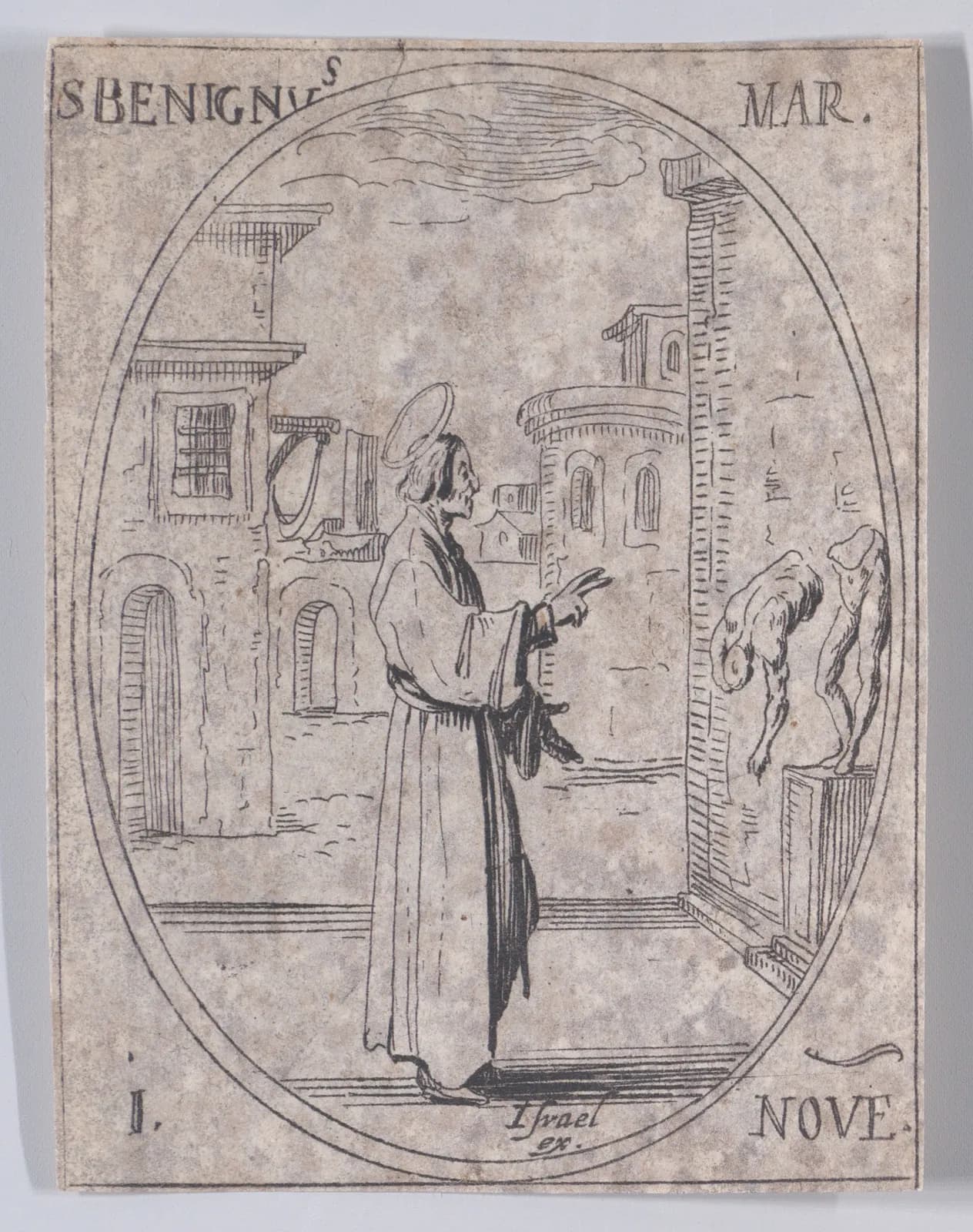
- Also called
- Bénigne 1
- Died
- A martyr in a persecution of the third century 3; the legend says under Marcus Aurelius 4 or Aurelian 3
- Historical record
- His martyrdom and early cult are historical; his Acts, written in the early sixth century, are not 34
- Patron saint of
- Dijon 3
Saint Benignus is the martyr of Dijon, put to death in a third-century persecution and honored at his grave there long before anyone knew his story. 34 The story arrived in the sixth century, in Acts that made him a disciple of Polycarp of Smyrna sent to convert Burgundy, and the Catholic Encyclopedia says plainly that they "possess no historical value." 3 His tomb, his name and his feast are what is certain, and the cathedral of Dijon is built over them. 14
What is known
The 1907 Catholic Encyclopedia puts the history in two sentences: "It is an historical fact that Benignus suffered martyrdom in a persecution of the third century and was publicly honoured as a martyr. His feast falls on 1 November; his name stands under this date in the so-called Martyrology of St. Jerome." 3 Its article on the diocese of Dijon adds that whatever the arguments about his story, "before the fifth century a saint named Benignus was venerated by the Christians of Dijon." 4
Beyond that, the encyclopedia says, "early in the sixth century no particulars concerning the person and life of Benignus were known at Dijon." 3 katolsk.no, which gathers the older scholarship, agrees that the legends about him are mixtures and inventions, and that in its present form, edited at Dijon, his Passion seems historically worthless. 1 It allows that he may really have been an early missionary from Lyon, perhaps a disciple not of Polycarp but of Polycarp's disciple Irenaeus. 1 The Dijon article is careful to add that the dispute over his legend does not "dim the splendour of the saint's miracles, as related by Gregory of Tours" and by a medieval book of his miracles. 4
The grave that a bishop doubted
His cult was found again, by Gregory of Tours's account, through a doubting bishop. The country people of Dijon venerated a grave in the great cemetery outside the walls. Gregory, bishop of Langres, the great-grandfather of Gregory of Tours, believed it was the grave of a pagan and wanted the devotion stopped. 135 Then he learned in a vision at night that it was the resting place of the martyr Benignus. 34
He restored the tomb and built a basilica over it. 3 The encyclopedia's Dijon article dates the revelation between 506 and 540; its Langres article says Gregory transferred the relics. 45 katolsk.no adds that the discovery was confirmed by a miracle, and that the church became so important that a monastery was founded beside it. 1 The bishops of Langres lived at Dijon for much of the Merovingian period, and Gregory and his son and successor Tetricus were both buried in the town. 45
The legend in the Acts
About the same time, the encyclopedia says, there was "a sudden appearance" of Acts of his martyrdom, brought to Dijon by a pilgrim on the way to Italy. 3 As katolsk.no retells them, Polycarp, after a vision of Irenaeus, sent the priests Benignus and Andochius and the deacon Thyrsus to preach in Gaul. They were shipwrecked on Corsica, landed at Marseille, and went up the Rhône and the Saône to Autun, where Benignus baptized the young Symphorian, later a martyr. 14 The Dijon article adds the three brothers baptized at Langres, Speusippus, Eleusippus and Meleusippus. 4
Benignus went on to Langres and to Dijon, preaching and working miracles, and was arrested at Épagny nearby. He refused to sacrifice to the idols or to the emperor, survived tortures with more miracles, and was finally killed, his skull crushed with an iron bar and his heart pierced, then buried in a tomb disguised as a pagan monument to deceive his persecutors. 1
The encyclopedia points out the obvious flaw: the Acts date his death to the persecution under Aurelian, in 270-275, and "the author had not noticed that the sending by Polycarp and the martyrdom under Aurelian are chronologically irreconcilable." 3 Polycarp died about 155. 1 The Dijon article, summarizing the same tradition, puts the martyrdom under Marcus Aurelius instead, and katolsk.no gives both readings, about 180 and about 270. 14
The verdict of the sources is the same. Following Duchesne, the encyclopedia says these Acts belong to a group of legends written in the early sixth century to describe the beginnings of Christianity at Besançon, Autun, Langres and Valence: "They are all falsifications by the same hand and possess no historical value." 3 The Dijon article calls them "apocryphal and copied from Cappadocian legends," and adds that "during the last generation no question has given rise to more animated polemics among the Catholic scholars of France than the apostolate of St. Benignus." 4
The church over his tomb
Gregory of Langres's basilica was followed in the eleventh century by a Romanesque church built by William of Volpiano for his reformed Benedictine monastery. 1 The encyclopedia calls the Romanesque church of Saint-Bénigne the masterpiece of the style in Burgundy, "consecrated by Paschal II in 1106 and completed in 1288." 4 katolsk.no says that church collapsed in 1272 and was replaced by the present building. 1
The town grew around it, so that a grave that once lay outside the walls of Roman Dijon is now in the middle of the city. 1 The abbey church became the cathedral of Dijon early in the nineteenth century, and his sarcophagus can still be seen in its crypt. 14
What is Saint Benignus the patron saint of?
Saint Benignus's feast day
Saint Benignus's feast day is November 1, the date under which his name already stands in the ancient Martyrology of Jerome. 13 The current Roman Martyrology keeps him on that day, as the Italian bishops print it, saying only that at Dijon he is venerated as a priest and martyr. 2 katolsk.no reports that the Martyrology calls him a disciple of Polycarp, and mentions February 17 and April 26, a translation feast at Langres, as other dates. 1
Praying with Saint Benignus
For the people who first prayed at his grave, there was no story at all. They knew a martyr was buried there, and they kept coming, until even their bishop thought they were honoring a pagan. 3 The cult came before the legend, and it has outlasted it. 34
The current Martyrology entry is almost as spare as what they knew: a priest and martyr, venerated at Dijon. 2 The tortures and the shipwreck are no longer in it.
His feast falls on November 1, alongside the feast of All Saints. 12 Before the Acts arrived, Dijon honored him knowing little more than that he was a martyr and was buried there. 34
Saint Benignus of Dijon, pray for us.
Sources
- 1."Den hellige Benignus av Dijon," Den katolske kirke (katolsk.no), Catholic Diocese of Oslo (in Norwegian).
- 2.Roman Martyrology, entry for November 1, "San Benigno, sacerdote e martire," as printed in "Santo del giorno," Conferenza Episcopale Italiana (in Italian).
- 3.Johann Peter Kirsch, "St. Benignus of Dijon," The Catholic Encyclopedia, Vol. 2 (New York: Robert Appleton Company, 1907).
- 4.Georges Goyau, "Dijon," The Catholic Encyclopedia, Vol. 4 (New York: Robert Appleton Company, 1908).
- 5.Georges Goyau, "Langres," The Catholic Encyclopedia, Vol. 8 (New York: Robert Appleton Company, 1910).
Saints to turn to next
Others in this collection who are turned to for some of the same things.