Saint Basiliscus of Comana
Died about 308 or 312
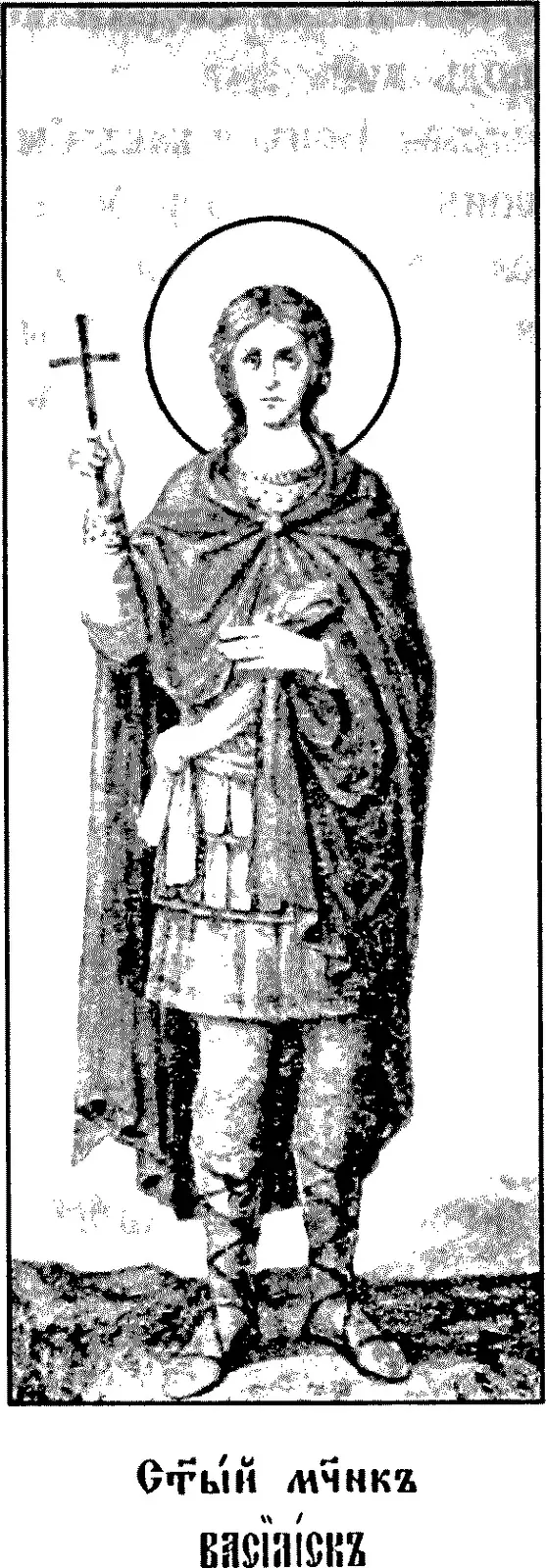
- Known for
- Appearing to Saint John Chrysostom the night before Chrysostom died in his shrine, in 407 451
Saint Basiliscus was a martyr of the early fourth century, honored at a shrine outside Comana in Pontus, and he is known almost entirely through the night Saint John Chrysostom spent there in 407. 14 Palladius, in his Dialogue on the life of Chrysostom, says the martyr stood beside the exhausted, exiled bishop and told him, "Be of good cheer, brother; to-morrow we shall be together," and that Chrysostom died there the next day. 4 The Roman Martyrology keeps Basiliscus on May 22 as bishop and martyr; the Greek tradition remembers him as a soldier. 736
What Palladius says
The oldest account of Basiliscus is a few lines in Palladius's Dialogue on the life of Chrysostom. Coming to Comana, Palladius writes, the soldiers escorting Chrysostom "lodged outside the wall in the shrine of a martyr, five or six miles from the town." 4
"The name of the martyr of the place was Basiliscus, who was Bishop of Comana, martyred under Maximian at Nicomedia, at the same time as Lucianus, priest of the Church of Antioch in Bithynia." 4 Palladius gives no more than that about the martyr himself; the rest of his chapter is about Chrysostom.
Butler follows Palladius, placing his martyrdom at Nicomedia in 312 under the tyrant Maximinus Daia, and adds that when peace came his body was brought back to Comana with honor. 1 katolsk.no gives the same outline: arrested at Comana, taken to Nicomedia in heavy chains, beheaded there in 312 when he would not offer incense to the idols, his body thrown into a river, recovered, and taken to Comana, where a chapel was built over it. 2
Bishop or soldier?
Gian Domenico Gordini, writing for santiebeati, sets out why the matter is not simple. Sozomen and other Greek historians repeat Palladius's detail that Basiliscus was bishop of Comana, and that is the point the critics dispute. 3 Other Greek sources, including the old synaxaria and the Life of Chrysostom by George of Alexandria, tell the same vision but make Basiliscus a soldier, and none of them calls him a bishop. 3
There is also a set of Acts in which Eutropius, Cleonicus and Basiliscus are soldiers and relatives of Saint Theodore the Recruit, tortured together and taken to Comana, where the first two were killed at once and Basiliscus some time later. santiebeati says the critics reject these Acts as fabulous, and thinks they were probably written to attach a real martyr to Theodore's far greater fame. 3
Gordini's own conclusion is cautious. A martyr Basiliscus certainly existed and was venerated at Comana, and Palladius's account of Chrysostom's stay at his tomb is held to be true. But most critics doubt there was ever a bishop of Comana by that name, and Palladius is confused in places: why, for instance, would a man martyred at Nicomedia be buried at Comana? It is more likely, he concludes, that Basiliscus was a soldier discovered to be a Christian, beheaded and buried at Comana, probably in 312. 3
The Byzantine Catholic Menaion keeps the soldier: it remembers Basiliscus at Comana as a soldier crucified with two comrades, a cousin of Saint Theodore the Recruit who "brought many to the Faith" by his preaching and example, and dates his death to 308. 6 The Roman Martyrology, as the Italian bishops print it today, keeps the bishop. 7
Chrysostom on the road to Pityus
In 407 the court at Constantinople ordered the deposed archbishop moved farther away, to Pityus on the shore of the Black Sea. 245 Palladius describes the march: three months on the road, one of the two guards so savage that he set out in pouring rain and was glad of a hot sun because it made the old bishop's head ache, and would not let him stop for a bath in any town. 4 katolsk.no adds that his warnings that he was exhausted were ignored. 2
They passed through Comana "as men cross a river by a bridge," Palladius writes, and spent the night at the martyr's shrine outside the town. 4 That night, he says, the martyr stood by Chrysostom and spoke to him; "it is said that he had first called to the priest who shared his abode, 'Get ready the place for our brother John; he is coming.'" 4 Butler tells the same two dreams, the warning to the priest and the promise to Chrysostom. 1
Sozomen gives it in one sentence: "It is said that during this journey, Basiliscus, the martyr, appeared to him at Comani, in Armenia, and apprised him of the day of his death." 5
"Glory to God for all things"
Chrysostom took the vision as a warning and asked to stay where they were until eleven in the morning. The guards refused and marched on, but after about thirty furlongs he was so ill that they had to bring him back to the shrine. 4 katolsk.no puts the distance at about six kilometers, and says they turned back because he seemed to be dying. 2
Palladius describes the end. Chrysostom asked for white clothes and changed into them down to his shoes, gave away everything else he had, received the Eucharist, and said his last prayer with his customary words, "Glory to God for all things." 4 katolsk.no dates his death to the feast of the Exaltation of the Cross, September 14, 407. 2
Monks, virgins and ascetics came in such numbers from Syria, Cilicia, Pontus and Armenia that people thought they had been summoned. And so, Palladius ends, "his poor body, like a victorious athlete's, was buried in the same shrine as Basiliscus." 4 Butler says Chrysostom died in the house of the clergy who served the martyr's church. 1
What is Saint Basiliscus the patron saint of?
Saint Basiliscus's feast day
Saint Basiliscus's feast day is May 22. The current Roman Martyrology, as the Italian bishops print it, enters him that day: at Gumenek in Pontus, in modern Turkey, Saint Basiliscus, bishop and martyr. 7 Butler and katolsk.no give May 22, and the Byzantine Catholic Menaion keeps him on May 22 with his own troparion and kontakion. 126
santiebeati notes that the older Roman Martyrology named him twice: on March 3 with Eutropius and Cleonicus, and on May 22 alone, a double commemoration it traces to the legendary Acts. 3 The current Martyrology's entry for March 3 names Cleonicus and Eutropius, martyrs at Amasea, without him. 8
Praying with Saint Basiliscus
Almost nothing about his own life can be told with confidence, and the sources are frank about it. 3 What has lasted is a shrine on a road and a martyr who, in Palladius's telling, made room for a stranger. 4
The words Palladius gives him are a welcome: "Be of good cheer, brother." 4 He called the exiled archbishop of Constantinople "brother," and told the priest to get a place ready for him. 4
Chrysostom had been driven across Asia Minor by a guard who wanted him dead. 4 He died at the martyr's tomb in white, having given away what he had, saying the prayer he always said. 4
Butler calls it comfort: Basiliscus bade him be of good courage, "for the next day they should be together." 1
Saint Basiliscus of Comana, pray for us.
Sources
- 1.Alban Butler, "St. Basiliscus, Bishop of Comana in Pontus, M.," May 22, in The Lives of the Fathers, Martyrs, and Other Principal Saints, Vol. V (Derby: Richardson and Son, 1843).
- 2."Den hellige Basiliskos av Komana (d. 312)," Den katolske kirke (Catholic Diocese of Oslo) (in Norwegian).
- 3.Gian Domenico Gordini, "San Basilisco," Santi, beati e testimoni (santiebeati.it) (in Italian).
- 4.Palladius, The Dialogue of Palladius concerning the Life of Chrysostom, chapter 11, trans. Herbert Moore (1921), The Tertullian Project.
- 5.Sozomen, Ecclesiastical History, Book VIII, chapter 28, trans. Chester D. Hartranft, Nicene and Post-Nicene Fathers, Second Series, Vol. 2 (1890), New Advent.
- 6."Menaion - May 22," Metropolitan Cantor Institute, Byzantine Catholic Archeparchy of Pittsburgh.
- 7.Roman Martyrology, entries for May 22, Santo del giorno, Conferenza Episcopale Italiana (in Italian).
- 8.Roman Martyrology, entries for March 3, Santo del giorno, Conferenza Episcopale Italiana (in Italian).
Saints to turn to next
Others in this collection who are turned to for some of the same things.