Saint Basil of Ancyra
Died 362
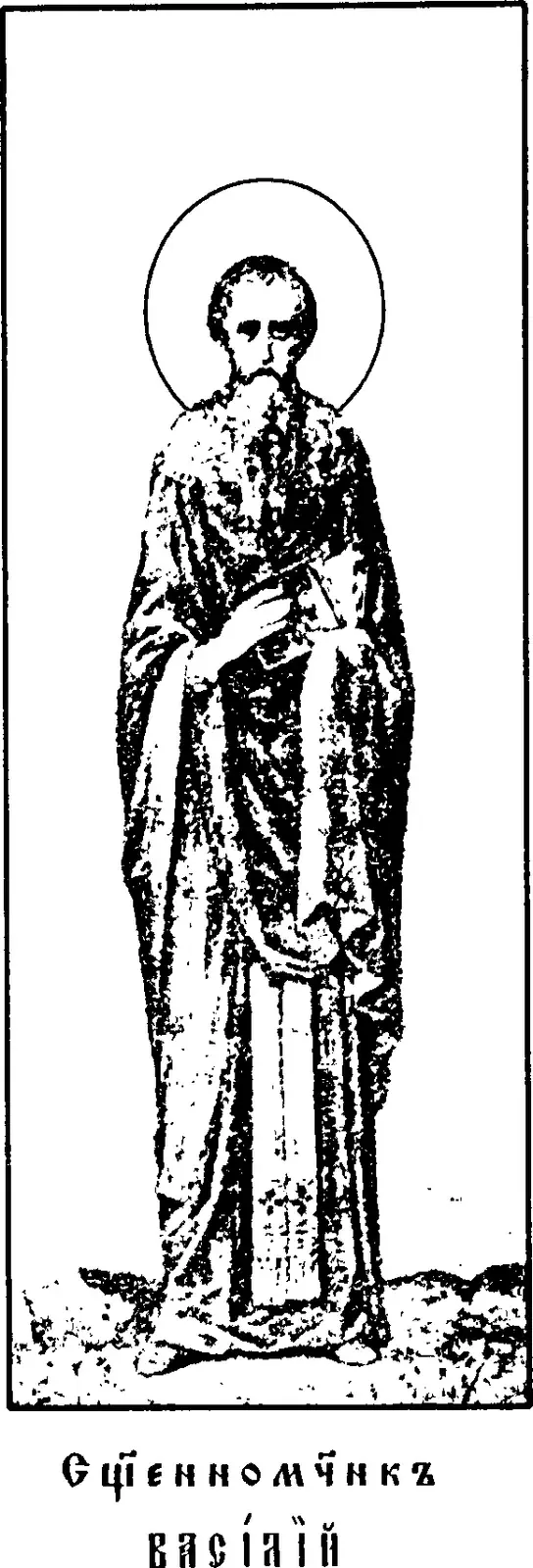
Saint Basil of Ancyra was a priest of the church at Ancyra, the modern Ankara, who resisted the Arians under the emperor Constantius and, when Julian the Apostate restored the worship of the gods, went about the city begging Christians not to sacrifice. 12 He was arrested, tortured and put to death in 362. 13 His feast is March 22. 15
A priest in an Arian city
Butler, who tells the story from what he calls "the authentic acts of his martyrdom," places Basil as a priest of Ancyra under its bishop Marcellus, "a man of a most holy life, and unblemished conversation." 1 Marcellus was banished for his opposition to the Arians, and a Semi-Arian, also called Basil, was put in his place. 1 The priest Basil, Butler says, never stopped warning the people to beware of the snares laid for them and to keep the Catholic faith. 1
Sozomen, writing in the fifth century, confirms the outline. Basil "had long manifested great zeal in defense of the faith, and had opposed the Arians during the reign of Constantius; hence the partisans of Eudoxius had prohibited him from holding public assemblies." 2 Butler dates the ban to 360, and adds that Basil defied it and defended the faith before Constantius himself. 1
Under Julian
When Julian the Apostate restored the worship of the gods, Basil went through the whole city, Butler says, urging the Christians to stand firm. 1 Sozomen describes it more fully. He "traveled hither and there, publicly and openly exhorting the Christians to cleave to their own doctrines, and to refrain from defiling themselves with pagan sacrifices and libations." He told them to count as nothing whatever honors the emperor might give them, since such honors were brief and led to lasting shame. 2
Sozomen gives the moment of his arrest in a single scene. Basil happened to pass some pagans offering sacrifice. "He sighed deeply, and uttered a prayer to the effect that no Christian might be suffered to fall into similar delusion." He was seized on the spot and taken to the governor of the province. 2 The current Roman Martyrology repeats it: having prayed God that no Christian should fall away from the faith, he was arrested and brought before the governor. 5
Butler's Acts tell it at greater length. The pagans dragged him before the proconsul Saturninus, accusing him of sedition, of overturning altars and of speaking against the emperor. Asked whether the emperor's religion was not the true one, Basil answered: "Can you yourself believe it? Can any man endued with reason persuade himself that dumb statues are gods?" 1 He was racked and sent back to prison. 1
Before the emperor
The proconsul reported to Julian, who sent two courtiers, Elpidius and Pegasus, both apostates, to help with the trial. 1 Pegasus visited Basil in his cell to talk him round, and came away offended by what the prisoner said to him about his own apostasy. Basil was racked again, more cruelly, loaded with irons and put in the deepest dungeon. 1
Then Julian himself came through Galatia on his way to Antioch and the Persian war. Santi e Beati dates his passage through Ancyra to May 362. 13 In Butler's account Basil was brought before him, and Julian told him with an air of pity that Christ, in whom he trusted, had died under Pilate and remained among the dead. 1 Basil answered that Julian had renounced Christ at the very moment Christ gave him the empire, and that he would lose both the empire and his life. 1
Julian ordered that strips of his skin be cut away every day in seven places, and left the sentence to the count Frumentinus, captain of his guard. 13 After the first day Basil asked to see the emperor. Frumentinus, expecting a recantation, carried the message, and Julian received him in the temple of Aesculapius. 1 There, Butler says, Basil refused once more to worship "blind and deaf idols," took a piece of his own flesh that had been cut that day and still hung by a strip of skin, "and threw it upon Julian." 1
The death of Basil
The emperor left Ancyra the next morning without seeing Frumentinus, who felt the insult as his own disgrace. 1 The count resumed the torture with greater fury. Basil, Butler says, showed him his shoulders and sides and told him that Christ had healed him in the night. 1 Frumentinus had him laid on his face and his back pierced with red-hot irons, and he died under them. 1
Butler dates his death to June 29, 362. 1 Santi e Beati says he died probably on June 28, 362; its heading for the entry says about 363. 3 The 1897 English edition of the Roman Martyrology records only that "having endured grievous torments under Julian the Apostate," he "gave up his soul to God." 4
Sozomen does not name the emperor among Basil's judges, and he adds a careful sentence after the martyrdoms at Ancyra and elsewhere: "Even if these cruelties were perpetrated contrary to the will of the emperor, yet they serve to prove that his reign was signalized by martyrs neither ignoble nor few." 2
Two Passions and a late cult
Santi e Beati sets out what is known of the sources. Two Greek Passions survive. The older was published by the Bollandist Daniel Papebroch in the Acta Sanctorum from a Vatican manuscript copied from a tenth- or eleventh-century original, and the notice in the Byzantine synaxaries is a summary of it. 3 The later one, by a monk called John the Hagiolite, repeats the same history with details of the author's own invention, among them a journey to Caesarea that comes from confusing Basil with his famous namesake, Basil the Great. 3
In the East he is kept on March 22, and in some synaxaries on the 23rd or 24th. 3 In the Latin Church, Santi e Beati says, his cult goes back only to 1586, when his name was entered in the Roman Martyrology. 3
What is Saint Basil of Ancyra the patron saint of?
Saint Basil of Ancyra's feast day
Saint Basil of Ancyra's feast day is March 22. Butler says that although he died in June, "his name is honored both by the Latins and Greeks on the 22d of March." 1 The 1897 Martyrology enters him on that day, and so does the current Roman Martyrology as the Italian bishops print it: at Ankara in Galatia, Saint Basil, priest and martyr, who opposed the Arians throughout the reign of Constantius and under Julian completed his martyrdom after many torments. 45
Praying with Saint Basil
The scene Sozomen chose to keep is a quiet one. Basil walks past a sacrifice, sighs, and prays that no Christian will be drawn into it. 2 That prayer is what got him arrested, and the current Martyrology keeps it too. 5
Before that he had spent years preaching against the Arians in a city where they held the bishop's chair, and had been forbidden to hold assemblies. 12 Under Julian he went about openly, telling people that the emperor's favors would not last. 2
His Acts are not gentle reading, and Butler does not soften them. 1 The sources do not say whether the most violent details are history; Santi e Beati is plain that the later Passion added to it. 3
The Church in the East kept his day for centuries before the West added his name. 3 He is one of the martyrs Sozomen meant when he wrote that Julian's reign had martyrs "neither ignoble nor few." 2
Saint Basil of Ancyra, pray for us.
Sources
- 1.Alban Butler, "St. Basil of Ancyra, Priest, M.," March 22, in The Lives of the Fathers, Martyrs, and Other Principal Saints, Vol. I (New York, 1895), Project Gutenberg eBook #20450.
- 2.Sozomen, Ecclesiastical History, Book V, chapter 11, trans. Chester D. Hartranft, Nicene and Post-Nicene Fathers, Second Series, Vol. 2 (Buffalo, 1890), revised for New Advent.
- 3."San Basilio di Ancira," Santi, beati e testimoni (santiebeati.it) (in Italian).
- 4.The Roman Martyrology, March 22 (Baltimore: John Murphy & Co., 1897).
- 5.Roman Martyrology, entries for March 22, Santo del giorno, Conferenza Episcopale Italiana (in Italian).
Saints to turn to next
Others in this collection who are turned to for some of the same things.