Saint Arethas and Companions
Died 523
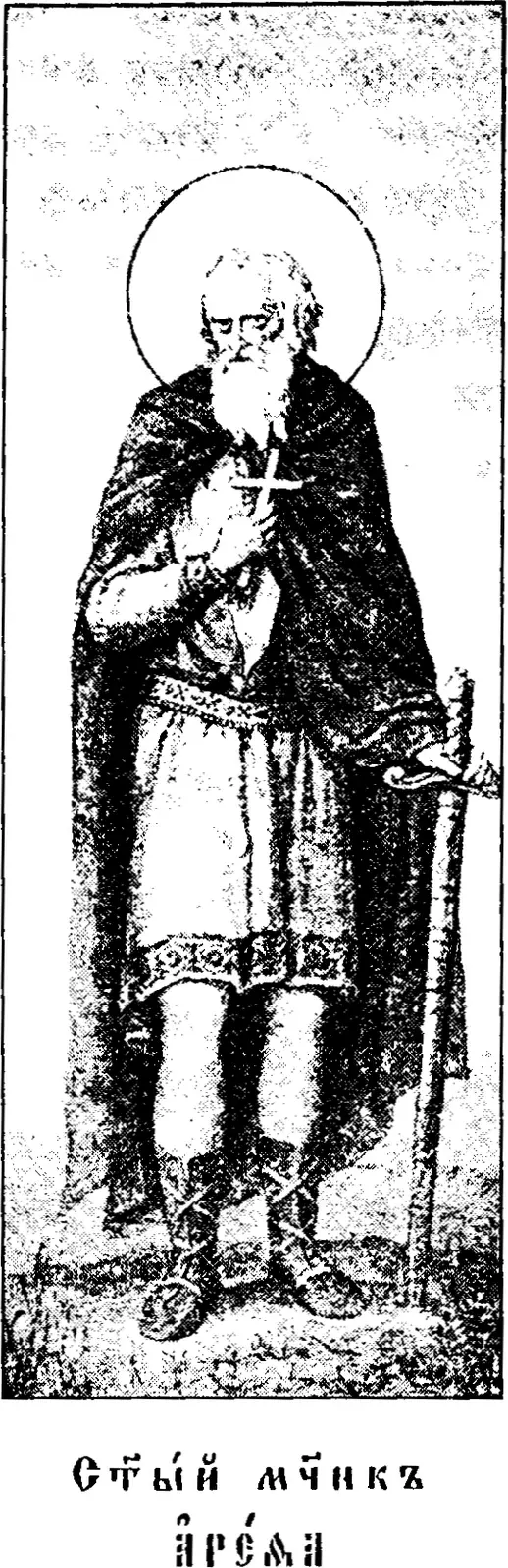
Saint Arethas, called al-Harith in Arabic, was the Christian chief of Najran, a city in southern Arabia with a large Christian community, in the early sixth century. 14 When the Himyarite king Dhu Nuwas took the city in 523 and ordered its Christians to give up their faith, Arethas and the leading men were beheaded beside a brook outside the town, and his wife Ruma and her daughters were killed after them. 13 The Roman Martyrology keeps him on October 24 with three hundred and forty companions. 5
The Christians of Najran
Najran was an important trading and religious center of pre-Islamic Arabia, in what is now southern Saudi Arabia, and by the fifth and sixth centuries it held a substantial Christian community. 4 Cattini, writing on santiebeati, notes a Christian inscription from the area dated 470, and recent excavations that have greatly widened what is known of the community, its churches and clergy. 4 The Catholic Encyclopedia says Arab historians agree that Christianity flourished in Himyar and Najran in that period. 1
Southern Arabia was caught between two powers. The kingdom of Himyar was ruled by a Jewish dynasty, and the Christian kingdom of Axum, across the Red Sea in Ethiopia, had made it subject to its own king. 134 About 523, the encyclopedia says, a Himyarite named Yusuf Dhu Nuwas, a Jew and a vassal of the Ethiopian king, revolted as soon as the Ethiopian army had gone home and turned on the Christians. 1 katolsk.no and Arduino say he first took the city of Zafar, massacred its garrison and clergy and turned its church into a synagogue. 34
Of Arethas himself very little is known before the end. 4 The sources call him the chief or prince of the city and the leader of its Christians. 145 katolsk.no says he was born in Najran in 427, which would have made him about ninety-five when he died; Cattini says neither his birth, his family nor how he came to lead the city is documented. 34
The fall of the city
Dhu Nuwas besieged Najran. katolsk.no and Arduino say the city held out until he promised an amnesty if it surrendered, that it did so against the advice of Arethas, and that he then let his soldiers plunder it and condemned every Christian who would not abandon the faith. 34 Cattini says the Christian sources agree the promised terms were not kept. 4
The encyclopedia, quoting the historian William Wright, describes what followed: large pits dug and filled with burning fuel, and all who refused to abjure their faith and embrace Judaism, "amounting to many thousands, including the priests and monks of the surrounding regions, with the consecrated virgins," thrown into the flames. 1 The bones of the city's late bishop, Paul, were dug up and burned. 1
The leading men, "with their prince, Arethas," were put in chains. 1 "Arethas and his companions were conducted to the side of a small brook in the neighbourhood, where they were beheaded." 1 The Greek Martyrdom of Arethas, as Cattini summarizes it, has the king accuse him of rebellion and try to make him renounce Christ, and has Arethas refuse and encourage the others to die without denying him. 4 Cattini warns that the speeches in these texts are the literary form of a martyr's story, not a transcript. 4
Ruma and the women
The women of the city were killed after the men. 1 The encyclopedia, again quoting Wright, says Ruma, "the wife of the chief," was brought with her two virgin daughters before Dhu Nuwas; the daughters were put to death in front of their mother, and then she was killed too. 1 katolsk.no gives the same account and adds that the daughters may have been a daughter and a granddaughter. 3
The other sources number her family differently. Butler calls her Duma and says she and her daughters suffered with him. 2 Arduino writes that the king wanted her as his concubine, and that when she refused he killed her four daughters before her eyes and then beheaded her. 4 Cattini, working from the Syriac Book of the Himyarites, names her Ruhm, daughter of Azma, and says she died with her daughter Aumah and a granddaughter; that she was Arethas's wife, he adds, is the tradition that grew up afterward. 4
How many died, and when
The Martyrology keeps Arethas with three hundred and forty companions. 5 Butler says he was beheaded "with four companions." 2 Cattini explains that 340 is the number handed down in the liturgy for the group that died with Arethas, and was never meant as the count of the whole massacre. 4 For that, the encyclopedia reports two figures: the letter of Simeon, bishop of Beth Arsham, gives 427 priests, deacons, monks and consecrated virgins and more than 4,000 lay people, and Ibn Ishaq gives 20,000. 1 katolsk.no and Arduino say other sources speak of more than 4,000. 34
The year is 523. 134 The encyclopedia and katolsk.no both insist on it against the date of 560 given by most Arab historians. 13 Cattini says the Greek Martyrdom dates the execution to October 24, 523, the day of the feast, while recent studies of the South Arabian inscriptions place the massacre in November of that year; katolsk.no cites a source giving November 25, 523. 34
The news, and the question of heresy
Dhu Nuwas sent word of what he had done to his allies, among them al-Mundhir, prince of Hira, who received the letter, the encyclopedia says, on January 20, 524, while an embassy from the emperor Justin was with him. 1 One of the envoys was Simeon of Beth Arsham, who wrote the account of the massacre on which later histories rest. 14 The Patriarch of Alexandria wrote to the bishops of the East asking that the dead be remembered as martyrs. 34 The Ethiopian king, called Elesbaan by the Greeks, then crossed to Arabia and overthrew Dhu Nuwas. 123 Butler honors Elesbaan as a saint on October 27, and has him end his life as a monk. 2
katolsk.no and Arduino say it was Cardinal Baronius, revising the Martyrology in the sixteenth century, who entered Arethas and the martyrs of Najran in it. 34 Both add that the Christians of Najran were very probably Monophysites, believing that Christ had only one nature, and suggest that Baronius either did not know or judged that martyrdom outweighed what may have been a technical heresy. 34 The encyclopedia itself calls Simeon of Beth Arsham a Monophysite. 1
The memory has not faded. Cattini records that in 2023, for the fifteen hundredth anniversary, Pope Francis granted a jubilee year for the martyrs of Arabia, from October 24, 2023, to October 23, 2024, and that a relic of Arethas, kept for centuries at the Orthodox monastery of Dionysiou on Mount Athos, was given to the Apostolic Vicariate of Northern Arabia and placed beneath the altar of the cathedral of Our Lady of Arabia in Bahrain. 4
What is Saint Arethas the patron saint of?
Saint Arethas's feast day
The feast of Saint Arethas and his companions is October 24. The current Roman Martyrology, as the Italian bishops print it, enters that day the passion of Saint Arethas, prince of the city, and three hundred and forty companions, martyrs at Najran in Arabia in the time of the emperor Justin, under Dhu Nuwas, king of Arabia. 5 Butler says he and his family are honored on October 24 "in the Roman, and in other Western, as well as in the Eastern and Muscovite calendars." 2 katolsk.no and santiebeati give the same day. 34
Praying with Saint Arethas
Almost nothing is known of Arethas except how he died, and the sources do not pretend otherwise. 4 What they record is a city that surrendered on a promise, a promise broken, and men led out to a stream. 13
The story does not end well for anyone in it. The women watched their children die. 1 The king who avenged them did it, katolsk.no says, with great savagery. 3
The sources argue about the numbers, the date, the daughters, even the doctrine of the dead. 1234 They do not argue about what was asked of them, which was to deny Christ, and what they answered. 14
Fifteen centuries later a relic of the chief of Najran was carried back to the Arabian Gulf and laid under an altar there. 4
Saint Arethas and Companions, pray for us.
Sources
- 1.Gabriel Oussani, "Arabia," The Catholic Encyclopedia, Vol. 1 (New York: Robert Appleton Company, 1907), section "South Arabian Christianity: Himyar, Yemen and Najran."
- 2.Alban Butler, "S. Elesbaan, King of Ethiopia, C.," October 27, in The Lives of the Fathers, Martyrs, and Other Principal Saints, Vol. X (Derby: Thomas Richardson and Son, 1846).
- 3.Per Einar Odden, "Den hellige Aretas og de 340 Najran-martyrene (d. 523)," Den katolske kirke (Catholic Church in Norway), katolsk.no (in Norwegian).
- 4.Giampietro Cattini and Fabio Arduino, "Santi Areta e Ruma, sposi, e 340 compagni, Martiri di Nagran," Santi e Beati, santiebeati.it (in Italian).
- 5.Roman Martyrology, entries for October 24, Santo del giorno, Conferenza Episcopale Italiana (in Italian).
Saints to turn to next
Others in this collection who are turned to for some of the same things.