Saint Arbogast of Strasbourg
Sixth or seventh century
- Died
- At Strasbourg, on July 21; the year is uncertain, given as 678 by Butler and about 660 by santiebeati 123
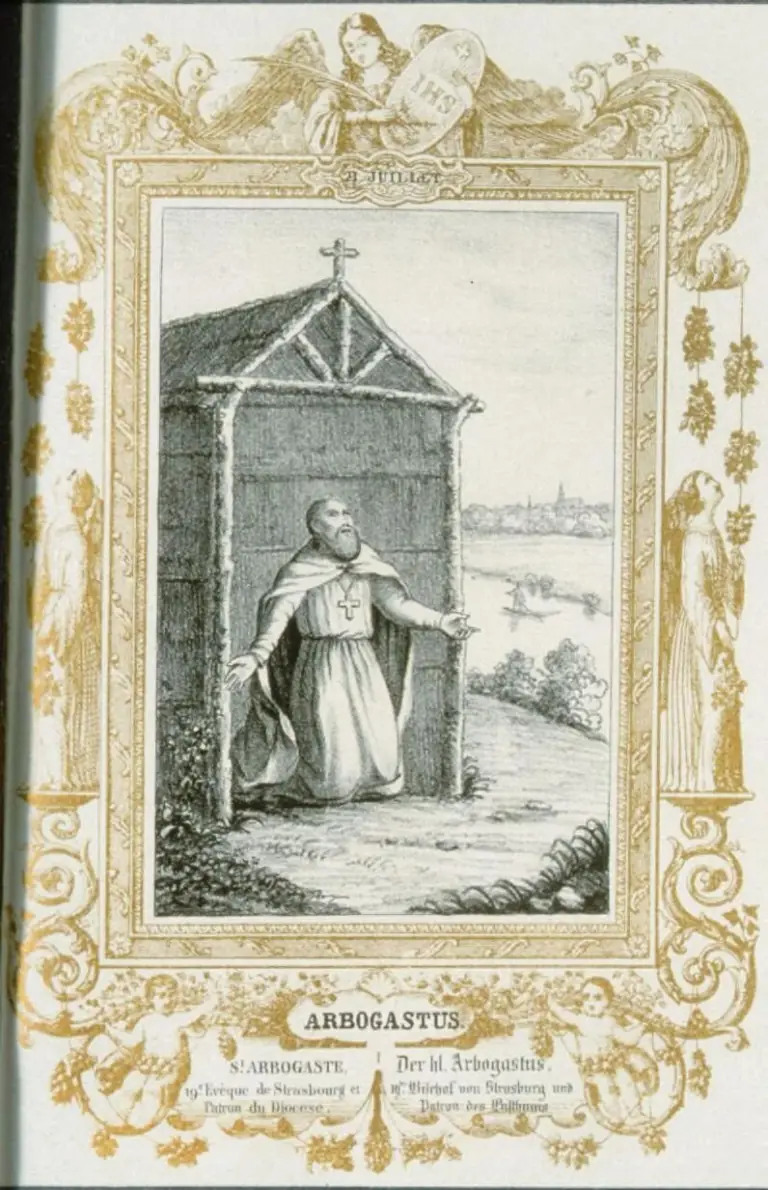
Saint Arbogast was a hermit in the forests of Alsace who was made bishop of Strasbourg by a Merovingian king named Dagobert, and who, when he died, asked to be buried on the hill where the city buried its criminals. 123 He is the principal patron of the Diocese of Strasbourg, and his feast is July 21. 134
A stranger in Alsace
Almost everything told about him comes from a Life written centuries after his death. katolsk.no calls it largely legendary but with some historical foundation, and notes that it is attributed, though not certainly, to Uto III, bishop of Strasbourg from 950 to 965. 1 Arduino, on santiebeati, likewise describes a Life "in large part legendary," written by one of his successors, that seems to rest on something real. 3
Where he came from is disputed. "The Irish challenge this saint as a native of their island," Butler writes. "The Scots also lay claim to him, and are supported by Richer's Chronicle of Sens, written in the thirteenth century, and by the life of St. Florentius, his successor, though his acts say he was of a noble family in Aquitain." 2 katolsk.no adds that the Bollandist Bosch accepted Aquitaine, that the claim for Scotland may be a misunderstanding because Scotia meant Ireland until late in the Middle Ages, and that his name suggests Frankish origin. 1 Cattini, on santiebeati, calls Ireland the oldest tradition and Aquitaine the likeliest, and concludes that none can be proved. 3
He went to Alsace to live as a hermit. 123 Butler places him about 630 in "the Sacred Forest (for this is the interpretation of the Teutonic name Heiligesforst)." 2 katolsk.no identifies it as the dense forest near Haguenau, called the Holy Forest after him, now the Forêt de Haguenau. 1 The reputation of his holiness drew people to him. 3
The king's son
The best-known story of his Life explains how he became a bishop. As katolsk.no tells it, the king's son was hunting boar with his father's huntsmen in the forests along the river Ill, near Arbogast's cell, and became separated from the others. A boar startled his horse, which reared and threw him; his foot caught in the stirrup and the horse trampled him. He was carried home and died the next day. 1 The king sent for Arbogast, who asked the Mother of God to intercede, and the prince sat up in his shroud. 1 In gratitude the king made Arbogast bishop of Strasbourg. 13
Other versions put the miracle after he was already bishop, and say that when the king offered him money he asked that it be spent on a cathedral instead. 1 Butler, following the Acts, puts it "not long after his exaltation," and adds a caution: "these acts call this prince Sigebert; his name is not recorded by the historians." 2
Which Dagobert is meant is a real problem. katolsk.no reports the tradition that it was Dagobert I, whose son became Saint Sigebert III, and the alternative that it was Dagobert II; it notes that the early Life speaks only of "a certain Dagobert," without calling him king, and that the whole story may have been invented later to explain his appointment. 1 Cattini says the chronology of the first bishops of Strasbourg cannot be fully reconstructed, but that scholars think it credible that Arbogast really was bishop there and reorganized the diocese in the sixth or seventh century. 3
Bishop of Strasbourg
There had been Christians in Strasbourg since the fourth century, katolsk.no says, but the community had probably been wiped out by the Alemannic invasions, and it was under the Franks that the faith returned. 1 Arbogast set himself to the renewal of the run-down city, building monasteries and churches, and tradition credits him with its first cathedral, dedicated to the Virgin Mary, the predecessor of the present one. 13 Bricks stamped with his name have been found, which both katolsk.no and santiebeati take as evidence that he existed and that his fame as a builder is old. 13
The king's favor brought the see large estates. Butler names "the manor and town of Rufach," with land on both sides of the river he calls the Alse or Elle, and the old royal palace of Isenburg. 12 He founded or endowed monasteries, among them Surbourg, the first in Alsace, and Shutteran, and perhaps Ebersmunster, though both Butler and katolsk.no say its chief founder was the father of Saint Odile, Duke Adalric, whom Butler calls Athico. 12
His people loved him, and katolsk.no says they honored him almost as a saint in his lifetime. 1 The legends credit him with healing the sick, driving out demons, settling quarrels and crossing a river dry-shod. 1 Arduino calls him an unequaled example of humility. 3
The gallows hill
Every account of him agrees on one request. "All writers on St. Arbogastus's life mention that, in his last will, he ordered his body should be interred on the mountain which was the burial-place of malefactors," Butler writes. 2 katolsk.no places it on the hill called Saint-Michel, where a gallows stood, and gives the reason told for it: to honor an innocent man who had been executed. 1 Cattini reads it as a sign that he thought himself unworthy of an honorable grave. 3
His wish was carried out, but so many people came to the grave that a church of Saint Michael was soon built over it, and an abbey of Saint Arbogast beside it; the place is now the quarter of La Montagne Verte in Strasbourg. 12 Butler says his successor Saint Florentius moved his body into the abbey church with honor. 2 katolsk.no gives the translation to his second successor, Ansoald. 1
The date of his death is just as uncertain. Butler, following Bosch, gives 678. 2 Arduino says about 660. 3 katolsk.no lists estimates from about 600 to about 700, and points out that Ansoald, his second successor, attended the Council of Paris in 614, which would put Arbogast's episcopate before the end of the sixth century and cannot be squared with the story of a Dagobert; against that, the historian Glöckler held in 1880 that he cannot have lived in the sixth century at all. 1
Butler adds that in the year after his death the bishopric was offered to Saint Wilfrid of York, then on his way to Rome, who declined it, and that it then went to Florentius. 2 katolsk.no explains that this happened under Dagobert II in 678 or 679, and that the confusion between the two Dagoberts lies behind the difficulty. 1
His relics did not survive. Part went to the abbey of Surbourg, where they were destroyed by Swedish troops in the Thirty Years' War in 1632; the rest were lost when the Augustinian house of Saint Arbogast in Strasbourg was pulled down in 1530. 1
What is Saint Arbogast the patron saint of?
Saint Arbogast is the principal patron of the Diocese of Strasbourg, and katolsk.no names him co-patron of other towns, including Rouffach in Alsace, Muttenz near Basel and Oberwinterthur in the canton of Zurich. 13 Both katolsk.no and Arduino on santiebeati say he is invoked for help in moments of weariness and discouragement. 13
Saint Arbogast's feast day
Saint Arbogast's feast day is July 21, the day of his death. 123 The current Roman Martyrology, as the Italian bishops publish it, enters him on that day: "A Strasburgo in Borgogna, sant'Arbogasto, vescovo," at Strasbourg in Burgundy, Saint Arbogast, bishop. 4 katolsk.no adds that Strasbourg keeps the feast locally on the nearest Sunday. 1
Praying with Saint Arbogast
He went into the forest to be alone and was called out of it. The sources do not say he wanted to be a bishop, only that a king made him one. 123
What he did with the office was ordinary and lasting: churches and monasteries, estates for the Church of Strasbourg, the care of a people who had lost their faith once already. 12 The bricks with his name on them are the plainest evidence there is that he lived at all. 13
And at the end he asked to lie among criminals. The sources give different reasons, humility in one, honor for an innocent man who was hanged there in another. 13 Either way, the request put him where the people nobody wanted to remember were buried, and the city built a church there. 12
He is invoked by people who are tired and discouraged. 13 Nothing in the sources explains why. It may be enough that he worked a long time, in a hard place, with no certainty of how it would be remembered.
Saint Arbogast of Strasbourg, pray for us.
Sources
- 1.Per Einar Odden, "Den hellige Arbogast av Strasbourg," Helgener, Den katolske kirke, katolsk.no (in Norwegian).
- 2.Alban Butler, "St. Arbogastus, Bishop of Strasburg, C.," July 21, in The Lives of the Fathers, Martyrs, and Other Principal Saints, Vol. VII (New York: P. J. Kenedy, 1908), via Project Gutenberg.
- 3.Giampietro Cattini and Fabio Arduino, "Sant'Arbogasto, Vescovo," with the Roman Martyrology entry, Santi, beati e testimoni, santiebeati.it (in Italian).
- 4.Roman Martyrology, entries for July 21, Santo del giorno, Conferenza Episcopale Italiana (in Italian).
Saints to turn to next
Others in this collection who are turned to for some of the same things.
- Saint Alphonsus LiguoriSeptember 27, 1696 - August 1, 1787PrayerAnxiety and mental health
- Saint Catherine of BolognaSeptember 8, 1413 - March 9, 1463PrayerAnxiety and mental health
- Saint Catherine of Genoa1447 - September 15, 1510Anxiety and mental healthPrayer
- Saint Mary Magdalene de' PazziApril 2, 1566 - May 25, 1607PrayerAnxiety and mental health