Saint Apollinaris of Ravenna
First or second century; dates disputed
- When he lived
- The first century by the traditional account; the late second or early third by the encyclopedia's article on Ravenna 124
- Historical record
- His Acts "have scarcely any historical value," but "it is certain that St. Apollinaris was the first bishop, and that he suffered martyrdom" 2
- Basilica
- Sant'Apollinare in Classe, near Ravenna, consecrated in 549 4
Saint Apollinaris was the first Bishop of Ravenna and died a martyr. The Catholic Encyclopedia calls those two facts certain and says the dramatic Acts of his martyrdom "have scarcely any historical value." 2 Tradition makes him a disciple sent by Saint Peter; the encyclopedia's own reckoning puts him a century or more later. 12 The sixth-century basilica of Sant'Apollinare in Classe bears his name and his portrait in mosaic, and his feast is July 20. 34
The traditional story
The older of the two Catholic Encyclopedia articles, by Thomas Campbell, tells the traditional life without comment and opens, "One of the first great martyrs of the church. He was made Bishop of Ravenna by St. Peter himself." 1 His miracles and preaching won converts and enraged the pagans, "who beat him cruelly and drove him from the city." He was found half dead on the seashore and hidden by the Christians, then caught again, made to walk on burning coals, and expelled a second time. 1
He stayed nearby and preached in the province of Aemilia, then returned to Ravenna a third time. This time he was cut with knives, had scalding water poured over his wounds, was struck in the mouth with stones "because he persisted in preaching," and was thrown in chains into a dungeon to starve. After four days he was put on a ship and sent to Greece. 1 There the pattern repeated, and when his presence was said to silence the oracles he was beaten and shipped back to Italy. 1
He came to Ravenna a fourth time. Vespasian was now emperor, Campbell writes, and had issued a decree banishing Christians. Apollinaris was hidden for a while, "but as he was passing out of the gates of the city, was set upon and savagely beaten, probably at Classis, a suburb." He lived seven more days, foretelling that persecution would grow worse and that the Church would triumph in the end. 1
Catholic Culture prints a version with more names in it: a nobleman called Boniface who recovers his speech, the daughter of a patrician named Rufinus raised from the dead, an exile that carries the bishop to the Danube and Thrace, and a centurion, secretly Christian, who lets him slip away by night. 3 It dates his death to the year 79 and says Peter sent him to Ravenna in the reign of Claudius. 3
What the encyclopedia doubts, and what it holds
Even Campbell hedges at the edges. "It is not certain what was his native place, though it was probably Antioch," he writes, and it is not sure that he was one of the seventy-two disciples of Christ, "as has been suggested." The date of his consecration cannot be fixed, though Campbell says he was bishop for twenty-six years. 1
Umberto Benigni, writing on Ravenna four years later in the same encyclopedia, goes much further. He reports the local tradition that Peter founded the church of Ravenna and set over it Apollinaris, a native of Antioch who was martyred under Nero, and then says of the Acts that they "have scarcely any historical value." They were probably written, he thinks, under a seventh-century bishop of Ravenna, and were meant, together with the claim of an apostolic origin for the see, "to abet the autocratic aspirations of that bishop." 2
What Benigni keeps is short and firm: "It is certain that St. Apollinaris was the first bishop, and that he suffered martyrdom." 2 For the date he turns to the list of Ravenna's bishops preserved by the ninth-century writer Agnellus. Severus, twelfth on the list, signed at the Council of Sardica in 343. Reckoning back from him, Benigni places Apollinaris at "the beginning of the third century, or possibly to the last decades of the second century," and suggests the martyrdom came "possibly, under Septimus Severus." 2 He adds that Apollinaris was the only martyr among the bishops of Ravenna. 2
John Paul II, writing to the Archbishop of Ravenna in 1999, took a date close to Benigni's. He called Apollinaris the city's "first Bishop," who "evangelized Ravenna in the second half of the second century." 4 So the sources offer the reader two bishops: Peter's disciple of the first century, and a bishop of a hundred years or more later. Benigni notes that Christian graves with second-century inscriptions were found near Classe in 1756, and concludes that the faith reached Ravenna by sea. 2
The basilica in Classe
Classe was the old Roman port of Ravenna, which is where the basilica gets its name. 4 The church was begun under Archbishop Ursicinus in the 530s, built under the supervision of Julian Argentarius, and consecrated by Archbishop Maximian in 549, "barely a year after the dedication of the Basilica of St Vitalis." 24 John Paul II wrote that it "is considered the cradle of the Christian faith in this region and preserves the body of its first Bishop." 4
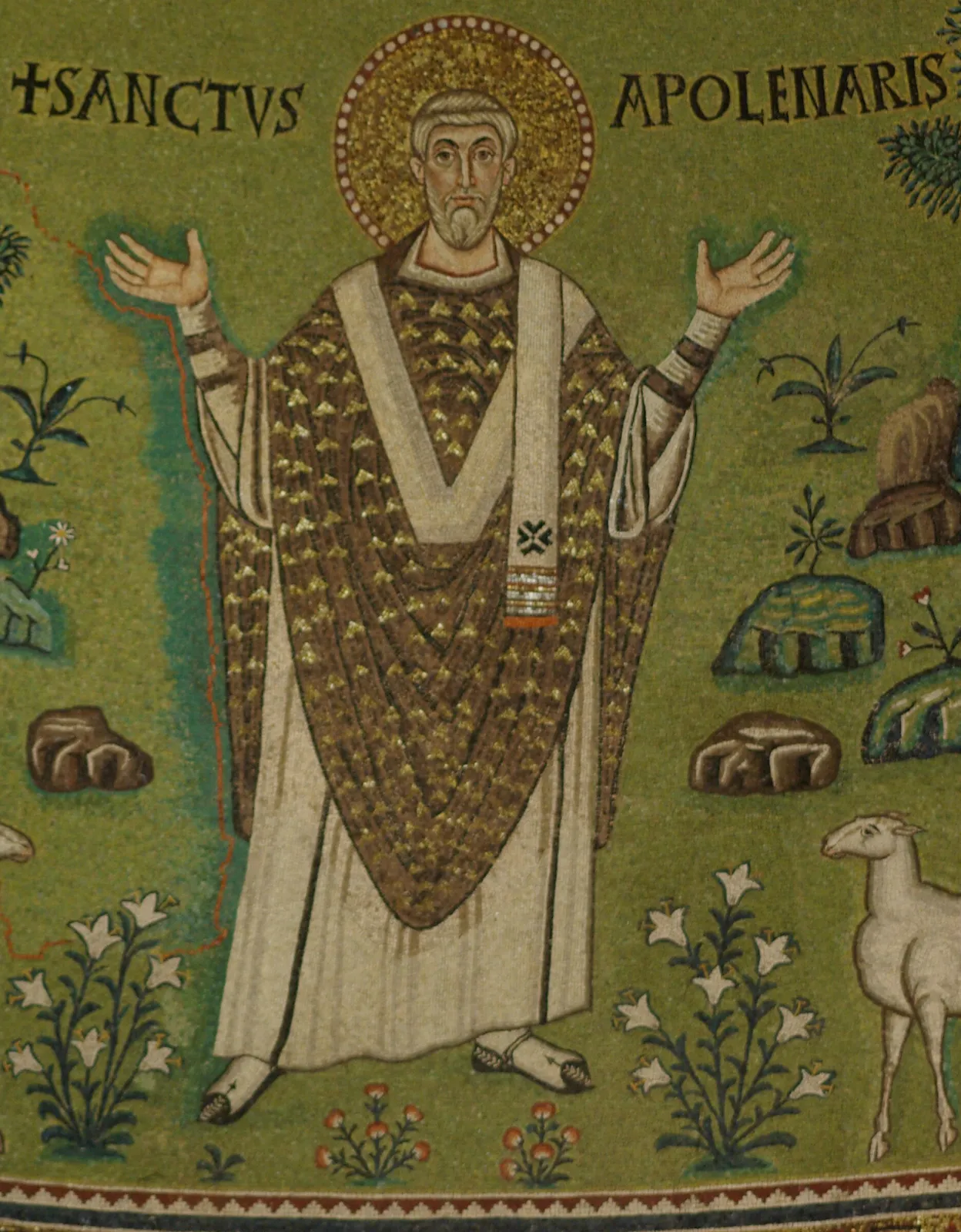
The mosaic in the apse shows him. John Paul II described it: in the vault "a great jeweled cross with the face of the transfigured Christ in the centre, and below, among many symbolic figures, is an image of St Apollinaris in a gesture of priestly prayer." 4 Benigni lists the same scene as "the preaching of St. Apollinaris" and notes that the apse mosaics have been restored. 2 The picture on this page is that figure, standing with raised hands under his name. Catholic Culture describes how he is usually shown: "bearded, in a chasuble and pallium, with sheep around him." 3
On one point the sources part. John Paul II and Catholic Culture both say his body lies in the basilica at Classe. 34 Benigni says that a church inside the city, once the Arian cathedral, is now called Sant'Apollinare Nuovo "because the relics of San Apollinaris were transferred to that church in the ninth century." 2
What is Saint Apollinaris of Ravenna the patron saint of?
Saint Apollinaris is the patron of Ravenna. John Paul II wrote that he "later became patron of the city, the Diocese and the entire region," and Catholic Culture lists the Archdiocese of Ravenna-Cervia. 34 Catholic Culture also says he is invoked against epilepsy and against gout. 3 Neither encyclopedia article names a patronage. 12
Saint Apollinaris of Ravenna's feast day
Saint Apollinaris's feast is July 20, an optional memorial, as Catholic Culture's calendar gives it; Vatican News lists "St. Apollinaris, Bishop of Ravenna and Martyr" on the same day. 35
Catholic Culture also gives the history of the date. The feast was first kept on July 23, "the day he died as a martyr," and was later moved to July 20 so as not to fall on the day of Saint Bridget of Sweden. "In the reform of the liturgical calendar of 1969, his feast day was removed due to lack of historical data, but in 2002, it was returned as an Optional Memorial on July 20." Classe, it adds, still celebrates him on July 23. 3
Praying with Saint Apollinaris
The traditional story describes a man who keeps coming back. Again and again he is driven out of Ravenna or left for dead, and each time he returns to the same city and the same work. 1 Benigni would say that this is a seventh-century composition and that the details cannot be trusted. 2 The portrait may still be true to the kind of bishop he was, since the one thing none of the sources disputes is that he was martyred. 2
The mosaic at Classe shows none of the violence. It shows a bishop at prayer, arms open, in a green field with his flock around him. 34 John Paul II hoped the basilica's architecture and mosaics would give every visitor a deep desire "to know the Lord, in order to bear witness to him in word and deed, after the example of the holy Bishop Apollinaris." 4
His feast has its own history of doubt. In 1969 his feast was taken off the general calendar for "lack of historical data." In 2002 it was put back, as an optional memorial. 3 Classe, by Catholic Culture's account, still keeps his day on July 23. 3 John Paul II wrote of him as the man who "by his labour and suffering, laid the firm foundations of the city's Christian history." 4
Saint Apollinaris of Ravenna, pray for us.
Sources
- 1.Thomas Campbell, "St. Apollinaris," The Catholic Encyclopedia, vol. 1 (New York: Robert Appleton Company, 1907).
- 2.Umberto Benigni, "Ravenna," The Catholic Encyclopedia, vol. 12 (New York: Robert Appleton Company, 1911).
- 3."Optional Memorial of St. Apollinaris, Bishop and Martyr," Liturgical Year, July 20, Catholic Culture.
- 4.Pope John Paul II, Message to the Archbishop of Ravenna-Cervia for the 1450th anniversary of the dedication of the Basilica of St. Apollinaris in Classe, July 23, 1999.
- 5."St. Apollinaris, Bishop of Ravenna and Martyr," Saint of the Day, 20 July, Vatican News.
Saints to turn to next
Others in this collection who are turned to for some of the same things.