Saint Andrew of Crete
c. 660 - 740
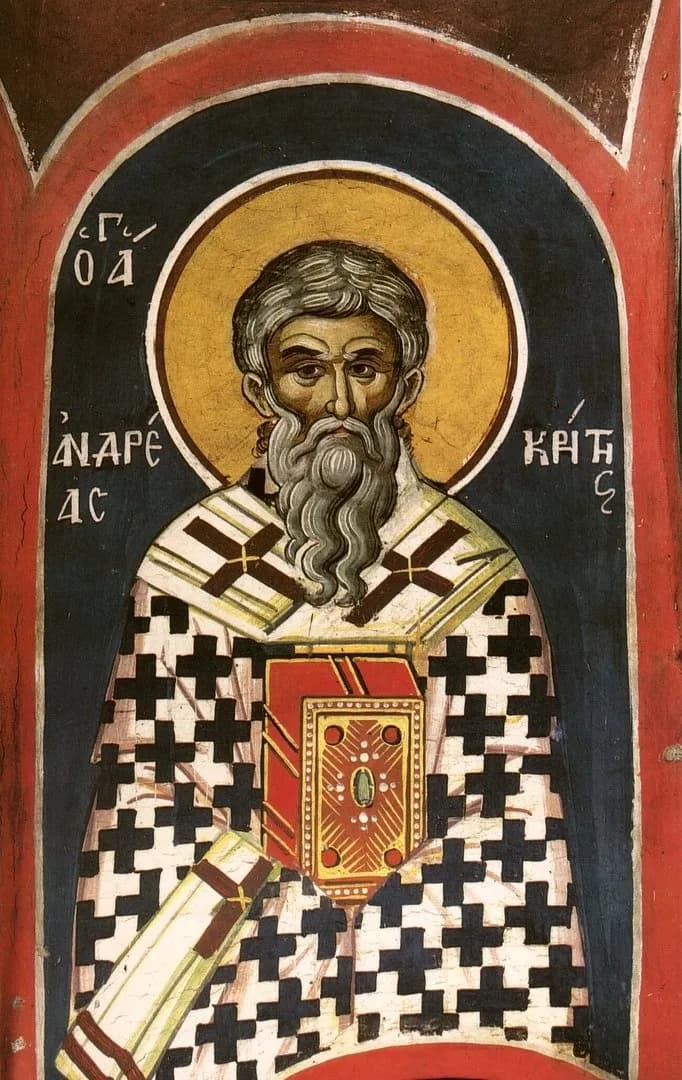
- Born
- At Damascus, about 660 1; "about the middle of the seventh century," according to the 1907 Catholic Encyclopedia 2
Saint Andrew of Crete was a monk of Jerusalem, a deacon of Constantinople and archbishop of Gortyna on Crete, who died in 740 and is remembered for what he wrote for the Church to sing. 12 His Great Canon, a hymn of repentance two hundred and fifty stanzas long, is still sung in Lent in the Byzantine liturgy. 12 The Roman Martyrology remembers him as the bishop who praised God in prayers, hymns and finely made songs, and who exalted the Virgin Mother of God. 3
Damascus and Jerusalem
Andrew was born at Damascus. The Norwegian bishops' saints database (katolsk.no) puts it at about 660 and says he came of a Christian Arab family in a city that had by then been under Muslim rule for thirty years; the 1907 Catholic Encyclopedia says only "about the middle of the seventh century." 12 At fifteen he went to Jerusalem and became a monk, by katolsk.no's account first at the monastery of Mar Saba outside the city and later at the Church of the Holy Sepulchre, ten years in all. 12
He joined the clergy of Theodore, patriarch of Jerusalem, which is why he is also called Andrew of Jerusalem, and, as the encyclopedia puts it, "rose to some distinction." 2 In 685 Theodore sent him with other monks to Constantinople. The encyclopedia says he went to congratulate the emperor Constantine Pogonatus on the Sixth General Council; katolsk.no says he went to confirm that Jerusalem accepted that council's decrees against Monothelitism, the teaching that Christ had only one will, the divine. 12
Constantinople and Crete
When the errand was done he stayed. He was ordained deacon at Hagia Sophia, and katolsk.no adds that he was put in charge of an orphanage and a home for old men. 12 Around 700 he was named archbishop of Gortyna, the metropolitan see of Crete. 12
Then came the one episode that does him no credit. In 711 Philippicus Bardanes, a convinced Monothelite, seized the throne, rejected the Sixth Council and called a synod to undo its decrees. 1 The encyclopedia dates that synod to 712 and says that Andrew, "at first an opponent of the Monothelite heresy," nevertheless attended it, "but in the following year amended his course." 2 katolsk.no says he accepted its decrees for a short time, until the usurper was driven out and the patriarch of Constantinople sent a letter of apology to the pope on behalf of those who had taken part. 1
After that, the encyclopedia says, he gave himself to "preaching, composing hymns, etc." 2 He died, by katolsk.no's account and the Martyrology's, at Eresos on the island of Lesbos. 13 The year is 740 in both katolsk.no and the encyclopedia, though the encyclopedia also allows 720. 12
The preacher
His sermons were prized in his own world and still are in the East. katolsk.no counts fifty surviving, twenty-one of them published, and says they are still read in the Byzantine Divine Office. 1 The encyclopedia counts twenty-two published and twenty-one unpublished, and judges that their doctrine, history, Scripture and "poetic imagination" put him in "the front rank of ecclesiastical orators of the Byzantine epoch." 2
Several of them are on the Virgin Mary. katolsk.no notes that he preached a number of sermons on the feast of her birth early in the eighth century. 5 The Martyrology singles out the same thread when it says he exalted the Mother of God, immaculate and assumed into heaven. 3
The Great Canon
A canon is a long liturgical poem built of odes, usually eight in practice and nine in theory, each made of short stanzas that follow the melody and rhythm of a model stanza at its head. 2 The encyclopedia says Andrew is "credited with the invention (or at least the introduction into Greek liturgical services)" of the form, "of which we have no intimation before his time." 2 katolsk.no is more cautious: he was long, and wrongly, regarded as the first to write canons, though he certainly wrote many and some are still in use. 1 The encyclopedia also notes a cost its inventor could not have foreseen: the new form gradually pushed out the older kinds of hymn in the Tropologion, the Greek prayer book. 2
The encyclopedia is candid about his gifts. Modern hymnologists, it says, found his style "rugged, diffuse, and monotonous," while the poets who followed him called him the "radiant star" and the "splendorous sun." 2 It credits him with no fewer than a hundred and eleven model stanzas, "a fertility beyond that of any other hymnographer," and lists canons of his on the raising of Lazarus, the conception of Saint Anne, the Maccabean martyrs and Ignatius of Antioch. 2 Not everything under his name is his. Of nine canons given to him in the Theotocarion of the monk Nicodemus, six are written as acrostics, a device the encyclopedia calls "wholly foreign to his authenticated compositions." 2 He also wrote many short hymns, each with its own melody, called idiomela. 12
The best known is the Great Canon, a penitential hymn for Lent of two hundred and fifty stanzas, whose "immense length" the encyclopedia says "has passed into a proverb with the Greeks." 12 It is divided into four parts sung on the first four days of Lent and is then recited entire later in the season. 2 It is still sung in the Byzantine liturgy. 1 katolsk.no adds that it is said he wrote it as penance for his brief support of the heresy. 1
What is Saint Andrew of Crete the patron saint of?
Saint Andrew of Crete's feast day
Saint Andrew of Crete's feast day is July 4, the day of his death. 123 The Roman Martyrology enters him on that day as bishop of Gortyna, dying at Eresos on Lesbos, and the Archdiocese of Madrid lists "Andrés de Creta" among the saints of July 4. 34 The encyclopedia notes that July 4 is also his feast in the Greek Church. 2
Praying with Saint Andrew of Crete
The bishop who wrote the Church's great hymn of repentance had something to repent of. For a year he went along with a synod that undid the council he had once traveled to Constantinople to support, and then he turned back. 12 The sources do not make him a hero of that year. They let it stand, and the Great Canon stands beside it. Whether or not he wrote it as penance, as is said, it is the work of a man who knew from the inside how easily a person gives way. 1
His work is also a reminder that much of the Church's prayer has authors. The stanzas sung every Lent in the Eastern churches were written by one monk from Damascus who spent his life between Jerusalem, Constantinople and an island see. 12 The encyclopedia thought them uneven, and the poets who learned from him thought them radiant, and both judgments have outlasted the man by thirteen centuries. 2
For Western Christians his feast is a door into a tradition that runs alongside their own, in which repentance is sung at length, slowly, over several days of Lent. 2 The Martyrology adds the other side of him, the preacher who kept returning to the Mother of God. 3 Between the two, a monk who had once given way spent the rest of his life writing words for other people to pray with.
Saint Andrew of Crete, pray for us.
Sources
- 1."Den hellige Andreas av Kreta (~660-~740)," Den katolske kirke (katolsk.no), Catholic Diocese of Oslo (in Norwegian).
- 2.Hugh Henry, "St. Andrew of Crete," The Catholic Encyclopedia, Vol. 1 (New York: Robert Appleton Company, 1907).
- 3.Roman Martyrology, entry for July 4, "Sant'Andrea di Creta, vescovo," as printed in "Santo del giorno," Conferenza Episcopale Italiana (in Italian).
- 4.Santoral for July 4, 2026, Oración y Liturgia, Archdiocese of Madrid (in Spanish).
- 5."Jomfru Marias fødsel," Den katolske kirke (katolsk.no), Catholic Diocese of Oslo (in Norwegian).
- 6."Den hellige Andreas av Kreta (Kalabytes) (-766)," Den katolske kirke (katolsk.no), Catholic Diocese of Oslo (in Norwegian).
Saints to turn to next
Others in this collection who are turned to for some of the same things.