Saint Andrew Dũng-Lạc
c. 1795 - December 21, 1839
- Baptized
- Andrew, at Vinh-Tri 4
- Beatified
- May 27, 1900, by Leo XIII, in the first group of Vietnamese martyrs 4
- Patron of
- No patronage is stated in the sources
Saint Andrew Dũng-Lạc was a Vietnamese parish priest, born to a poor family that was not Christian, who was ransomed out of prison by his parishioners more than once and beheaded at Hanoi on December 21, 1839. 124 His name stands at the head of the feast of the 117 Martyrs of Vietnam, bishops, priests and lay people killed for the faith, the last of them in 1862, whom John Paul II canonized together on June 19, 1988. 1234 Their feast is November 24. 23
One name for many
Vatican News puts it plainly: "One man, a priest, gives his name to today's feast, but the one stands for many." 2 John Paul II counted the many in his homily: 117 martyrs, of whom eight were bishops, fifty were priests and fifty-nine were lay people, and among them one woman, Agnes Lê Thị Thành, a mother of six. 1 Ninety-six were Vietnamese and twenty-one were missionaries from Spain and France. 2 Katolsk.no breaks the missionaries down further: eleven Spanish Dominicans, six of them bishops, and ten priests and bishops of the Paris Foreign Missions. 4
The sources date the deaths differently: 1745 to 1862 in katolsk.no, the seventeenth to the nineteenth century in Vatican News. 24 Franciscan Media gives 1820 to 1862 in one sentence and three centuries in the next. 3
Behind the 117 stands a much larger number whom nobody can name. Vatican News estimates them at between 100,000 and 300,000 martyrs. 2 Franciscan Media uses the same figures for Catholics "killed or subjected to great hardship" in the sixty years after 1820, and katolsk.no reckons the persecutions from 1625 to 1886 cost about 130,000 lives. 34 Even of the 117, John Paul II said, he could not stop over each one. 1
The boy who became Andrew
He was born Dung An-Tran, in the spelling Vatican News uses, around 1795 in northern Vietnam; katolsk.no places the family in Bac-Ninh, and Franciscan Media gives the year as 1791. 234 His parents were very poor and were not Christians. 12
Two accounts of his conversion survive. In the one Vatican News and katolsk.no tell, the family moved to Hanoi when he was twelve so that his parents could find work, and there he met a catechist who gave him food and shelter and taught him the faith. 24 Katolsk.no says the instruction lasted three years and that he was baptized at Vinh-Tri with the name Andrew. 4 John Paul II says only that he was entrusted to a catechist from his infancy. 1
He learned Chinese and Latin, became a catechist himself and taught in the countryside, and was then chosen to study theology. 4 He was ordained a priest in 1823; katolsk.no gives the date as March 15. 124 As parish priest of Ke-Dâm he preached tirelessly, fasted often and lived simply, and many people asked for baptism. 24
The edict of 1832
Christianity had come to Vietnam with the Portuguese, and the Jesuits opened the first permanent mission at Da Nang in 1615. 3 In 1832 the emperor Minh Mạng banned foreign missionaries and ordered Vietnamese Christians to renounce the faith by trampling on a crucifix. 234 Churches were to be destroyed and the teaching of Christianity was forbidden. 4
Many refused. Vatican News describes the faithful hiding priests in caves or in their own homes, and Franciscan Media compares those hiding places to the priest-holes of Ireland. 23 Some were beheaded, some suffocated and some flayed alive, and some, often priests, were hung in cages in public squares until they died. 2
Ransomed, and unwilling to be
Andrew was first arrested in 1835, and his parishioners paid for his release. 24 John Paul II says he was freed from prison more than once by ransoms the faithful paid, and that he longed for martyrdom. 1 The pope quoted him at the canonization: whoever dies for the faith goes up to heaven, Andrew said, while those who keep hiding spend money to get away from their persecutors, and it would be far better to let themselves be arrested and die. 1
He took a new name all the same, Lac, and moved to another district to go on working. 24 Persecution followed him there. 2
Arrested on the way to confession
On November 10, 1839, katolsk.no says, he was arrested again, together with another Vietnamese priest, Peter Thi, whom he had gone to visit in order to make his confession. 24 John Paul II singled the detail out for the French and Spanish pilgrims the day after the canonization, as one of many testimonies to how these priests had opened the mercy of the sacrament of penance to their people. 6
The two priests were ransomed once more, and their freedom lasted only a short time. 24 They were arrested again, taken to Hanoi and tortured, and on December 21, 1839, both were beheaded. 124
His companions
Besides Andrew, the homily tells the story of only one other martyr: Vincent Liêm, a Dominican priest martyred in 1773, the first of the ninety-six Vietnamese. 1 John Paul II added the next day that the Spanish Dominican Jacinto Castañeda gave his life together with him. 6 Ignacio Clemente Delgado, a Spanish Dominican bishop, died in a cage of hunger, thirst and exposure before the sentence of beheading could be carried out. 4 John Paul II gives his age as seventy-seven and his years as a bishop in Vietnam as forty-four; katolsk.no says seventy-six, after fifty years of work there. 46
Agnes Lê Thị Thành, the mother of six, carried letters from the confessors held in prison. 14 Dominic Xuyên, a Dominican priest, prayed the Rosary without ceasing and kept repeating, John Paul II told the Vietnamese pilgrims, that a wise man rich in faith and strong in hope does not fear the sword. 5 Théophane Vénard, a French priest of the Paris Foreign Missions, was kept in a bamboo cage and beheaded in 1861. 4
The persecution broke out again in 1847, when the emperor suspected Christians of sympathizing with a rebellion led by one of his sons. 34 Under Tự Đức, Christians had the words "ta dao," false religion, marked on their faces, families were separated and Christian villages destroyed. 24 By katolsk.no's count, of the 117, seventy-six were beheaded, twenty-one suffocated, six burned alive and five mutilated, and nine died in prison of their torture. 4 The last of them, Franciscan Media says, were seventeen lay people, one a nine-year-old, executed in 1862, the year a treaty with France guaranteed Catholics religious freedom. It did not stop all persecution. 3
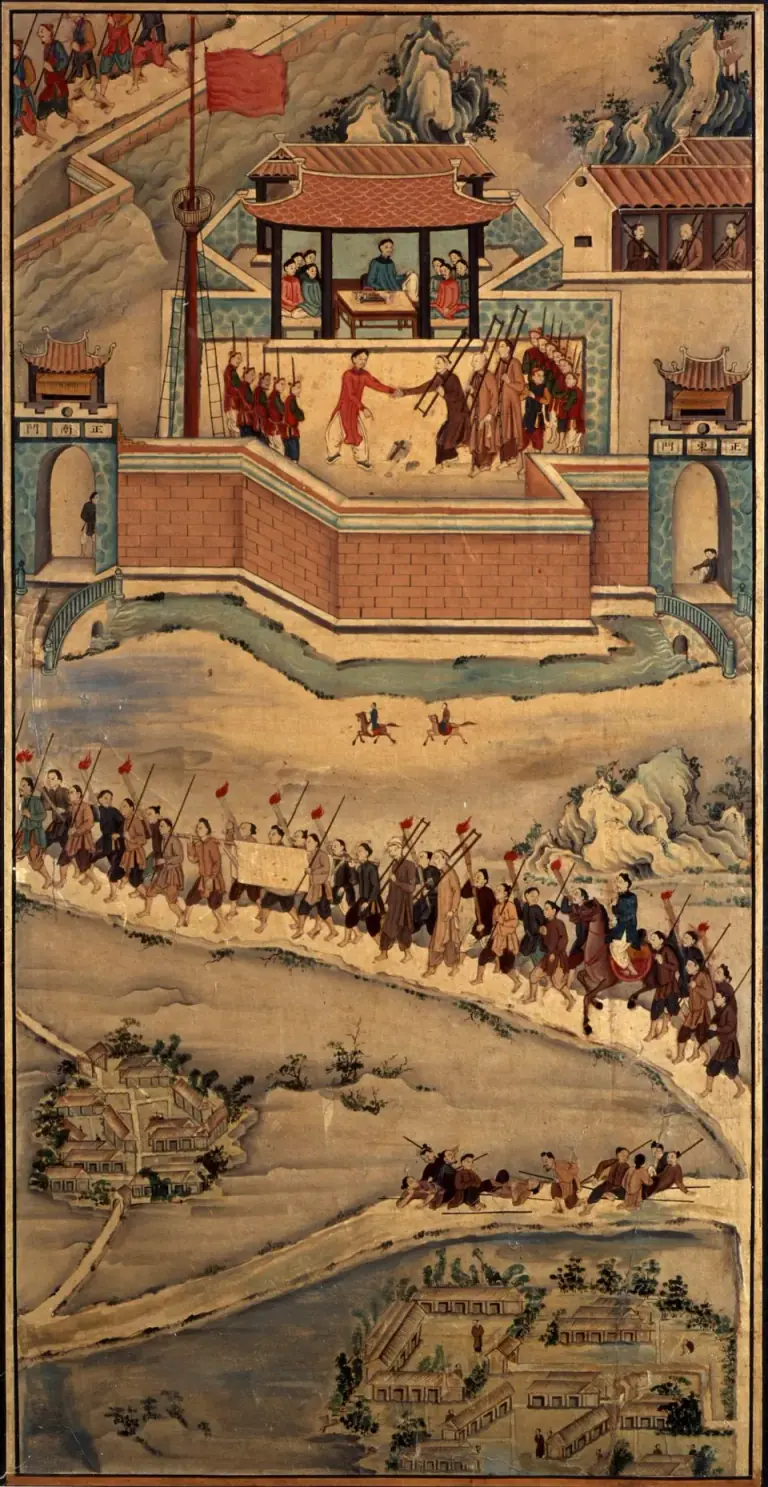
The painting at the top of this page shows three more of them under arrest at Ninh Bình: a priest, Paul Phạm Khắc Khoan, and two laymen, Peter Nguyễn Văn Hiếu and John Baptist Đinh Văn Thanh, who died in 1840 and are numbered among the saints. 7
Canonized together
The 117 were beatified in four groups: in 1900 by Leo XIII, in 1906 and 1909 by Pius X, and in 1951 by Pius XII. 34 John Paul II canonized them together in Rome on June 19, 1988, and told the Spanish pilgrims the next day that it was the largest canonization yet held. 16
The government of Vietnam allowed no one from the country to attend. 24 Vatican News says 8,000 Vietnamese Catholics of the diaspora came instead. 2 That evening, in a short greeting in Vietnamese, the pope told them he rejoiced with them that the Church in Vietnam now had 117 saints. 5
He also spoke of how the martyrs had stood toward their own country. Following the first Vietnamese catechism, he said, they bore witness that one God alone is to be worshiped, and they declared their loyalty to the country's authorities in everything just and honest, and taught respect and veneration for ancestors according to the customs of their land. 1
What is Saint Andrew Dũng-Lạc the patron saint of?
None of the sources read for this page names Saint Andrew Dũng-Lạc the patron saint of anything. Vatican News, Franciscan Media and katolsk.no present him as a priest and martyr whose name the feast of the Vietnamese martyrs carries, and John Paul II presents him the same way. 1234
What John Paul II asked of the martyrs as a group was intercession. On the evening of the canonization he told the Vietnamese pilgrims that the martyrs were more than examples to them: they intercede, he said, and call them to stay faithful. 5
Saint Andrew Dũng-Lạc's feast day
Saint Andrew Dũng-Lạc and his companions are celebrated on November 24. 234 Katolsk.no notes that the groups beatified at different times were formerly kept on different days, February 2 for those beatified in 1909, and also July 11 and November 6, and that all are now kept together on November 24. 4
November 24 is not the day he died, which was December 21. 12 Katolsk.no does record that on November 24, 1960, John XXIII established the Catholic hierarchy in Vietnam. 4
Praying with Saint Andrew Dũng-Lạc
He did not want to be ransomed. He said so, and the pope quoted it at his canonization: better to be arrested and die than to keep paying to stay hidden. 1 He was ransomed anyway, more than once, and he took a new name and went on working. 24 The page does not settle which of them was right, and neither do the sources. A priest who longed for martyrdom spent the years after his first arrest working under another name among people who would not let him have it.
When he was taken the last time, he was on his way to confession. 24 John Paul II thought that worth telling to pilgrims in Rome a century and a half later. 6 He had gone to another priest to confess his sins, and that is where they took him.
The feast carries his name, but it is a feast of a crowd: a mother of six, a bishop of seventy-six or seventy-seven left in a cage, a nine-year-old put to death in 1862. 1346 Nothing in the sources makes that last fact easier to read, and the page does not try. Behind the 117 stand a hundred thousand or more others, whose names nobody kept. 234
John Paul II asked the Vietnamese in Rome to stay faithful to their roots and to the Church still in Vietnam, and to look to the martyrs as more than examples. 5 The martyrs he described in his homily had refused one thing only. Everything else that was just and honest they had given their country, the pope said, and he asked the same of their heirs. 1
Saint Andrew Dũng-Lạc, pray for us.
Sources
- 1.John Paul II, Homily at the canonization of 117 Vietnamese martyrs, Rome, June 19, 1988. The Holy See (in Italian).
- 2."Sts. Andrew Dũng Lạc, and his companions, Martyrs," Saint of the Day for November 24, Vatican News.
- 3."Saint Andrew Dung-Lac and Companions," Saint of the Day, Franciscan Media.
- 4.Per Einar Odden with John Vu Manh Hùng, "St. Andrew Dung-Lac and his 116 companions (d. 1745-1862)," Den katolske kirke (the Catholic Church in Norway), last updated March 1, 1998.
- 5.John Paul II, Address to a group of Vietnamese pilgrims, June 19, 1988. The Holy See (in French, with a greeting in Vietnamese).
- 6.John Paul II, Address to the French and Spanish pilgrims in Rome for the canonization of the 117 Martyrs of Vietnam, June 20, 1988. The Holy See (in French and Spanish).
- 7."Saints and Blesseds of Vietnam," GCatholic.org.
Saints to turn to next
Others in this collection who are turned to for some of the same things.