Blessed Miguel Pro
January 13, 1891 - November 23, 1927
- Feast day
- November 23, the day he was killed; an optional memorial in the dioceses of the United States 12
- Born
- Miguel Agustín Pro Juárez, January 13, 1891, at Guadalupe de Zacatecas, Mexico, the son of a mining engineer 23
- Beatified
- By John Paul II in St. Peter's Square, September 25, 1988 4
Blessed Miguel Agustín Pro was a Mexican Jesuit who came home in 1926, newly ordained, just weeks before the government suppressed all public worship and every priest in the country became a hunted man. 3 For more than a year he said Mass in private houses, often in disguise, and on November 23, 1927 he was shot without a trial, his arms stretched out in the shape of a cross. 35 His last words were "¡Viva Cristo Rey!" - Long live Christ the King. 2
Zacatecas, and a novitiate that burned
He was born on January 13, 1891, at Guadalupe de Zacatecas, into a family Franciscan Media describes as prosperous and devout. 2 His father was a mining engineer. 3 He was taught mostly by tutors, so that when he entered the Society of Jesus he had not finished his secondary education and found the studies hard; the Jesuits' own account says he made up for it by giving himself to prayer. 3
The Register remembers a boy who played practical jokes on his brothers and sisters and liked to entertain his classmates, and a seminarian his companions recalled as the most playful and the most prayerful of them. 5 Poor health sent him to the hospital more than once, and to the surgeon. 5
He entered the Jesuits in 1911 and took his vows in August 1913, just as the Mexican Revolution turned on the Church. 23 The forces of Venustiano Carranza and of Pancho Villa sacked churches and tortured priests and religious, and on August 5, 1914, Carranza's men ransacked the novitiate and burned its library. 3 The rector told each novice to make his own way across the border into the United States. 3
Exile: California, Spain, Nicaragua, Belgium
Franciscan Media's short account says only that three years after he entered, he fled to Granada, in Spain. 2 The Jesuit curia's account, and the Register's, put the United States first: he reached the house the Jesuits had offered the Mexican seminarians at Los Gatos, California, on October 9, and spent a year there before going on to Spain to study philosophy. 35
In 1920 he was sent to teach in Nicaragua, then went back to Spain for theology. 3 In 1924 he moved to Enghien, in Belgium, to finish the theology course and to study sociology, because he was interested in the workers' movements and wanted to be ready for them when he went home. 3 He was ordained in Belgium in 1925, while the persecution in Mexico was sharpening under President Plutarco Elías Calles. 23
A priest in hiding in Mexico City
He crossed back into Mexico in June 1926 without any trouble. At the end of July the government suppressed all public worship and closed the churches. 3 From then on he served what Franciscan Media calls a Church "forced to go 'underground,'" celebrating the Eucharist in secret and bringing the other sacraments to small groups of Catholics. 2
He set up stations in different parts of Mexico City and visited them on a regular round to preach and give the sacraments. 3 John Paul II's beatification homily calls them "stazioni eucaristiche," Eucharistic stations in private homes where, through the years of persecution, people could receive Communion in secret every day. 4 The same homily puts the daily Mass at the center of his life. 4
He usually lived with his family, who had moved to the capital, and kept other places to shelter. 3 Two of his brothers, Humberto and Roberto, worked with him, printing and distributing literature for the Religious Defense League. 3 By the Register's account he traveled in disguise: as a well-dressed businessman in Mexico City, raffling donated goods to feed and clothe the poor, and once as a mechanic, to preach to a congregation of cab and bus drivers. 5
He was picked up more than once in that year and released each time for lack of proof. 5 In one letter he joked that God was protecting his ministry so plainly that he might never get to die at all, which would be a great disappointment, since he was looking forward to playing the guitar with his guardian angel. 5
November 1927
On Sunday, November 13, 1927, a bomb was thrown at General Álvaro Obregón and exploded without killing him. 3 The accounts name the target differently: the Jesuit curia says Obregón, Franciscan Media says "Mexico's president," and the Register says Calles. 235 Neither Miguel nor his brothers had any part in the plot. 23 One of the brothers had owned a car used in the attack, and had sold it only days before. 3
The brothers decided to leave for the United States, but the police surrounded the house where they were staying and arrested all three. 3 Luis Segura, who had organized the attack, gave himself up when he heard that Father Pro had been arrested and blamed for it. 3 It made no difference. Calles wanted an example made of the Jesuit, and on November 22 he invited friends to an execution the next day. 3 He also made sure a photographer would be there. 5 There was no trial. 5
The morning of November 23
Soldiers brought him into the prison yard on the morning of November 23; the Jesuit account says he did not know what was waiting for him. 3 When he saw the spectators and the firing squad, he asked for a few moments to pray, and then refused the blindfold. 3 The Register adds that he blessed the soldiers as he passed them and forgave the men who were about to kill him. 5
He stood against the wall with his arms stretched out in the form of a cross. 35 The Jesuit account puts his rosary in his hand; the Register gives him a crucifix in one hand and the rosary in the other. 35 At the order to fire he cried out "¡Viva Cristo Rey!" 23 The volley did not kill him, and a soldier walked up and finished him with a shot at point-blank range. 5
His brother Humberto was shot later that morning, and so was Luis Segura. Roberto was spared at the last moment. 23
The photographs, and the funeral
The photographs Calles had ordered were printed the next day, and the Register says they covered the front pages of the country's newspapers. 5 They were meant to frighten Catholics. They did the opposite. 5
His father claimed the body and held the wake at the family's home, and thousands of workers, and soldiers too, came to see it. 3 Franciscan Media says simply that the funeral became a public demonstration of faith. 2 The Register gives numbers: 40,000 people lining the procession through Mexico City, and his father, refused a Catholic funeral, saying the prayers over his son's body himself while 20,000 more joined the crowd. 5
His cause was opened in 1952. 5 On September 25, 1988, in St. Peter's Square, John Paul II beatified him together with five others, among them Junípero Serra. 4 The Pope called him a new glory for the Mexican nation and for the Society of Jesus, and said that neither grave illness nor a ministry carried on in painful and dangerous conditions had been able to smother the joy that came from his love of Christ. 4 The deepest root of his self-giving, the homily says, was that love, and his desire to become like Christ even in his death. 4
What is Blessed Miguel Pro the patron saint of?
None of the sources used here names a patronage for him, and the page leaves it that way rather than borrow one.
What John Paul II did with him at the beatification was hold him up to priests. Faced with his example, the Pope urged his brother priests toward a total dedication to Christ, celibacy lived with joy, and generous service to others, the poorest and most abandoned above all. 4
Blessed Miguel Pro's feast day
Blessed Miguel Pro is remembered on November 23, the day he was killed in 1927. 123 In the United States it is an optional memorial, entered in the Proper Calendar for the Dioceses of the United States as "Blessed Miguel Agustín Pro, Priest and Martyr." 1 Franciscan Media keeps him on the same day. 2
In 2026, November 23 falls on a Monday in the last week of Ordinary Time, and a parish may celebrate him, or Saint Clement I, or Saint Columban, all three of them optional memorials: red for the two martyrs, white for Columban. 1
Praying with Blessed Miguel Pro
Before his courage, the people who knew him remembered that he was funny. 5 The jokes did not stop when the churches closed; the letter about the guitar and the guardian angel was written by a man who knew he was being hunted. 5 John Paul II said the same thing in a homily's language: the joy outlasted the illness and the danger, and nobody could take it from him. 4
He was also not a natural scholar. He came to the Jesuits without a finished education, found the work hard, and answered the difficulty with prayer. 3 Then came nearly twelve years of exile in four countries, much of it spent preparing for a ministry among workers that he would exercise for about seventeen months, almost entirely in secret. 3
The ministry itself was small and repetitive: the same houses on a round, Mass in private homes, the sacraments given quietly to a few people at a time. 234 Nothing in it was designed to be seen. What was seen, in the end, was the one moment Calles chose to photograph, and he chose it in order to break people. 5
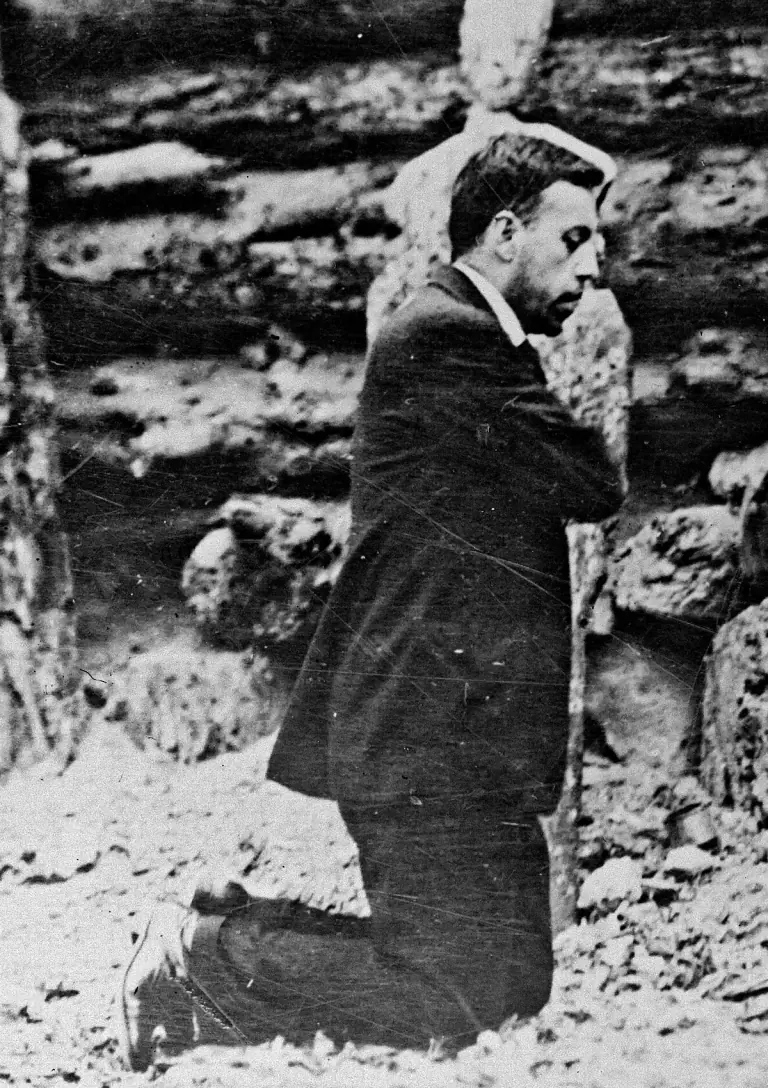
It is not a story that turns out well for everyone in it. His brother Humberto was shot the same morning on the same false charge, and Roberto was spared only at the last moment. 23 The photograph at the top of this page shows Miguel on his knees a few minutes before he died, praying, in a yard full of men who had come to watch. 3 It is right to look at it slowly.
Blessed Miguel Pro, pray for us.
Sources
- 1.Liturgical Calendar for the Dioceses of the United States of America 2026, United States Conference of Catholic Bishops, Secretariat of Divine Worship.
- 2."Blessed Miguel Agustín Pro," Saint of the Day, Franciscan Media.
- 3.Tom Rochford, SJ, ed., "Blessed Miguel Agustín Pro," Saints and Blessed, The Society of Jesus (jesuits.global).
- 4.John Paul II, Homily for the beatification of six Servants of God, St. Peter's Square, September 25, 1988 (in Italian).
- 5.Kelly Marcum, "'Viva Christo Rey!': How Miguel Pro's Martyrdom United a Nation," National Catholic Register, November 29, 2024.
Saints to turn to next
Others in this collection who are turned to for some of the same things.
- Saint Bernardo TolomeiMay 10, 1272 - August 20, 1348PrayerCourageSuffering and illness
- Saints Carpus, Papylus and Agathonicad. c. 170 or 250CourageSuffering and illnessPrayer
- Saint Claude de la Colombiere1641 - February 15, 1682PrayerSuffering and illnessCourage
- Saint Dominic SavioApril 2, 1842 - March 9, 1857PrayerSuffering and illnessCourage