Saint Zosimus
Died December 26 or 27, 418
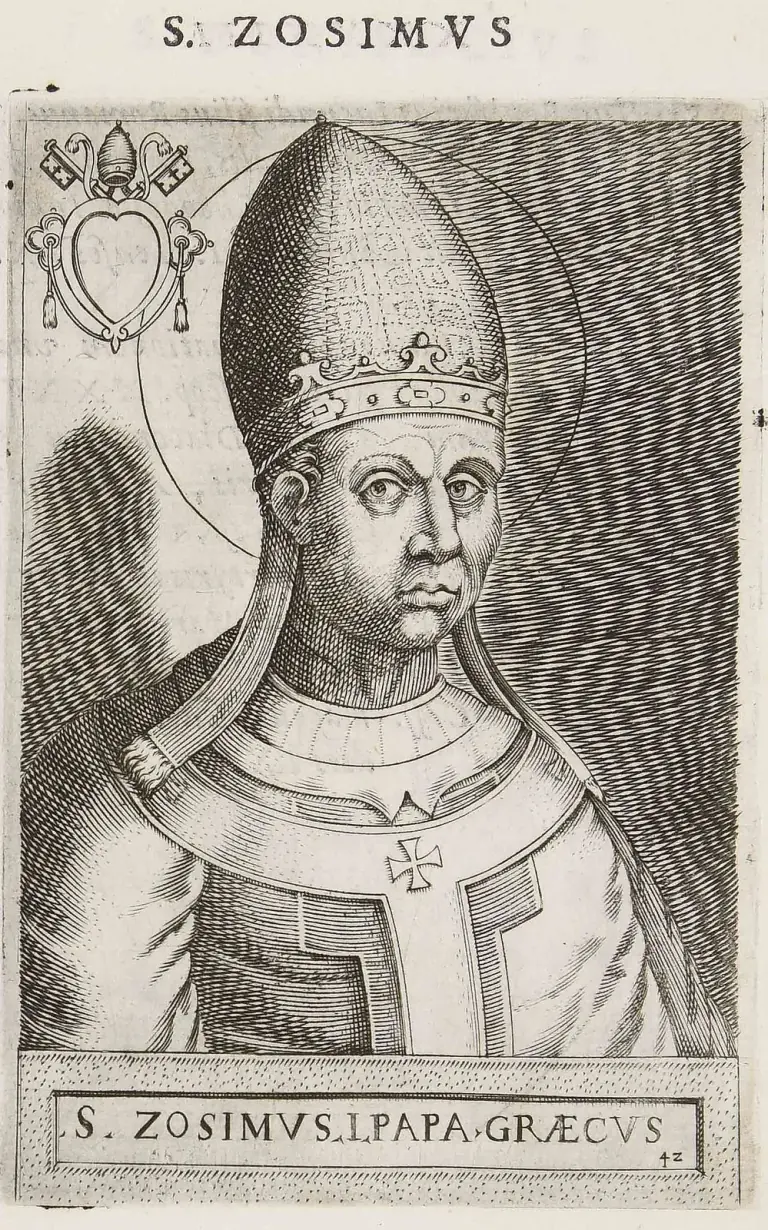
Saint Zosimus was pope for twenty-one months, from March 417 to December 418. 1 His short reign is remembered for one affair: he first accepted the professions of faith of the Pelagian leaders Caelestius and Pelagius and rebuked the African bishops who had condemned them, then, when the Africans answered, condemned both men in a letter sent to the whole Church. 12 His feast is December 26. 5
A Greek in Rome
Innocent I died on March 12, 417, and Zosimus was consecrated bishop of Rome on March 18. 1 The Liber Pontificalis says he was "by nationality a Greek, son of Abramius." 4 Johann Peter Kirsch, writing in the Catholic Encyclopedia, notes that the historian Harnack wanted to infer a Jewish family from the father's name, and adds Duchesne's caution that the book's statements about popes' families "cannot always be regarded as exact." 1 The Norwegian bishops' database calls Jewish descent possible. 3 Of his life before his election, Kirsch says flatly, "nothing is known." 1
He began at once. Within four days he had issued a letter making Patroclus, bishop of Arles, metropolitan over the provinces of southern Gaul and a kind of papal vicar for the whole country; no Gallic cleric could travel to Rome without a certificate from him. 13 The bishops of Vienne, Narbonne and Marseilles protested that their rights had been taken. 1 The Norwegian account says Zosimus went so far as to depose the bishop of Marseilles in March 418, and that his successor had to undo the arrangement. 3 Kirsch says the dispute was not settled until Leo I. 1
Caelestius and Pelagius in Rome
Innocent had excluded Pelagius and his disciple Caelestius from communion in January 417 "until they should come to their senses." 2 Within months of his death both men appealed to his successor. 12 Caelestius came to Rome in person. In the summer of 417 Zosimus heard him before the Roman clergy in the basilica of Saint Clement. 1 Caelestius would not condemn the propositions for which he had been condemned at Carthage in 411, but declared that he accepted the doctrine of Innocent's letters and made a confession of faith "from the Trinity of one God to the resurrection of the dead." 12 Pelagius, still in Palestine, sent a confession of his own, addressed to Innocent, with a new treatise on free will. 12
Zosimus was persuaded. He wrote to the Africans that it was not certain the two men had taught what they were accused of, that the bishops who had brought the charges had acted hastily, and that anyone with a case against Caelestius should come to Rome within two months. 12 A second Roman synod heard Pelagius's documents, found them orthodox, and Zosimus wrote again in his defense. 1
The encyclopedia's two writers judge this differently. Kirsch says "the pope was won over by the shrewdly calculated conduct of Coelestius," and that Pelagius's "skilfully chosen expressions" hid what he meant. 1 Joseph Pohle, in the encyclopedia's article on Pelagianism, is gentler: the persons, not the doctrine, were in question, and "Zosimus' sense of justice forbade him to punish anyone with excommunication before he was duly convicted of his error." 2 The Norwegian account is the hardest of the three. It calls him impulsive and a poor judge of people, and says he let himself be deceived. 3
Carthage answers, and the Tractoria
"The papal command struck Africa like a bomb-shell," Pohle writes. 2 A synod met at Carthage in November 417 and begged Zosimus not to undo Innocent's sentence until the two men had confessed that grace is needed for every good thought, word and deed. 2 Zosimus drew back. In a letter of March 21, 418, he told the Africans that he had decided nothing definitively and wished to settle nothing without them. 12
On May 1, 418, a great council met at Carthage and condemned Pelagianism again in eight or nine canons. Pohle counts 200 bishops present; the Norwegian account, 214. 23 The day before, the emperor Honorius had issued a rescript from Ravenna banishing the Pelagians from the cities of Italy. 2 Zosimus summoned Caelestius again, and Caelestius did not come. 23
The pope then issued his Tractoria, a letter to the bishops of the world condemning Pelagianism and its authors. Only fragments survive. 12 The Norwegian account reports Prosper of Aquitaine's praise of it, that it put the sword of Peter into the hand of every bishop. 3 Eighteen Italian bishops who would not sign were deposed and exiled, Julian of Eclanum first among them. 2 Kirsch's conclusion is that "the occupant of the Apostolic See at the right moment maintained with all authority the traditional dogma of the Church." 1
The appeal of Apiarius
A second quarrel with Africa followed. Apiarius, a priest of Sicca, had been excommunicated by his bishop and appealed directly to Rome, passing over the course of appeal laid down in Africa. 1 Zosimus accepted the appeal at once and sent legates to investigate. 1 Kirsch thinks this a mistake: "A wiser course would have been to have first referred Apiarius to the ordinary course of appeal in Africa itself." 1
He made a second mistake in good faith. He justified his action by a canon he believed to be from the Council of Nicaea, which was in fact a canon of Sardica. In the Roman manuscripts, Kirsch explains, the canons of Sardica followed those of Nicaea "without an independent title," while the African copies contained only the genuine Nicene canons, so the Africans could not find the canon he cited. 13 The dispute outlived him. 1
Decrees, opposition and death
The Liber Pontificalis credits him with small decrees for the Roman clergy: that deacons in the parishes might wear a cloth of wool and linen over the left shoulder, that the wax might be blessed, and that no cleric "should drink in public." 4 The Norwegian account adds that he barred men born outside marriage from the priesthood, and that in his last months a party among his own clergy intrigued against him at the court in Ravenna. He was preparing to excommunicate them when he fell ill. 3
He died after a long illness, on December 26, 418, by the Norwegian reckoning; Kirsch gives December 27. 13 The Liber Pontificalis says he was buried "on the Via Tiburtina, near the body of blessed Lawrence, the martyr," on December 26, while Loomis, its translator, dates the burial to Friday, December 27. 4 Within a day of his funeral the Roman clergy had split over his successor. 4
What is Saint Zosimus the patron saint of?
Saint Zosimus's feast day
Saint Zosimus's feast day is December 26. The Roman Martyrology, in the text published by the Italian bishops, enters him on that date: at Rome, on the Via Tiburtina near Saint Lawrence, the burial of Saint Zosimus, pope. 5 The 1897 English edition of the Martyrology also has "St. Zosimus, pope" on December 26, and the Norwegian bishops' database gives the same day. 36
Praying with Saint Zosimus
Zosimus is not remembered for getting things right the first time. Two men under sentence came to him with professions of orthodox faith, and he believed them and rebuked the bishops who had condemned them. 12 The Africans told him he had been deceived, and within a year he condemned both men in a letter to the whole Church. 12
Pohle reads his first decision as a scruple about justice: the men had not been convicted in his presence, and he would not condemn them unheard. 2 Kirsch reads it as a pope outmaneuvered. 1 Both can be true of the same act.
What the sources agree on is the turn. When the evidence came, he summoned Caelestius once more, and when Caelestius did not appear he wrote the Tractoria. 2 He told the Africans in March 418 that he had settled nothing without them, which was not quite how his first letters had sounded. 12
The Apiarius affair shows the other side. He cited a canon in good faith that turned out to be from the wrong council, and the quarrel it started was still running after his death. 1
Saint Zosimus, pray for us.
Sources
- 1.Johann Peter Kirsch, "Pope St. Zosimus," The Catholic Encyclopedia, vol. 15 (New York: Robert Appleton Company, 1912).
- 2.Joseph Pohle, "Pelagius and Pelagianism," The Catholic Encyclopedia, vol. 11 (New York: Robert Appleton Company, 1911).
- 3."Den hellige pave Zosimus," compiled and translated by Per Einar Odden, Den katolske kirke (katolsk.no), the Catholic Church in Norway (in Norwegian).
- 4.The Book of the Popes (Liber Pontificalis), vol. 1, To the Pontificate of Gregory I, translated by Louise Ropes Loomis (New York: Columbia University Press, 1916), "Zosimus" and "Boniface I," with the translator's notes.
- 5.Roman Martyrology, entry for December 26, "San Zosimo, papa," Santo del giorno, Conferenza Episcopale Italiana (in Italian).
- 6.The Roman Martyrology, December 26 (Baltimore: John Murphy & Co., 1897).
- 7."Zosimus," The Supreme Pontiffs, The Holy See.
Saints to turn to next
Others in this collection who are turned to for some of the same things.