Saint Zechariah the Prophet
Sixth and fifth centuries B.C.; date of death unknown
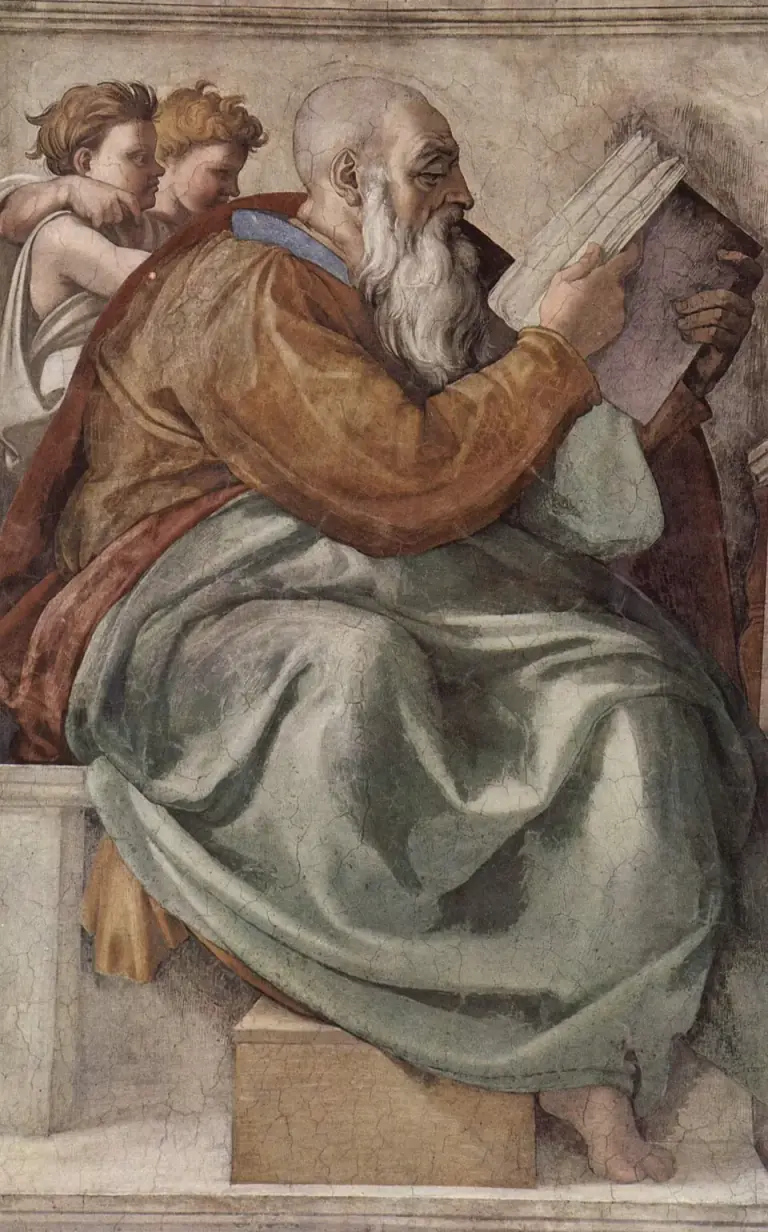
- Name
- "Yahweh remembers" 1
- Known for
- Urging the rebuilding of the Temple; the king "poor, and riding upon an ass"; "they shall look upon me, whom they have pierced" 1101215
- Died
- Unknown; by tradition in old age, buried near the prophet Haggai 4
Saint Zechariah was the prophet who, with Haggai, stirred the Jews who had come back from Babylon to rebuild the Temple in Jerusalem, beginning in 520 B.C. 1315 His book is the source of two of the most quoted prophecies in the Gospels: the king who comes "poor, and riding upon an ass," fulfilled on Palm Sunday, and "they shall look upon me, whom they have pierced," fulfilled at the Cross. 110121718 The Church keeps his feast on September 6. 2
Which Zechariah?
The name was common, and it means "Yahweh remembers." 1 This Zechariah calls himself "the son of Barachias, the son of Addo," while the Book of Esdras twice calls him simply "the son of Addo." 51516 Walter Drum, in the 1912 Catholic Encyclopedia, notes that Addo was a chief priest who came back from captivity with Zerubbabel, and that a Zechariah of Addo's family appears as a chief priest a generation later, "most likely" the prophet. 1 Vatican News says only that he could have been a priest as well. 3
He is not the Zechariah of Saint Luke's Gospel, the priest "of the course of Abia" who lived "in the days of Herod" and became the father of John the Baptist, five centuries later. 20 Nor is he the Zechariah son of Joiada the priest, who rebuked King Joas and was stoned "in the court of the house of the Lord." 21 Christ speaks of the blood "of Zacharias the son of Barachias, whom you killed between the temple and the altar," and because the father's name is the same, the question has been asked whether he meant the prophet. 122 Drum calls that "not at all probable": the man killed in the Temple was the son of Joiada, and the people of the prophet's own day obeyed him. 1
The prophet of the second Temple
The first exiles had come home under Cyrus in 538 B.C. and laid the Temple's foundations, and eighteen years later it stood unfinished. 115 In the second year of King Darius the prophet Haggai asked: "Is it time for you to dwell in ceiled houses, and this house lie desolate?" 14 Two months later, in the eighth month of the same year, the word of the Lord came to Zechariah. 15
His first message is a call to conversion. "Turn ye to me, saith the Lord of hosts: and I will turn to you." 5 Their fathers had not listened to the former prophets, he told them, and had learned the cost. 5
The Book of Esdras records what followed. "Aggeus the prophet, and Zacharias the son of Addo, prophesied to the Jews that were in Judea and Jerusalem," and Zerubbabel and the high priest Joshua began to build, "and with them were the prophets of God helping them." 15 The elders "built and prospered according to the prophecy of Aggeus the prophet, and of Zacharias the son of Addo," and the house was finished in the sixth year of Darius. 16
Eight visions in one night
Three months into his ministry, on the twenty-fourth day of the eleventh month, Zechariah saw a series of visions by night. 15 Drum counts eight. 1 The first is a man on a red horse standing among myrtle trees, with other horsemen behind him who report that all the earth is at rest. 5 The angel pleads for Jerusalem, and the answer is comfort: "the Lord will yet comfort Sion, and he will yet choose Jerusalem." 5
In another, a man with a measuring line is told that the new Jerusalem will need no walls, because the Lord will be a wall of fire around it. 1 Then Joshua the high priest stands before the angel "clothed with filthy garments," with Satan at his right hand to accuse him. 6 The Lord rebukes Satan, "Is not this a brand plucked out of the fire?", and the filthy garments are taken away. 6 The vision ends with a promise: "I will bring my servant the Orient." 6 Challoner's note reads the Orient as Christ, rising "like the sun in the east"; Drum renders the Hebrew as "the Sprout." 16
A golden lampstand stands between two olive trees, which the angel calls "two sons of oil," the high priest and the governor. 7 To Zerubbabel, struggling with a half-built house, comes the word: "Not with an army, nor by might, but by my spirit, saith the Lord of hosts." 7 And to those who thought the new Temple a poor thing beside the old: "For who hath despised little days?" 7 The rest, among them a flying scroll and four chariots sent to the ends of the earth, complete the night. 1
"Judge ye true judgment"
Almost two years later, in the fourth year of Darius, a delegation asked the priests and prophets whether they still had to keep the fast that mourned the burning of the Temple. 18 Zechariah asked whether, in all those years, they had fasted for the Lord at all, and repeated what the former prophets had said. "Judge ye true judgment, and shew ye mercy and compassion every man to his brother. And oppress not the widow, and the fatherless, and the stranger, and the poor." 8 Drum sums it up: "abstinence from fraud and not from food is the service Yahweh demands." 1 Vatican News draws from the same chapters a prophet attentive to social justice. 3
The next chapter is one of the gentlest in the prophets. Old men and old women will sit again in the streets of Jerusalem, each with a staff in his hand, "and the streets of the city shall be full of boys and girls, playing in the streets thereof." 9 The fasts of mourning will become "joy, and gladness, and great solemnities: only love ye truth and peace." 9
"Behold thy king will come to thee"
The second part of the book, chapters 9 to 14, is poetry, and in Drum's reading it was written many years later, when the Temple stood again and the prophet "peers into the faraway future." 1 Some critics give these chapters to another writer; Drum held that Zechariah wrote them too, perhaps thirty-five years after the first part. 1 Their best-known verse is this: "Rejoice greatly, O daughter of Sion, shout for joy, O daughter of Jerusalem: Behold thy king will come to thee, the just and saviour: he is poor, and riding upon an ass, and upon a colt the foal of an ass." 10 The king will take the chariot and the war horse away and "speak peace to the Gentiles, and his power shall be from sea to sea." 10
Saint Matthew writes that when Jesus sent his disciples to bring the ass and the colt, "all this was done that it might be fulfilled which was spoken by the prophet." 17 The Martyrology remembers Zechariah in the same terms, as the prophet who announced a king of peace, a promise that Christ the Lord wonderfully fulfilled in his triumphal entry into the holy city. 2
Benedict XVI, preaching on Palm Sunday in 2006, drew three things from the prophecy. 19 The king would be "a king of the poor, a poor man among the poor and for the poor"; he would be a king of peace, fulfilled in the Cross, which the Pope called "the broken bow"; and his kingdom would reach "from sea to sea," across every border. 19
The shepherd and the pierced one
In chapter 11 the prophet is told to "feed the flock of the slaughter." 11 He asks for his wages, "and they weighed for my wages thirty pieces of silver," which he is told to cast to the potter, "a handsome price, that I was prized at by them." 11 Drum sees the prophet here acting out a shepherd rejected and sold, a figure of the Good Shepherd. 1
Then comes the verse Saint John quotes at the Cross. God will pour out "the spirit of grace, and of prayers," and "they shall look upon me, whom they have pierced: and they shall mourn for him as one mourneth for an only son." 12 When the soldier opened Christ's side with a spear, John writes, "another scripture saith: They shall look on him whom they pierced." 18 Drum reads the mourning of Jerusalem as a figure of the sorrow and prayer that Jesus would inspire in the Church "while its members look upon Him Whom they have pierced." 1
The next chapter promises "a fountain open to the house of David, and to the inhabitants of Jerusalem: for the washing of the sinner." 13 Then: "strike the shepherd, and the sheep shall be scattered." 13 Drum notes that Saint Matthew saw in this verse the scattering of the Lord's disciples. 1
How did Zechariah die?
Scripture does not say. Drum suggests that the occasion of the book's second part was "perhaps the approach of the Prophet's death," and places the whole prophecy in Jerusalem. 1 The 1897 English edition of the Roman Martyrology gives the older tradition: he "in his old age, returned from Chaldea to his own country, and lies buried near the prophet Aggeus." 4 Vatican News reports the opinion, drawn from Augustine, Epiphanius and Isidore, that he may have begun his ministry in Babylon and ended it in Palestine. 3
What is Saint Zechariah the patron saint of?
Saint Zechariah's feast day
Saint Zechariah's feast day is September 6. The Roman Martyrology, in the text published by the Italian bishops, commemorates him that day as the prophet who foretold the people's return from exile to the promised land and announced to them a king of peace. 2 Vatican News and the 1897 Martyrology also give September 6. 34
He should not be confused with Zechariah the father of John the Baptist, who is a separate entry in the Martyrology: the 1897 edition kept "St. Zachary, priest and prophet, father of blessed John the Baptist" on November 5. 420
Praying with Saint Zechariah
Zechariah spoke to people who had come home to ruins and lost heart, their own houses finished and the Lord's house desolate. 14 He began with the plainest word a prophet has: turn to me, and I will turn to you. 5
Much of what he was given to say was about small things: a half-built Temple, a governor told that it would be finished "not with an army, nor by might, but by my spirit," children playing in the streets again. 79
When the people asked about fasting, he turned the question back on them: judgment, mercy, and care for the widow, the orphan, the stranger and the poor. 8 The fasts of mourning were to become feasts, on one condition: "only love ye truth and peace." 9
The Gospels quote him at the two ends of Holy Week. The king who comes on an ass is the one Benedict XVI called a poor man among the poor, and the one they look upon, whom they have pierced, is the same king on the Cross. 1012171819
Saint Zechariah the Prophet, pray for us.
Sources
- 1.Walter Drum, "Zacharias," The Catholic Encyclopedia, vol. 15 (New York: Robert Appleton Company, 1912).
- 2.Roman Martyrology, entry for September 6, "San Zaccaria, profeta," Santo del giorno, Conferenza Episcopale Italiana (in Italian).
- 3."San Zaccaria, profeta," Santo del giorno, 6 settembre, Vatican News (in Italian).
- 4.The Roman Martyrology, September 6 and November 5 (Baltimore: John Murphy & Co., 1897).
- 5.Zechariah (Zacharias) 1, Douay-Rheims Bible, Challoner revision, as hosted by drbo.org.
- 6.Zechariah (Zacharias) 3, with Challoner's notes, Douay-Rheims Bible, as hosted by drbo.org.
- 7.Zechariah (Zacharias) 4, Douay-Rheims Bible, Challoner revision, as hosted by drbo.org.
- 8.Zechariah (Zacharias) 7, Douay-Rheims Bible, Challoner revision, as hosted by drbo.org.
- 9.Zechariah (Zacharias) 8, Douay-Rheims Bible, Challoner revision, as hosted by drbo.org.
- 10.Zechariah (Zacharias) 9, Douay-Rheims Bible, Challoner revision, as hosted by drbo.org.
- 11.Zechariah (Zacharias) 11, Douay-Rheims Bible, Challoner revision, as hosted by drbo.org.
- 12.Zechariah (Zacharias) 12, Douay-Rheims Bible, Challoner revision, as hosted by drbo.org.
- 13.Zechariah (Zacharias) 13, Douay-Rheims Bible, Challoner revision, as hosted by drbo.org.
- 14.Haggai (Aggeus) 1, Douay-Rheims Bible, Challoner revision, as hosted by drbo.org.
- 15.Ezra (1 Esdras) 5, Douay-Rheims Bible, Challoner revision, as hosted by drbo.org.
- 16.Ezra (1 Esdras) 6, Douay-Rheims Bible, Challoner revision, as hosted by drbo.org.
- 17.Matthew 21, Douay-Rheims Bible, Challoner revision, as hosted by drbo.org.
- 18.John 19, Douay-Rheims Bible, Challoner revision, as hosted by drbo.org.
- 19.Benedict XVI, Homily for Palm Sunday, April 9, 2006, Libreria Editrice Vaticana.
- 20.Luke 1, Douay-Rheims Bible, Challoner revision, as hosted by drbo.org.
- 21.2 Chronicles (2 Paralipomenon) 24, Douay-Rheims Bible, Challoner revision, as hosted by drbo.org.
- 22.Matthew 23, Douay-Rheims Bible, Challoner revision, as hosted by drbo.org.
Saints to turn to next
Others in this collection who are turned to for some of the same things.