Saint Alban
Martyred at Verulamium in the third century, or about 304
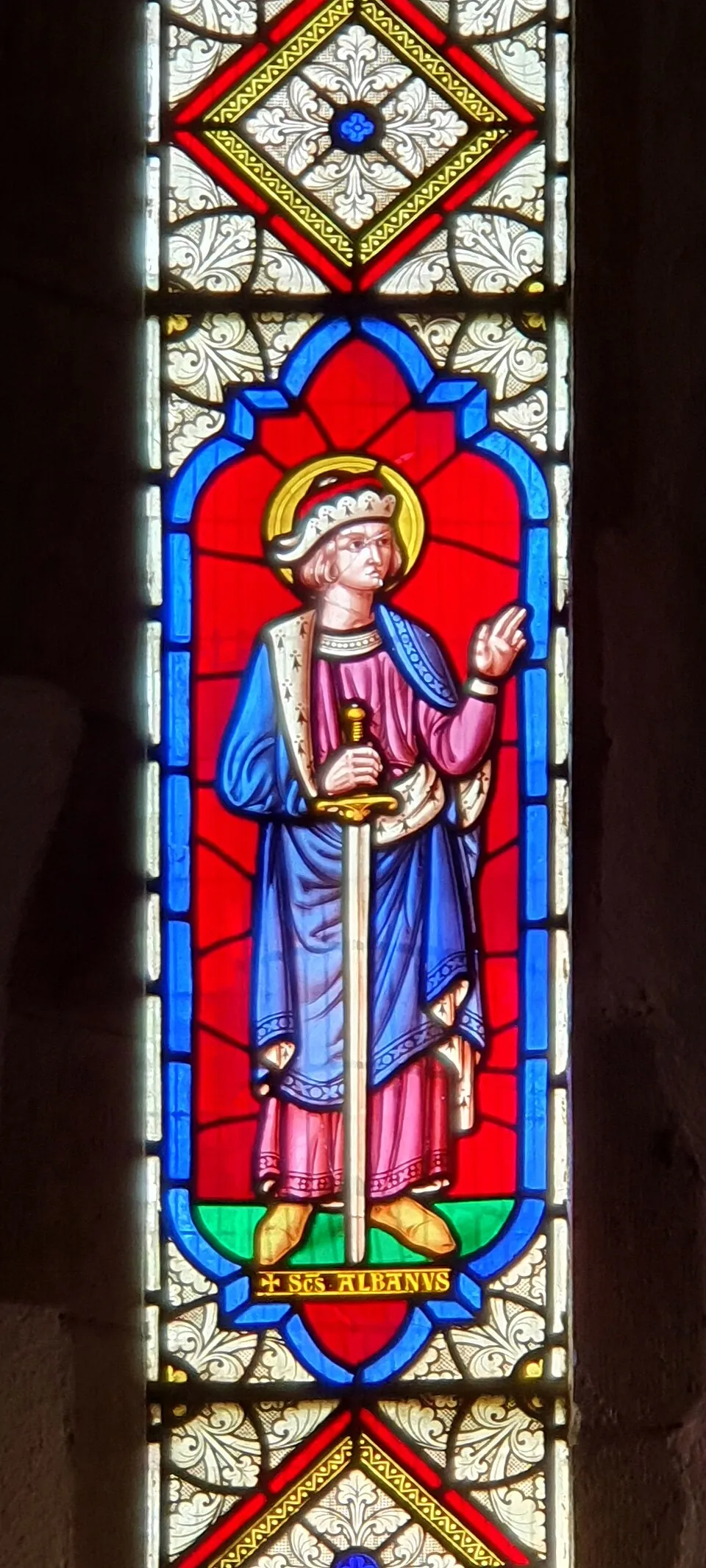
- Feast day
- June 20 in the national calendars of England and Wales 345; June 22 according to Bede and the 1907 Catholic Encyclopedia 12
- When
- In the persecution of Diocletian according to Bede and the Wales calendar, about 304 according to the 1907 Catholic Encyclopedia 124; probably under Decius in the mid-third century according to the England calendar 3
- Patron of
- None of the sources used for this page names a patronage
- Earliest accounts
- Constantius's Life of Germanus of Auxerre, about 480; the legend Bede knew was probably current by the first half of the sixth century 2
- Kept with
- Saints Julius and Aaron, martyrs of Caerleon, in the calendar for Wales 4
Saint Alban was a pagan of Verulamium, in Roman Britain, who hid a Christian priest from the persecutors, became a Christian himself, and was beheaded after giving himself up in the priest's place. 12 He is honored as the first martyr of Britain, and the 1907 Catholic Encyclopedia judges it certain that he has been venerated in England without a break since the fifth century. 2 Nearly everything told of him comes from one chapter of Bede, and the encyclopedia is frank that what "germ of truth" lies under the legend is difficult to decide. 12
The guest in his house
Bede sets the story in the persecution under Diocletian and Maximian, which, he says, reached Britain at last and lasted ten years. 1 Alban was still a pagan when a cleric fleeing the persecutors came to his house, and he took him in. 12 Bede does not name the man. 1
What Alban noticed, in Bede's telling, was that his guest prayed and kept watch "day and night." 1 He began to imitate him, was "gradually instructed by his wholesome admonitions," and gave up the worship of idols to become a Christian "in all sincerity of heart." 1 The 1907 Catholic Encyclopedia says that after some days he "himself received baptism." 2 The Liturgy Office's notes for the calendar of Wales read it differently, and say that Alban, "unbaptised by water, attained a baptism of blood." 4 Bede himself says only that he became a Christian. 1
In the priest's cloak
Word reached the authorities that the fugitive was hiding at Alban's house, and soldiers came to search it. 1 Alban presented himself to them instead of his guest, wearing the priest's "habit or long coat," and was led bound before the judge. 12
The judge was standing at the altar offering sacrifice when Alban was brought in, and he was angry that the man had put himself in danger for his guest. 1 He told Alban that he would suffer the punishment meant for the fugitive unless he worshiped the gods. 1 Asked his family, Alban answered, "What does it concern you of what stock I am?" and said he was a Christian; asked his name, he said, "I am called Alban by my parents, and I worship and adore the true and living God, who created all things." 1 He refused to sacrifice, was scourged, and when torture did not move him he was condemned to death. 12
The Liturgy Office's notes for England call him "a pagan soldier." 3 Bede does not; the 1907 Catholic Encyclopedia lists Alban the soldier who had visited Rome among the later developments of the legend. 12
The river and the hill
Bede's account of the walk to execution is full of wonders, and the page gives them as his. 1 A fast river ran between the town wall and the arena, and the crowd that had come out to watch had so filled the bridge that Alban could hardly cross it before evening. 1 He lifted his eyes to heaven, Bede says, and the riverbed dried so that he could pass. 12
The executioner saw it, threw down his drawn sword and fell at Alban's feet, asking to die with him or in his place. 1 While the others hesitated to pick the sword up, Alban climbed a hill about five hundred paces away, which Bede describes as covered with flowers and sloping down to a beautiful plain. 1 At the top he prayed for water, and a spring broke out at his feet. 12
There he was beheaded. 1 Bede says the man who struck the blow lost his eyes, which fell to the ground with the martyr's head, and that the soldier who had refused was beheaded with him. 12 Of that soldier Bede writes that although he was "not regenerated by baptism," he was cleansed in his own blood. 1 The judge, astonished, ordered the persecution stopped. 1
Bede gives the day as the twenty-second of June, near the city of Verulam, where a church "of wonderful workmanship" was later built and where, he says, the sick were still being cured in his own time. 1 Verulamium is now the town of St Albans in Hertfordshire. 2
What can be known
The 1907 Catholic Encyclopedia, in an article by Herbert Thurston, is careful about all of this. 2 The first writer to mention Alban at all is Constantius, in his Life of Germanus of Auxerre, written about 480; the passages there about opening the tomb and taking relics are later interpolations. 2 The legend as Bede knew it was probably already in existence in the first half of the sixth century and was used by Gildas before 547. 2 About 580 the poet Venantius Fortunatus, in southern Gaul, knew the name: "Lo! fruitful Britain vaunts great Alban's name." 2 Bede quotes the same poet at the head of his chapter. 1
The sources do not agree on when he died. 123 Bede places him in the persecution of Diocletian, and the Liturgy Office's notes for Wales follow him. 14 The encyclopedia dates him to about 304. 2 The notes for England put his death "probably in the persecution under the emperor Decius, in the middle of the 3rd century," and Loyola Press likewise gives the mid-third century. 35
Later tellings gave the priest a name, Amphibalus, and said that he and some companions were stoned to death a few days afterward at Redbourn, four miles away. 2 Thurston thinks the name probably came from a version in which the cleric's cloak, an amphibalus, was mistaken for a man, a mistake Geoffrey of Monmouth, the earliest witness to the name, makes in another passage. 2 Thurston also notes that the story became confused with that of another Saint Alban, martyred at Mainz. 2
Germanus at the tomb
Bede tells one more story of the place. 1 After Germanus of Auxerre and his companion had confuted the Pelagian teachers in Britain, they went to the martyr's tomb to give thanks. 1 He had the tomb opened and laid in it relics of the apostles and other martyrs, and took away some of the earth where Alban's blood had been shed. 1 The England calendar note says that two hundred years after the martyrdom the site was already a shrine, and that it has remained one to the present day. 3
What is Saint Alban the patron saint of?
None of the sources used for this page names a patronage for Saint Alban. 12345 The 1907 Catholic Encyclopedia calls him the first martyr of Britain, the Liturgy Office's notes for Wales the protomartyr of Britain, and Loyola Press the first English martyr; none goes further. 245 Patronages for him are sometimes listed elsewhere, but this page claims none it cannot cite.
Saint Alban's feast day
Saint Alban is kept on June 20 in the Catholic Church in England and Wales. 34 In the national calendar for England he is an optional memorial on his own; in the calendar for Wales he is kept the same day with Saints Julius and Aaron, martyrs of Caerleon, whom Bede names among those who suffered at the same time. 134 Loyola Press also gives June 20. 5
The older date is June 22, the day Bede gives for his death. 1 The 1907 Catholic Encyclopedia says the feast was "still kept as of old, on 22 June," and celebrated throughout England as a greater double. 2
Praying with Saint Alban
In Bede's account Alban is not converted by an argument. He watches a stranger on the run pray day and night under his roof, and begins to do the same. 1 Bede says the instruction came gradually, over the days the man stayed. 1 The faith Alban died for was a few days old.
He also took a risk before he was a Christian at all. He opened his door to a man the authorities were looking for, and when they came he put on the man's coat and went out to them. 1 The judge's anger in Bede's telling is about exactly that: that Alban had "of his own accord" put himself into their hands for a guest. 1
His answers in court are short. Asked who his family was, he declined to say; asked his name, he gave it, and said whom he worshiped. 1 Then he was beaten, and Bede says he bore it patiently. 1
The executioner who threw down his sword died with him, unbaptized, and Bede counts him a martyr as well. 1 The priest Alban sheltered does not appear again in Bede's chapter. 1 Later writers gave him a name and a death of his own, which the 1907 Catholic Encyclopedia doubts; Bede says only that his time of martyrdom had not yet come. 12
Saint Alban, pray for us.
Sources
- 1.Bede, Ecclesiastical History of the English Nation, Book I, chapters 6, 7 and 18 (731), translated by J. A. Giles, in the Internet Medieval Sourcebook (Fordham University).
- 2.Herbert Thurston, "St. Alban," The Catholic Encyclopedia, Vol. 1 (New York: Robert Appleton Company, 1907).
- 3."National Calendar for England," Liturgy Office of the Catholic Bishops' Conference of England and Wales, June 20.
- 4."National Calendar for Wales," Liturgy Office of the Catholic Bishops' Conference of England and Wales, June 20.
- 5."Saint Alban," Saints Stories for All Ages, Loyola Press, from Bert Ghezzi, Voices of the Saints.
Saints to turn to next
Others in this collection who are turned to for some of the same things.