Saint Andrew Bobola
1590, 1591 or 1597 - May 16, 1657
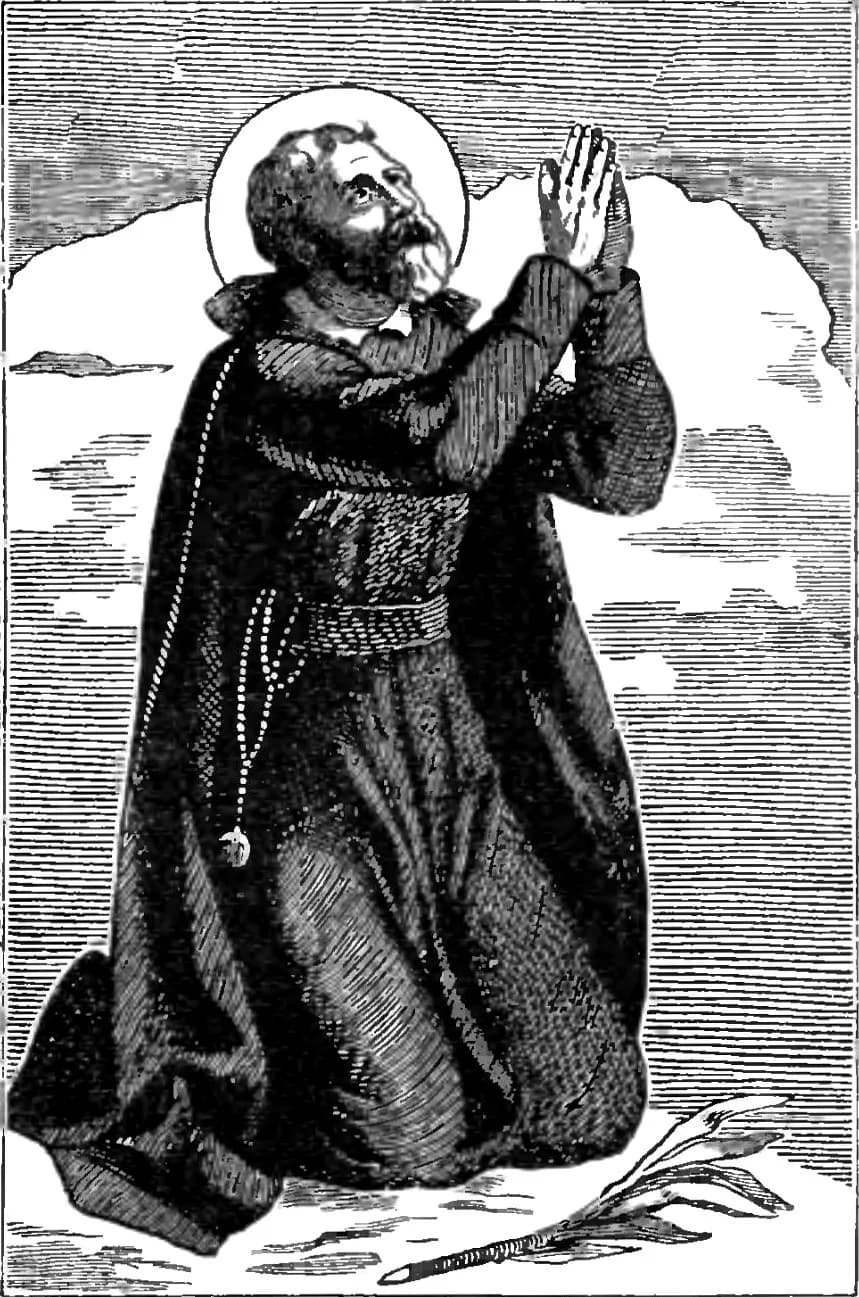
- Feast day
- May 16 4; the 1907 Catholic Encyclopedia says the Society of Jesus then kept it on May 23 1
- Patron saint of
- Poland, so declared by the Polish bishops in 2002, and the Archdiocese of Warsaw 5
- Ordained priest
- 1622 1
- Relics
- The Jesuit National Shrine of Saint Andrew Bobola, Warsaw 5
Saint Andrew Bobola was a Polish Jesuit priest who preached for decades at Vilnius, Bobruisk and Pinsk, and was seized and killed by Cossacks at Janów on May 16, 1657. 123 He died in a war that set Catholics and Orthodox against each other, and his own order says his defense of Catholics was "forceful." 3 His body then traveled for nearly three centuries, from Pinsk to Polotsk, to a museum in Moscow, to Rome and finally to Warsaw. 5 Pius XI canonized him in 1938, the Polish bishops named him a patron of Poland in 2002, and his feast is kept on May 16. 245
A noble son who became a Jesuit
The sources agree that he came from an old Polish noble family in the Palatinate of Sandomierz and disagree about the year. 123 The 1907 Catholic Encyclopedia gives 1590, Pius XII's 1957 encyclical on him gives 1591, and the Jesuit Curia's biography gives 1597. 123 Pius XII describes his parents as distinguished "by the nobility of their family, but even more so by the vigor and constancy of their Catholic faith." 2
He entered the Jesuit novitiate at Vilnius in 1611, at nineteen by Pius XII's reckoning. 123 Pius XII does not make him a natural saint. "By temperament proud, impatient, and sometimes obstinate," the pope wrote, Bobola "had to wage a very sharp contest against himself" to learn humility. 2 He spent long hours before the tabernacle, according to the same letter, and as a young teacher at Vilnius taught the catechism and encouraged devotion to the Eucharist and to the Virgin Mary. 2
He was ordained in 1622, and Pius XII notes that it was on the same day that Ignatius of Loyola and Francis Xavier were canonized in Rome. 12
Preacher, pastor and missionary
The two main accounts of his early priesthood do not match. The encyclopedia makes him preacher at the Church of St. Casimir in Vilnius, then, after his solemn vows on June 2, 1630, superior at Bobruisk, where it says he "wrought wonders by his preaching" and stood out for his devotion during an epidemic of plague. 1 The Jesuit Curia sends him first to the Jesuit church at Nesvizh for two years, then back to Vilnius for sixteen, where he became known as a preacher and organized sodalities whose members visited prisoners and taught children the catechism. 3 In its telling the plague came twice to Vilnius, and he and the sodalists "acted heroically" both times; he moved to Bobruisk in 1630. 3
At Bobruisk, the Jesuit Curia says, most people were Orthodox and many Catholics had drifted from their faith, partly for want of their own priests and churches. 3 From 1636, according to the encyclopedia, he worked in the Lithuanian missions. 1 Pius XII describes him going through "cities, towns, and villages" in the east by order of his superiors, and says that, as tradition has it, he "received from all, even from the schismatics," the title "hunter of souls." 2
War and division in the east
Bobola's missions fell in years of war. The encyclopedia describes a country "ravaged by Cossacks, Russians, and Tatars." 1 The Jesuit Curia sets the religious quarrel inside a war: the Union of Brest in 1596 had tried to settle the conflict between Orthodox and Catholics so that they could coexist, but some Orthodox joined the Cossack leader Bogdan Chmielnicki, who aimed to drive the Catholics out, and by 1655 he held much of what is now Belarus. 3 Russia and Poland were at war at the same time, and on August 8, 1655, the tsar's army took and sacked Vilnius. 3
Bobola went to Pinsk, where, the encyclopedia says, a Catholic nobleman had offered the Jesuits a house. 13 The encyclopedia, writing in the language of 1907, says his success in winning Orthodox to the Catholic Church "drew upon him the rage of those in high authority," and that his opponents "vainly endeavoured in every manner" to stop his work, and attacked him in person. 1 The Jesuit Curia, writing now, says that his success "only increased the sectarian conflict," and that people harassed him in the streets. 3
His death at Janów
In 1657 the Cossacks occupied Pinsk, and the Catholics fled into the forests. 3 At Janów, the Jesuit Curia records, they killed Catholics and Jews alike. 3 Bobola was in a nearby town, and someone told the Cossacks where he could be found. 3 He was taken on May 16, 1657, which Pius XII notes was the feast of the Ascension that year. 12
According to the Jesuit Curia, they first gave him the chance to renounce his faith. 3 Pius XII quotes the decree of canonization for his answer, when they asked whether he was a priest of the Latin rite: "I am a Catholic priest; I was born in the Catholic faith; in that faith I wish to die." 2 All the sources say he was beaten and dragged behind horses to Janów and tortured there at length before he was killed. 123 The encyclopedia calls the tortures "incredible" and says he was finally "released from suffering by a sabre stroke." 1 Pius XI's canonization homily, as Pius XII quotes it, names a crown "like that of Jesus Christ" bound about his head. 2 The Jesuit Curia says the crown was of twigs and was meant to mock his faith. 3
The long journey of his body
A party of Poles reached Janów as he died, too late to save him, and carried his body back to the crypt of the Jesuit church at Pinsk. 3 According to the Jesuit Conference of European Provincials, the college and church there were plundered and burned over the following years, and when the Jesuits found his coffin again about thirty years later, the body "was unharmed." 5 The Polish Jesuits began working for his beatification in 1714, but the Society was suppressed in 1773, and in 1808 his coffin was moved to Polotsk, by then under Russian rule. 5 Writing in 1907, the encyclopedia says it was "still held in honour" there, "even by the schismatics." 1
Pius IX beatified him in 1853, on October 30 according to the Jesuit Conference. 125 On June 23, 1922, the same source says, the Bolsheviks took the body from Polotsk to Moscow, examined it, and put it on display in the Museum of Hygiene. 5 The Jesuit Curia says it was "only returned to Poland in 1923." 3 The Jesuit Conference tells it differently: in 1924 the papal mission sent to relieve the famine in Russia recovered the relics and brought them to Rome, where they were placed in the Jesuit church of the Gesù. 5
Pius XI canonized him on Easter Sunday, April 17, 1938. 25 That June the coffin was carried in procession through Slovenia, Hungary and Czechoslovakia into Poland, by way of Krakow, Poznan and Lodz, to Warsaw. 5 It lay for three days in St. John's Cathedral, and on June 19, 1938, it was brought to the Jesuit chapel on Rakowiecka Street. 5 In 2007 the Polish bishops gave that church the title of National Shrine. 5
What is Saint Andrew Bobola the patron saint of?
Saint Andrew Bobola is a patron saint of Poland. The Jesuit Conference of European Provincials reports that the Polish bishops' conference declared him so in 2002, and calls him patron of the Warsaw metropolis as well. 5 Pius XII, writing in 1957, called him the "great glory" of the Polish people, "since he was born of that nation," and addressed the encyclical to them in a special way. 2 At the shrine in 2017, Cardinal Kazimierz Nycz of Warsaw called him "the patron of difficult unity." 5
Saint Andrew Bobola's feast day
Praying with Saint Andrew Bobola
Pius XII held him up chiefly for his faith, and he did not pretend that the faith came easily. He described a man "proud, impatient, and sometimes obstinate" by temperament who had to fight himself, helped by "constant and fervent prayers," and who spent long hours before the tabernacle when he could. 2 The encyclopedia and the Jesuit Curia add the ordinary work of a priest: sermons, sodalities that visited prisoners and taught children, and the plague, during which the encyclopedia praises his devotion and the Curia says he "acted heroically." 13
His death is hard to pray with, and it does not get easier for knowing more. He was killed by other Christians in a war that also took the lives of Jews and Catholics at Janów, and his own order describes the conflict as sectarian and his defense of Catholics as forceful. 3 The words the canonization decree gives him are a confession of what he believed and a plea to his captors to repent. 2
John Paul II, preaching at Gorzow in 1997, named him among the Polish martyrs who "testify to the primacy of conscience and its inviolable dignity, the primacy of the spirit over the body, the primacy of eternity over time." 6 Pius XII wrote that the witness of faith is not given "only by shedding of blood," and that there is "always a bit of martyrdom" in daily striving toward a more perfect Christian life. 2
His body, by the Jesuit Conference's account, was lost, found, moved, put on display in a museum in Moscow, and carried at last across central Europe to Warsaw, where tens of thousands prayed along its route. 5 The Jesuit Curia's title for him is simpler: a Jesuit who "stood firm in the face of trial." 4
Saint Andrew Bobola, pray for us.
Sources
- 1.F. M. Rudge, "St. Andrew Bobola," The Catholic Encyclopedia, Vol. 1 (New York: Robert Appleton Company, 1907).
- 2.Pope Pius XII, Invicti Athletae, encyclical on St. Andrew Bobola, May 16, 1957.
- 3.Tom Rochford, SJ, ed., "Saint Andrew Bobola," Saints and Blessed, The Society of Jesus (jesuits.global).
- 4."Saint Andrew Bobola, a Polish Jesuit who stood firm in the face of trial," Communications Office of the General Curia, The Society of Jesus, May 15, 2024.
- 5.Anna Dziemska, "Andrzej Bobola, patron of unity and peace," Jesuit Conference of European Provincials, 2017.
- 6.Pope John Paul II, Homily at Gorzow Wielkopolski, Apostolic Journey to Poland, June 2, 1997.
Saints to turn to next
Others in this collection who are turned to for some of the same things.