Saint Stanislaus of Kraków
July 26, 1030 - 1079
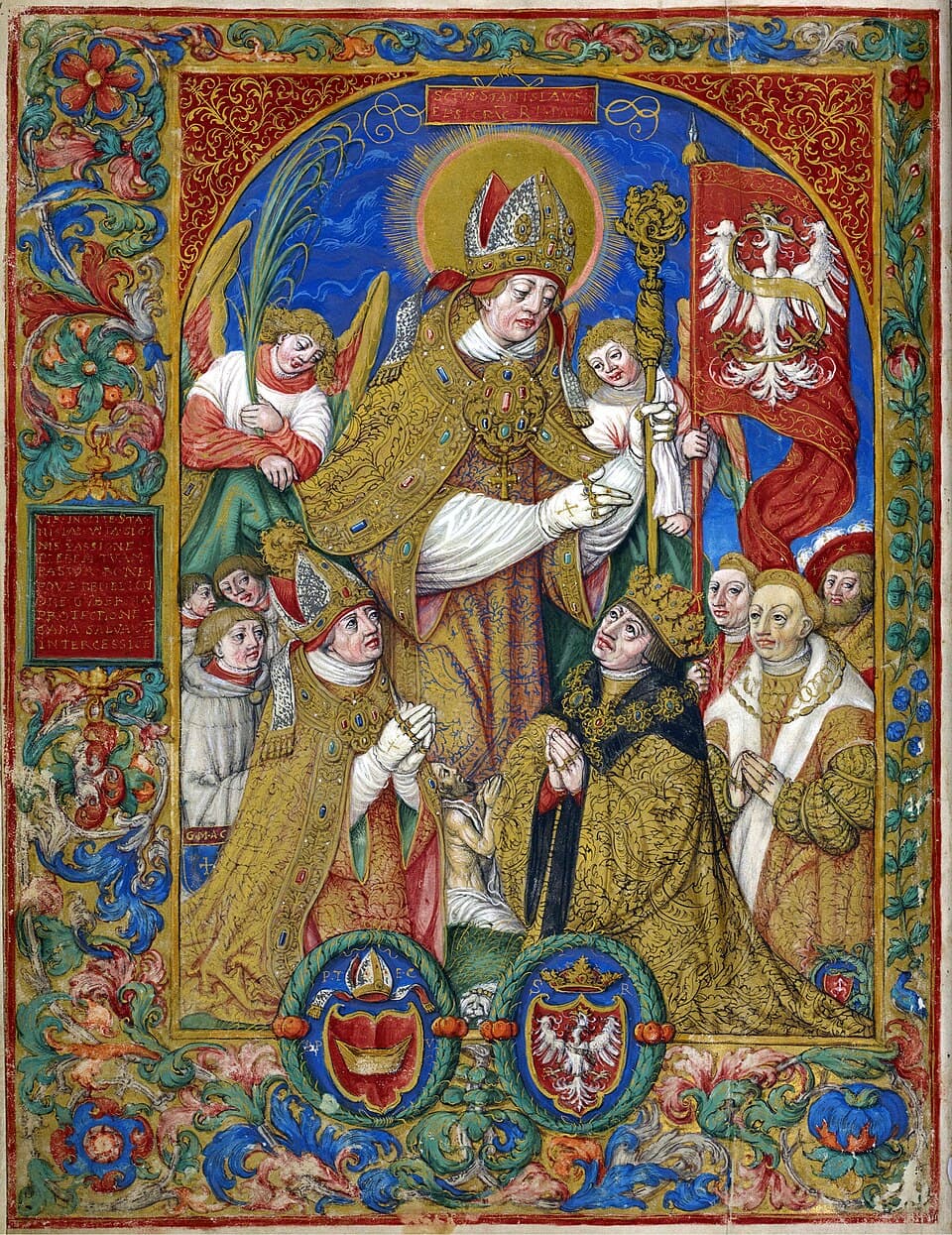
- Died
- Killed by King Bolesław II in 1079: on May 8 according to the Catholic Encyclopedia and Vatican News; on April 11 according to John Paul II and Franciscan Media 1357
- Shown with
- A bishop's vestments and a sword 1
Saint Stanislaus was bishop of Kraków for about seven years, and in 1079 King Bolesław II killed him, by the king's own hand according to both the Catholic Encyclopedia and Franciscan Media. 136 Why the king did it has been argued over ever since: the encyclopedia's life of the saint describes a pastor who excommunicated a cruel and immoral king, while its own article on Poland reports that the king had him condemned for high treason. 12 He is the patron of Poland and the first Pole to be canonized, and his feast is April 11, kept in Poland on May 8. 35
Szczepanów, Gniezno and perhaps Paris
He was born at Szczepanów, in the Diocese of Kraków, on July 26, 1030. 13 The 1912 Catholic Encyclopedia warns at the outset that "no contemporary biography of the saint is in existence," and that the life written around the time of his canonization, by a Dominican it tentatively names Vincent, "contains much legendary matter." 1 That tradition names his parents as Belislaus and Bogna, devout and noble, and has him study at Gniezno and at Paris. 1 The encyclopedia prints a question mark after Paris; Franciscan Media states both schools without one. 13
After his parents died he gave away his inheritance to the poor. 1 Bishop Lambert Zula ordained him and made him pastor of Czembocz, near Kraków, then canon and preacher at the cathedral, and finally vicar-general. 1 Franciscan Media remembers him in those years as preacher and archdeacon, whose "eloquence and example brought about real conversion in many of his penitents, both clergy and laity." 3
Bishop on the pope's orders
When Lambert died, Stanislaus was elected to succeed him, and accepted only on the explicit command of Pope Alexander II. 1 He took the see in 1072. 37 John Paul II, who held the same see nine centuries later, wrote that the ministry "lasted barely seven years." 8
The encyclopedia says he "inveighed against vices among high and low, regardless of consequences." 1 John Paul II described the same work more broadly: Stanislaus taught "the moral order in the family based on sacramental marriage," and taught the moral order within the state, "reminding even the king that in his actions he should keep in mind the unchanging Law of God." 8
The quarrel with the king
Bolesław II, known as the Bold, had made his name in war. In Mershman's 1912 account the king then "sullied" that renown "by atrocious cruelty and unbridled lust," and quarreled with the bishop over a piece of Church land that he claimed unjustly, and over some nobles who "had left their homes to ward off various evils threatening their families" and whom the king treated cruelly. 1 Stanislaus "spared neither tears nor prayers and admonitions" to bring him around. 1
Franciscan Media places the trouble during an expedition against Kiev and says the bishop's criticism took in the peasantry as well as the king, "especially the unjust wars and immoral acts of King Boleslaus II." 3 The king made excuses, then a show of penance, then went back to his old ways. Stanislaus kept up his opposition "in spite of charges of treason and threats of death." 3 In the end he excommunicated the king, 13 and instructed the cathedral canons to stop the Divine Office if Bolesław tried to come in. 1
Killed at the altar
Stanislaus withdrew to the Chapel of Saint Michael in a suburb of Kraków. 1 The king followed with his guards and sent some of them in to kill him. They would not do it. Both the encyclopedia and Franciscan Media say Bolesław then killed the bishop himself, and the encyclopedia adds that it happened "during the Holy Sacrifice." 13 John Paul II gave the place as the church of Saint Michael on Skałka, where "tradition has it" the bishop was killed "while celebrating the Eucharist." 6
The body was cut apart. The 1911 encyclopedia says he was "done to death and hewn in pieces," and John Paul II recalled a "devout tradition" that the dismembered body would grow whole again. 28 It was buried first in the chapel and moved to the cathedral in 1088. 1 His skull is still kept, and in 1979 John Paul II said it "still shows the marks of his mortal wounds." 7
Martyr or traitor?
The Catholic Encyclopedia's own article on Poland, published a year before its life of Stanislaus, tells the story differently, and not even consistently with itself. 2 In its history of the kingdom, Bolesław was an ally of Pope Gregory VII, who sent him a crown, and the king was the one pushing Church reform, against clergy who resisted Gregory's decree on clerical celibacy. 2 Nobles who hated him as a despot rose against him under the protection of Bohemia. The bishop excommunicated the king, "while the king declared the bishop guilty of high treason for allying himself with Bohemia and the emperor." 2
Further on, in the same article's account of the Church in Poland, the quarrel is over "heathen marriages" that the bishop condemned, and the bishop, "having formed a conspiracy with the magnates," was killed by the king himself. 2 Between the two encyclopedia articles, then, the same death is a pastor murdered for rebuking sin, a rebel executed for treason, and something in between.
Nothing here settles it, and the encyclopedia's note that no contemporary biography exists is the reason. 1 The Church has kept him as a martyr since 1253, and John Paul II, who followed the modern research, called the killing "this crime" and said the studies of what caused it had been "a source of pleasure" to him. 6 This page reports the treason charge as the encyclopedia printed it and leaves the verdict open.
What became of Bolesław
A revolt followed, and the king fled to Hungary. 23 Franciscan Media says he "supposedly" spent the rest of his life as a penitent at a Benedictine abbey in Osiak. 3 John Paul II wrote that, "as is recorded," he "was reconciled to God and died away from his fatherland," and that later kings of Poland, his successors, walked in the yearly procession honoring the bishop he killed. 6
Canonization, and nine centuries of memory
Pope Innocent IV canonized him at Assisi in 1253. 18 John Paul II gave the day once as September 8, at the tomb of Saint Francis, and once as September 17. 68 Poland was then split into rival duchies, and the princes of the ruling Piast family gathered at his tomb in Kraków for the celebration. 8 The tradition that his body would be made whole became, John Paul II wrote, a hope that the divided kingdom would be one again, and after the canonization Stanislaus was chosen as Poland's chief patron. 8
John Paul II also called him patron of Poland's struggle to survive the Second World War, whose end in Poland coincided with his feast in May. 8 In 1979, the nine hundredth year since the killing and the first year of his own pontificate, the Polish pope raised Stanislaus's memorial to an obligatory memorial for the whole Church. 6 In May 2024 Pope Francis asked Polish pilgrims to seek his intercession for peace in Europe, in Ukraine and in the Middle East. 5
What is Saint Stanislaus of Kraków the patron saint of?
Saint Stanislaus is the patron saint of Poland. 13 The 1912 Catholic Encyclopedia adds the city and Diocese of Kraków, and says he is "invoked in battle." 1 For centuries he was Poland's principal patron; since a concession of Pope John XXIII he shares that title with the Blessed Virgin Mary, Queen of Poland, and with Saint Adalbert. 6 John Paul II also called him "a patron of the moral and social order in our homeland." 8
Saint Stanislaus of Kraków's feast day
The universal Church keeps his feast on April 11. 3457 Poland celebrates him on May 8, as it has for centuries. 567 The 1912 encyclopedia recorded May 7 in the Roman Martyrology and May 8 in Kraków, with a separate feast of the translation of his relics on September 27. 1
The two dates reflect a disagreement about the day he died. The encyclopedia and Vatican News give May 8, 1079. 15 John Paul II, preaching in Kraków in 1979, said that "the day of his death, the sources say, was 11 April," and Franciscan Media gives April 11 as well. 37
Praying with Saint Stanislaus
He did not take the office of bishop until a pope ordered him to. 1 Seven years later it killed him. 68 Nothing in the sources suggests he went looking for a fight.
His story is told with a disagreement still attached, and it does not have to be tidied before he can be prayed with. The same encyclopedia calls him a pastor who rebuked a king and a bishop accused of conspiring against one. 12 Whatever the politics were, he was killed at an altar by a man he had refused to let into church, and for nine centuries Poles have treated that as the point. 16
The king is part of this too. Bolesław fled, and Franciscan Media and John Paul II both report, with their own hedges, that he ended his life reconciled to God. 36 Later kings who walked behind the bishop's relics in procession did so as his successors. 6 John Paul II read that as a sign that Stanislaus had become an instrument by which Poles, those in authority and those under it alike, were reconciled to God, and that reading leaves room for the murderer as well as the murdered. 6
His skull, with its wounds, is still carried through Kraków every year. 67 When Poland was carved up, Poles crossed the new borders to pray at his relics, and through the Second World War and the years of oppression after it they kept asking for his help. 8 None of them needed to settle what happened in 1079 first.
Saint Stanislaus of Kraków, pray for us.
Sources
- 1.Francis Mershman, "St. Stanislaus of Cracow," The Catholic Encyclopedia, Vol. 14 (New York: Robert Appleton Company, 1912).
- 2.Edmund Kolodziejczyk, "Poland," The Catholic Encyclopedia, Vol. 12 (New York: Robert Appleton Company, 1911).
- 3."Saint Stanislaus," Saint of the Day, Franciscan Media.
- 4."St Stanislaus, Bishop of Cracow and Martyr," Saint of the Day for April 11, Vatican News.
- 5."Pope: May St. Stanislaus obtain for us gift of peace," Vatican News, May 2024.
- 6.John Paul II, Apostolic Letter Rutilans agmen, on the ninth centenary of the death of Saint Stanislaus, May 8, 1979.
- 7.John Paul II, Homily at the Mass in honor of Saint Stanislaus, Błonia, Kraków, June 10, 1979.
- 8.John Paul II, Letter to the Archdiocese of Kraków and to the Church of Poland on the 750th anniversary of the canonization of Saint Stanislaus, May 8, 2003.
Saints to turn to next
Others in this collection who are turned to for some of the same things.