Saint Afra of Augsburg
d. c. 304
- Historical record
- The 1907 Catholic Encyclopedia calls her martyrdom "an indisputable historical fact" and her conversion story "a legendary narrative" 1
- Relics
- The crypt of the Basilica of Sts. Ulrich and Afra, Augsburg 2
- Patron saint of
- The city and Diocese of Augsburg, penitent women, the poor souls and medicinal herbs; invoked against danger of fire 2
Saint Afra of Augsburg was a Christian woman put to death at Augsburg, in what is now Bavaria, around the year 304, during the persecution of Diocletian. 1 That much is solid. The 1907 Catholic Encyclopedia calls it "an indisputable historical fact," and her grave was drawing pilgrims within a few generations. 1 The famous story attached to her - a prostitute converted by a fugitive Spanish bishop who knocked on the wrong door - is another matter, and the Church in Augsburg, which keeps her as its patron, says so itself. 23
What is certain
Augsburg was then Augusta Vindelicorum, a Roman colony on the river Lech in the province of Raetia, not far from the Danube. 1 Nobody knows how Christianity first arrived there. The encyclopedia's article on the diocese guesses at soldiers or merchants and admits that the beginnings "are shrouded in obscurity." 5 What proves that the faith had reached the town before Constantine is Afra herself. Johann Peter Kirsch, who wrote her entry, says her martyrdom establishes it "beyond question." 1
The evidence is old and comes from outside Augsburg. The Martyrologium Hieronymianum, a compilation of calendars and martyr lists whose original form goes back to the fourth century, records Afra as having suffered at Augsburg and as buried there. 1 Then there is a poet. In 565 Venantius Fortunatus, an Italian who would later become bishop of Poitiers, passed through on his way from Ravenna to the tomb of Saint Martin at Tours. 13 In the poem he wrote about Martin soon afterward he tells a traveler what to do on reaching the city between the Lech and the Wertach: venerate the bones of the holy martyr Afra. 13
The legend
The story most people know comes from the "Acts of Afra," and the diocese of Augsburg tells it on its own website, with a warning that her life was repeatedly added to, heightened by legend, and probably miscopied along the way. 2 In that telling Afra was the daughter of the king of Cyprus. After his violent death she fled with her mother, Hilaria, by way of Rome to Augsburg, and there, as a servant of Venus, she kept a brothel. 2 Kirsch summarizes an older form in which it was her grandparents who came from Cyprus, and her own mother who handed her over to the goddess. 1
Two strangers came to the house by mistake. They were Narcissus, bishop of Gerona in Spain, and his deacon Felix, running from the persecution. 12 Before they ate, they prayed. Afra was curious and asked them to explain. Seven days later her whole household was baptized and the brothel was closed. 2 Her uncle - Dionysius in Kirsch, Dionysius or Zosimus in the diocese's account - was ordained and left in charge, and the legend makes him the first bishop of Augsburg. 12 Narcissus and Felix stayed nine months, went home to Gerona, and were martyred there. 2
When a governor named Gaius heard that Afra had shut her house because she was now a Christian, he had her arrested and ordered her to take up her old life again and sacrifice to the gods. She refused. 2 Once Afra had been laid in her tomb, the legend adds, her mother and three serving women, Digna, Eunomia and Eutropia, were themselves put to death by fire. 12
What the encyclopedia makes of it
Kirsch does not treat the Acts as one document. Most critics, he says, see in them two different accounts joined together: a story of her conversion and a story of her martyrdom. 1 On the first he is severe. It "has not the least claim to historical credibility, being merely a legendary narrative of Carlovingian times, drawn up with the intention of connecting with St. Afra the organization of the church of Augsburg." 1 In other words, the brothel, the bishop at the door and the uncle made bishop were written centuries after she died, to give the diocese a founding story with her at the center of it. The mother and the three serving women, he says, clearly belong to the same late narrative. 1
The second account is a different thing. The scholar Louis Duchesne dated it to the end of the fourth century or the beginning of the fifth, and Kirsch thinks it may preserve "not only the fact of the martyrdom, but also reliable details concerning the Saint and her death." 1 In it Afra appears alone. She is condemned because she professes herself a Christian and refuses to take part in pagan rites, she is executed on a little island in the Lech, and she is buried some distance away. Kirsch notes that it has "no trace of those exaggerations and fantastic embellishments which characterize the later legends of the martyrs." 1
The Church's official list of saints holds the two strands together in one careful sentence. The current Roman Martyrology says that Afra turned to Christ from a life of sin and that, as it is told, she was given to the pyre for confessing her faith while still unbaptized. 4 The entry also differs from the legend on one point: there, Narcissus baptizes the whole house. 24
Fire or the sword
How she died is told in two ways, and Kirsch's own article contains both. Early on he writes that she "was beheaded at Augsburg"; summarizing the old Passio a few paragraphs later he says she "was condemned to the flames." 1 The diocese lays the two traditions side by side. In one she was sentenced to die by fire on an island in the Lech and did not burn, but was suffocated by the smoke. In the other she was tied to a tree and beheaded. 2 The Martyrology speaks of the pyre, and so does the encyclopedia's article on the diocese, which has her suffering "at the stake." 45
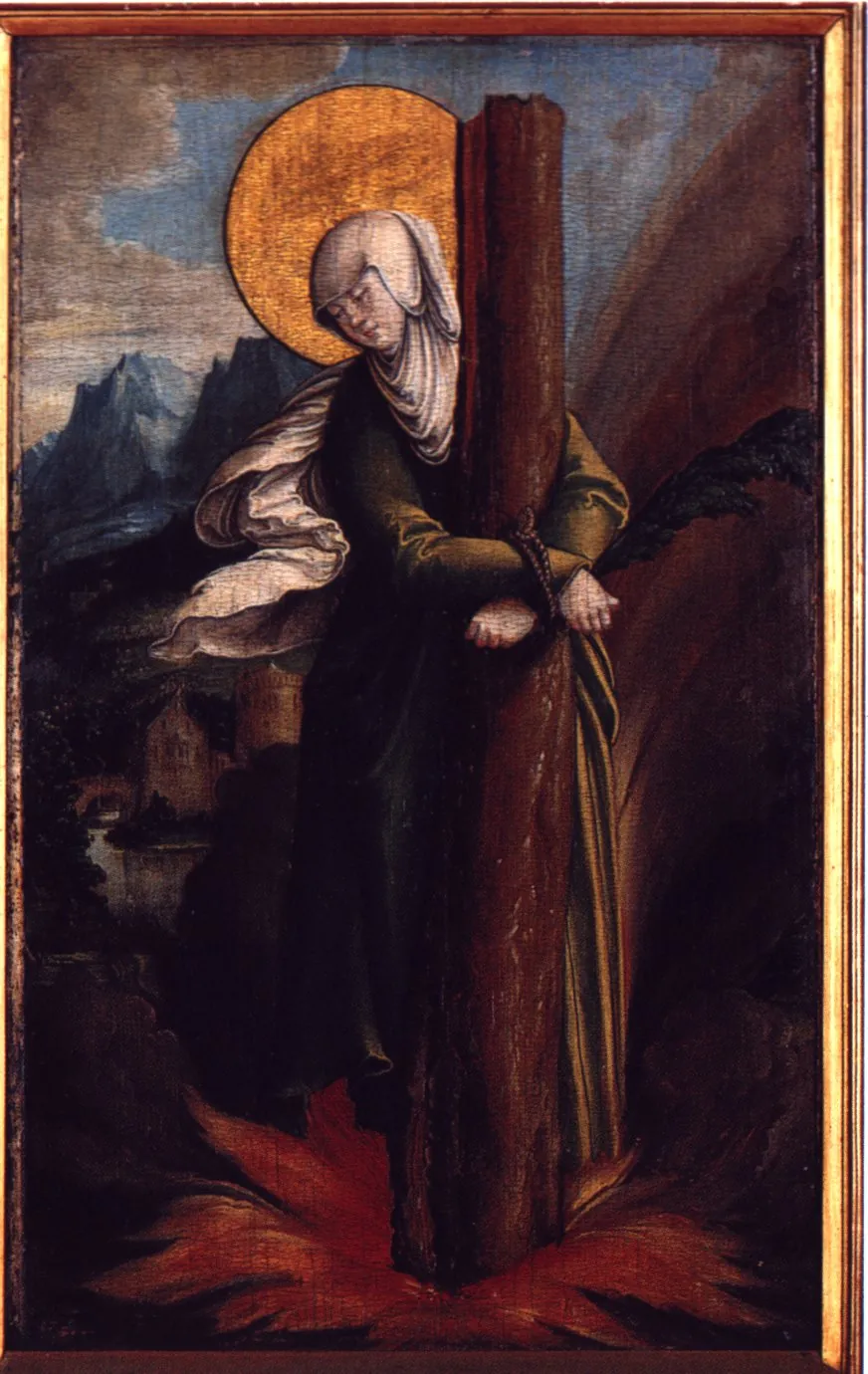
Art settled on the fire. She is painted bound to a post or a tree trunk with flames licking at her feet, sometimes richly dressed, in a veil or a crown. 2
Her grave
She was buried in a Christian cemetery at the southern edge of Augsburg, and by the sixth century a church dedicated to her stood over it. 2 It was destroyed more than once. Saint Ulrich, the bishop who held Augsburg against the Hungarians in 955, rebuilt it. 25 In 1064 her bones, charred according to the diocese, were solemnly raised. 2 They rest today beneath the Afra altar in the crypt of the Basilica of Sts. Ulrich and Afra, the great Gothic church built between 1467 and 1594 that also holds Ulrich's tomb and what the encyclopedia calls "the stone sarcophagus of St. Afra." 25 A Benedictine abbey stood beside it. 1
At Friedberg, just outside Augsburg, the church of St. Afra im Felde is said to stand close to the place where she was executed. 2 Investigations in and around the basilica have continued into recent years, and Prelate Bertram Meier, preaching there in 2019, said they show that she has been venerated in Augsburg without a break since late Roman times. 3
What is Saint Afra the patron saint of?
Saint Afra's feast day
Saint Afra's feast day is August 7. The Diocese of Augsburg gives that date, and the Roman Martyrology enters her on it. 24 The date has moved around. The Martyrologium Hieronymianum has her under August 5, though some of its manuscripts say August 6 or 7. 1 Kirsch, in 1907, wrote that "her feast is celebrated on 7 August," and the editor of the online edition of the encyclopedia added a bracketed note reading "now 5 August." 1 In Augsburg her day ranks as a solemnity, and in 2019 the basilica kept it on the nearest Sunday, August 4. 3
Praying with Saint Afra
Start with what there is. A woman, a name, a city, a refusal, a grave that people would not stop visiting. Preaching on her feast, Meier admitted that by the standards of modern history we have hardly any secure knowledge of how she lived or died, and that the bare frame of dates is overgrown with legend. 3 He did not treat that as an embarrassment. The veneration, he said, has always pointed at one thing: Christ changed her life, and she then gave it up for him. 3
The legend deserves a second look for what it chose to say. A diocese inventing its own founder could have invented anyone. Augsburg told a story about a woman from a brothel, and it has gone on telling it. 12 Meier observed that pious tradition gave her a place among sinners for a reason, and that people find themselves in her: someone who had to feel her way into faith, and who learned what it is to be accepted with every fault and weakness. 3 His own phrase is hard to improve on. She shows less how to get to heaven in a straight line than that, through all the human zigzag, the door to Christ stays open. 3
And then the stake. The painters show her upright, tied to the post, never lying on the pyre, and Meier drew the plain conclusion that she never fell over, not even in dying. 3 He turned it into a question for his congregation: how does our own profession of faith hold when the subject gets hot at work, among friends, or at the family table? 3 He did not answer it for them.
Saint Afra of Augsburg, pray for us.
Sources
- 1.Johann Peter Kirsch, "St. Afra," The Catholic Encyclopedia, Vol. 1 (New York: Robert Appleton Company, 1907).
- 2."Afra," Heilige des Tages, Bistum Augsburg (the Diocese of Augsburg) (in German).
- 3.Bertram Meier, diocesan administrator of Augsburg, "Mutter des Glaubens, Schwester im Glauben, Zeugin des Glaubens," homily for the Solemnity of Saint Afra, Basilica of Sts. Ulrich and Afra, August 4, 2019, Bistum Augsburg (in German).
- 4.Roman Martyrology, entry for August 7, "Santa Afra, martire," as printed in "Santo del giorno," Conferenza Episcopale Italiana (in Italian).
- 5.Joseph Lins, "Augsburg," The Catholic Encyclopedia, Vol. 2 (New York: Robert Appleton Company, 1907).
Saints to turn to next
Others in this collection who are turned to for some of the same things.