Saint Amand of Maastricht
c. 584 - c. 676
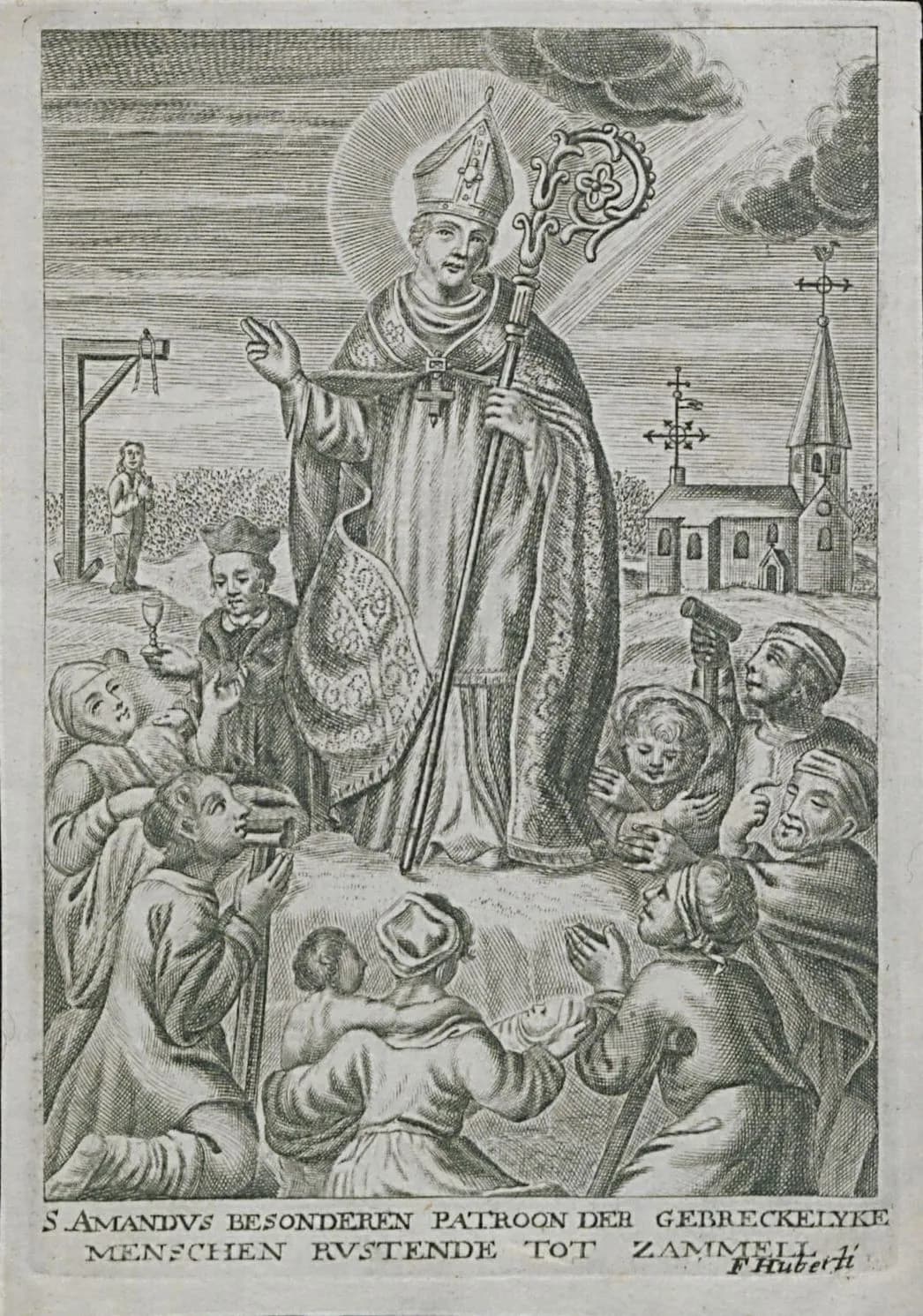
Saint Amand was a seventh-century bishop from western France who spent most of a very long life preaching to the pagans of what is now Belgium, founding monasteries wherever he could, and getting into trouble with kings. 13 The 1907 Catholic Encyclopedia calls him "one of the great apostles of Flanders," and the Roman Martyrology remembers him as the bishop of Maastricht who carried the word of God to many provinces and peoples, as far as the Slavs. 12 He held that see only briefly and gave it up. 13
From Nantes to a cell at Bourges
Amand was born near Nantes, at the end of the sixth century according to the encyclopedia, about 584 according to the Catholic Church in Norway, and about 590 according to the parish that bears his name in Ghent. 135 His family was apparently noble. 13 At about twenty he ran away from home to become a monk, near Tours in Thomas Campbell's account, and on the island of Yeu off the coast of the Vendée in the Norwegian biography and in a 2025 article by Benoit Lannoo for Kerknet. 134 His father tracked him down and tried to bring him home by force, and, the Norwegian biography says, threatened to disinherit him; Amand answered that Christ was his only inheritance. 3
From there he went to Tours, where the Norwegian biography says he was ordained a priest, and then east to Bourges. 3 Under the direction of the bishop of Bourges, Saint Austregisilus, he lived in a cell near the cathedral for fifteen years, "subsisting on bread and water." 13 After a pilgrimage to Rome he was consecrated in France as a missionary bishop, without a fixed see, at the age of thirty-three. 1 Lannoo gives the year as 628. 4 The Ghent parish adds a detail from the tradition: at the tomb of Saint Peter, the apostle appeared to him and sent him to preach in Gaul. 5
Ghent, and the hanged man
At the request of King Clotaire II he went first to Ghent, whose people the encyclopedia calls "degraded idolaters," and from there throughout Flanders. 1 It went badly for a long time. The Norwegian biography says no preacher was willing to try Ghent at all, and that this was exactly why Amand went; he was spat on, thrown in the mud, beaten bloody, and once stripped and thrown into the Scheldt. 3 Campbell says he achieved nothing "until the miracle of restoring the life of a criminal who had been hanged, changed the feelings of the people to reverence and affection and brought many converts to the faith." 1
Monasteries followed. Campbell names Ghent and Mont-Blandin and calls them "the first monuments to the Faith in Belgium." 1 The Ghent parish says the community he founded there became the later abbey of St. Bavo, and Lannoo credits him with both St. Bavo's and St. Peter's in Ghent; the Norwegian biography thinks St. Bavo's unlikely and gives him St. Peter's on Mont-Blandin, on land given by Bavo himself. 345 That Bavo was won over by Amand's preaching and became his follower, the Norwegian biography and the parish agree. 35 Amand's best-known foundation was Elnon, near Tournai, now the town of Saint-Amand-les-Eaux; the Norwegian biography dates it to 639, on land from King Dagobert, and says he made it his headquarters. 3
Kings, Slavs and Basques
Back in France about 630, Amand tried to recall King Dagobert from a sinful life and was expelled from the kingdom for it. 1 Dagobert later begged him to come back, asked his pardon and wanted him as tutor to the heir to the throne; Amand refused, Campbell says, because of "the danger of living at court." 1 The Norwegian biography tells the reconciliation through the baptism of Dagobert's long-awaited son, the future Saint Sigebert III, which Amand performed at Orléans after first declining. 3
His mission to the Slavs along the Danube "met with no success." 1 He reported to the pope in Rome, and on the way back, the encyclopedia says, he is said to have calmed a storm at sea. 1 Much later, at seventy, he went back to the Basques, among whom he had failed thirty years before, and "appears to have banished idolatry from the land." 1 Lannoo, a little drily, notes that the Basque country had by then become Pippinid territory too. 4
Bishop of Maastricht, briefly
He was made bishop of Maastricht about 649 by Campbell's reckoning; the Norwegian biography says he succeeded Saint John Agnus in 646, Lannoo that King Sigebert III appointed him in 647, and the encyclopedia's article on Liège gives his years as 647 to 650. 1346 He could not control the disorders he found, and wrote to Pope Martin I for instructions. 1 The pope's reply traced a plan of action against "fractious clerics" and warned him about the Monothelite heresy then troubling the East. 1 Amand was also charged with convoking councils in Neustria and Austrasia, and used the errand to ask to be released from Maastricht. 1 The Liège article says simply that he "abandoned the episcopal chair in discouragement, and built monasteries." 6
The Norwegian biography adds a caution of its own: his episcopate at Maastricht is highly uncertain, and may reflect the habit of medieval biographers of turning abbots into bishops. 3
Who wrote his life
Most of what is told about Amand comes from the Vita Amandi. The Norwegian biography attributes it to his disciple Baudemund and dates it to about 750, and says the monk-poet Milo of Elnon expanded it in the ninth century. 3 Lannoo reports a long scholarly argument about it. The Jesuit Édouard de Moreau devoted some three hundred pages to the question; the text seems to date from the first half of the eighth century and to rest on eyewitness information; Bruno Krusch had already disproved Baudemund's authorship; and the author was probably an anonymous diocesan cleric. 4
Lannoo's larger point is about the mission itself. Amand, his fellow pilgrim Humbert of Maroilles, Bavo, and Itta with her daughters Begga and Gertrude were all aristocrats of the Pippinid circle, and the Christianization of the Low Countries was, as he puts it, an affair of state. 4 Campbell records the same alliance from the other side: Amand entered into relations with the family of Pepin of Landen and helped Saint Gertrude and Saint Itta found their monastery at Nivelles. 1 Lannoo does not doubt that Amand was a holy apostle of the faith. He calls him a tireless diplomat and doer, who used every opportunity his powerful patrons gave him to plant abbeys. 4
Death at Elnon
Amand died at Elnon. Campbell says he was ninety; the Ghent parish says about 85, and gives the date as February 6, 675 or 676; the encyclopedia's article on Mechlin gives 679. 157 He dictated a testament in the monastery, which survives. 3 He was buried in its church of St. Peter. 3 The Martyrology enters on February 6 his burial at Elnon, the monastery he had built himself. 2
His name is all over the map of Flanders. Lannoo lists Sint-Amand churches from Antwerp to the Flemish coast, and the Norwegian biography counts villages named for him, Sint-Amandsberg near Ghent among them, and a pre-Reformation chapel dedicated to him at East Hendred in England. 34 The encyclopedia's Mechlin article records that he visited Antwerp. 7 Painters show him as a bishop with a church in his hands for all his foundations, sometimes with a dragon for the paganism he drove out of Ghent, and sometimes with broken chains for the prisoners he freed. 3
What is Saint Amand the patron saint of?
None of the sources read for this page names a patronage for Saint Amand. The Norwegian biography calls him the apostle of the Franks and of Belgium and the father of Belgian monasticism, and Kerknet calls him the apostle of the Low Countries; churches and parishes across Flanders keep him as their patron. 34
Saint Amand's feast day
Saint Amand's feast day is February 6. The encyclopedia, the Roman Martyrology, the Norwegian biography and Kerknet all give it. 1234 The Norwegian biography adds that in the Dutch Diocese of Roermond, to which Maastricht now belongs, all the holy bishops of Maastricht are kept together on May 15, and that this was formerly done on February 6. 3
Praying with Saint Amand
For long stretches nothing worked. Ghent beat him and threw him in the river, the Slavs did not listen, the Basques did not listen the first time, and the disorders at Maastricht defeated him until he asked to be released. 13 The encyclopedia's phrase for the Flemish years is "achieving nothing." 1 He was not a man who succeeded at everything he tried, and the sources do not pretend he was.
What he did instead was keep going and keep building. At seventy he went back to the people who had turned him away thirty years earlier. 1 Lannoo's sober account, which makes him a man of the powerful as much as a missionary, takes nothing away from that persistence; it only shows the world he was persistent in. 4
He also knew when to refuse. He would not stay at court as a royal tutor, and he would not stay in a bishop's chair he could not fill. 1 The fifteen years in a cell at Bourges, on bread and water, came before any of the preaching, and the long life ended where it had begun, in a monastery. 12
Saint Amand of Maastricht, pray for us.
Sources
- 1.Thomas Campbell, "St. Amandus," The Catholic Encyclopedia, Vol. 1 (New York: Robert Appleton Company, 1907).
- 2.Roman Martyrology, entry for February 6, "Sant'Amando, vescovo," as printed in "Santo del giorno," Conferenza Episcopale Italiana (in Italian).
- 3."Den hellige Amandus av Belgia (~584-~676)," Helgener, salige og andre, katolsk.no, the Catholic Church in Norway (in Norwegian).
- 4.Benoit Lannoo, "Amandus: apostel van de Lage Landen," Kerknet, February 6, 2025 (in Dutch).
- 5."Sint-Amandus," Parochie Gent-Oost, Kerknet (in Dutch).
- 6.Joseph Brassinne, "Liège," The Catholic Encyclopedia, Vol. 9 (New York: Robert Appleton Company, 1910).
- 7.Albert Kempeneer, "Mechlin," The Catholic Encyclopedia, Vol. 10 (New York: Robert Appleton Company, 1911).
Saints to turn to next
Others in this collection who are turned to for some of the same things.