Saint Zachary
Birth unknown - March 752
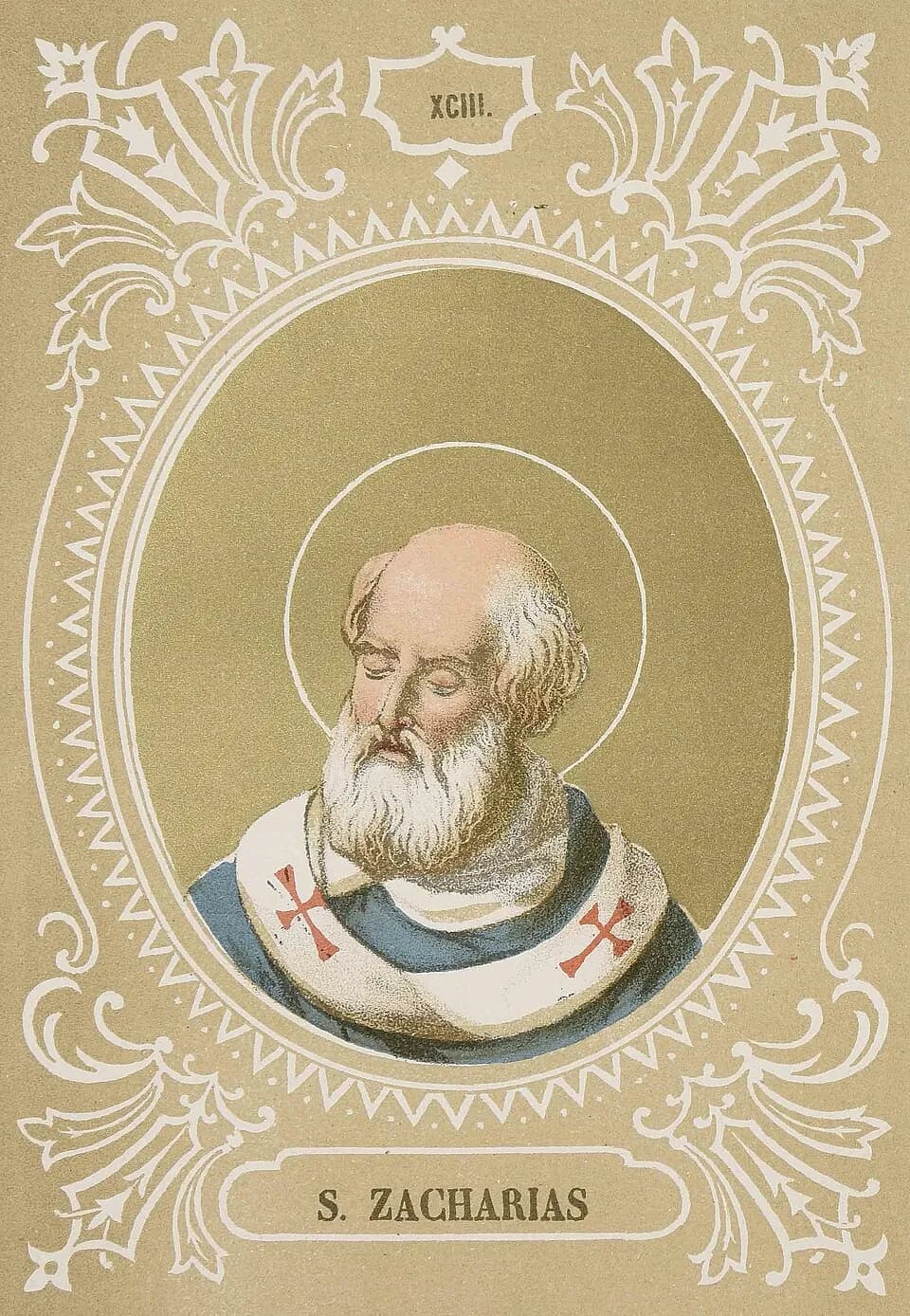
- Known for
- Talking the Lombard king Liutprand out of two invasions, backing Saint Boniface in Germany, and his answer to Pepin 126
- Wrote
- A Greek translation of the Dialogues of Gregory the Great 1
Saint Zachary was pope from 741 to 752, a Greek from southern Italy who twice traveled to meet a Lombard king who was preparing for war and twice sent him home without a battle. 12 He stood behind Saint Boniface's mission in Germany, gave the answer that let Pepin become king of the Franks, and bought the slaves that merchants in Rome were about to ship to Africa. 16 His feast is March 15. 23
A Greek from Calabria
Nobody recorded the year of his birth. Johann Peter Kirsch, in the Catholic Encyclopedia, says Zachary "sprang from a Greek family living in Calabria" and that the Liber Pontificalis, the old book of papal lives, names his father as Polichronius. 1 The Jesuit historian Joseph Brusher calls him simply "a Greek from Calabria," and the Holy See's list of popes gives his birthplace as Greece. 25
He was most probably a deacon of the Roman Church, and as one he signed the decrees of a Roman council in 732. 1 When Pope Gregory III was buried on November 29, 741, Zachary was "immediately and unanimously elected pope," and Kirsch dates his consecration to December 5. 1 The Holy See's list begins the pontificate on December 3. 5
His first biographer, in the Liber Pontificalis, describes "a man of gentle and conciliatory character who was charitable towards the clergy and people." 1 Brusher puts it more warmly: Zachary was "one of those happy people with a gift for making friends." 2
Two journeys to the Lombard king
Rome in 741 was in real danger. Liutprand, king of the Lombards, was preparing to move into Roman territory, and the duke of Spoleto, with whom Gregory III had allied himself against the king, had not kept his promise to help recover the towns already lost. 1 Zachary dropped the alliance and went to see Liutprand himself, at Terni, where the king "received him with every mark of honour." 1
He came back with four towns, Ameria, Horta, Polimartium and Blera, with every estate of the Roman Church the Lombards had taken in the previous thirty years, and with a truce of twenty years. 1 Brusher says the two men dined together to mark the agreement and that "Liutprand declared that he had never had so glorious a dinner." 2
The next year Liutprand turned on Ravenna, the seat of the Byzantine governor. The governor and the archbishop begged the pope to step in. 1 His envoys failed, so Zachary set out again, first to Ravenna and then on to the royal court at Pavia. Brusher says the king tried to keep him from coming and that Zachary refused to be stopped. 2 He reached Pavia on the eve of the feast of Saints Peter and Paul, kept the vigil and the feast there, and persuaded Liutprand to call off the attack and give back the land around the city. 1 "This time it took argument," Brusher writes, "but again Zachary won." 2
Liutprand died not long afterward. With a later king, Ratchis, Kirsch says the pope "was on the best of terms," and in 749 Ratchis confirmed the peace. 1 That same year Ratchis gave up his crown, and he, his wife and his daughter took monastic vows before the pope. 1
Boniface and the church in Germany
Early in 742 a letter reached the new pope from Saint Boniface, who was organizing the Church in the German territories. He asked Zachary to confirm three new dioceses, at Würzburg, Buraburg and Erfurt, and for authority to hold a synod and correct the lives of the clergy. 1 Zachary answered on April 1, confirmed the dioceses and sent Boniface to the Frankish synod as his legate. 16 Later he named him archbishop of Mainz, a decision Francis Mershman dates May 1, "748 (747)", and at Boniface's request placed the abbey of Fulda directly under the Holy See, which Mershman calls "something new for Germany." 6
The letters went back and forth for a decade. Benedict XVI, speaking about Boniface in 2009, said that Zachary "confirmed him in his office and praised his dedication," and quoted Boniface writing to this pope: "I never cease to invite and to submit to obedience to the Apostolic See those who desire to remain in the Catholic faith and in the unity of the Roman Church." 9 The two did not always agree. Kirsch mentions "various questions in which the pope and Boniface disagreed," and Brusher says Zachary took with "good-humored kindness" the complaints Boniface made "about certain matters in Rome." 12
One disagreement involved an Irish abbot at Salzburg, Vergilius. A priest there had, through ignorance, baptized with a garbled Latin formula; Vergilius held the baptisms valid, Boniface complained to Rome, and Zachary decided for Vergilius. 8 Boniface then accused the abbot of teaching something about the shape of the earth and its other inhabitants that was "contrary to the Scriptures." 8 William Turner, in the encyclopedia, quotes the pope's ruling: "if it be proved that he held the said doctrine, a council be held, and Vergilius expelled from the Church and deprived of his priestly dignity." 8 The treatise is lost. Turner thinks Boniface misunderstood it, and says Vergilius "succeeded in freeing himself from the charge." 8 He later became bishop of Salzburg and was canonized in 1233. 8
The question from the Franks
Pepin and his brother Carloman ruled the Franks as mayors of the palace while a Merovingian king held the title. 27 In 747 Carloman resigned, came to Rome and was received by Zachary as a monk. 1 Pepin was left ruling alone. 7
He then sent two ambassadors, Bishop Burkard of Würzburg and the chaplain Folrad of Saint-Denis, to ask the pope, in Kirsch's words, "whether it seemed right to him that one should be king who did not really possess the royal power." 1 Zachary replied that it did not seem good to him. 1 Brusher dates the exchange to 751 and gives the reply in the form by which it is remembered: "he who did the work of king should be king." 2 The last Merovingian king was set aside and Pepin was proclaimed king of the Franks. 17
The encyclopedia's writers are careful about what this was. Franz Kampers, in the article on Pepin, says the pope was "hard pressed by the Lombards" and welcomed the approach, but that the crown "was given him not by the pope but by the Franks," who elected Pepin by their old custom. 7
The emperor, the poor and the slaves
Papal letters were still dated by the regnal year of the emperor at Constantinople, and the emperors of these years were iconoclasts; Brusher describes Constantine V as devoted to "smashing images." 12 Zachary announced his election in a letter addressed to the Church of Constantinople and not to its iconoclast patriarch, and wrote to the emperor Constantine V urging him to restore the Church's teaching and practice. 1 Kirsch records that the emperor received the envoys kindly and gave the Roman Church two estates in Italy; Brusher records that on the question of images the pope urged him in vain. 12
At home Zachary restored Roman churches and the decayed Lateran palace, and when the head of the martyr Saint George was found during the repairs he moved it to the church of San Giorgio in Velabro. 1 Alms went out regularly from the papal palace to the poor. 1
One act stands apart. Venetian merchants were buying slaves in Rome to resell to the Saracens in Africa, and Kirsch says "the pope bought all the slaves, so that Christians should not become the property of heathens." 1 He was a scholar as well, and translated the Dialogues of Gregory the Great into Greek, a version "which was largely circulated in the East." 1
He died in March 752 and was buried in Saint Peter's. 12 The Holy See's list closes his pontificate on March 15. 5
What is Saint Zachary the patron saint of?
None of the sources consulted for this page names Pope Saint Zachary as the patron saint of anything, and the page does not supply a patronage. 123 He is a different man from Zechariah, the father of John the Baptist, whom some English books also call Saint Zachary and who has a page of his own with Saint Elizabeth.
Saint Zachary's feast day
Saint Zachary's feast day is March 15. Brusher says so in as many words: "His feast is kept on March 15." 2 Vatican News lists "St. Zachary, Pope" on that date, and the Roman Martyrology, in the text published by the Italian bishops, has his entry there: at Rome, Saint Zachary, pope, who held back the force of the Lombard invasion, showed the Franks what just government was, gave churches to the Germanic peoples and kept firm the union with the Church of the East, governing the Church of God with great shrewdness and prudence. 34
Kirsch does not mention a feast. He and Brusher say only that Zachary died in March 752. 12
Praying with Saint Zachary
Zachary had no army. What he had, by every account, was a manner: gentle and conciliatory in the old biography, shrewd in Kirsch, charming in Brusher. 12 With it he went in person, twice, to a king preparing for war, and the second time the king had tried to keep him away. 12
His dealings with Boniface show the same temper from the other side. Boniface brought him complaints, among them accusations against a fellow missionary and criticism of Rome itself. 28 Zachary supported him from the first year of the pontificate and still ruled against him over the baptisms at Salzburg, and made his judgment on Vergilius depend on proof. 68
Then there are the slaves. Kirsch gives the episode one sentence and no names: merchants from Venice, buyers in Africa, and a pope who bought every one of the slaves himself. 1 He calls Zachary, at the end, "an excellent, capable, vigorous, and charitable successor of Peter." 1
Saint Zachary, pray for us.
Sources
- 1.Johann Peter Kirsch, "Pope St. Zachary," The Catholic Encyclopedia, vol. 15 (New York: Robert Appleton Company, 1912).
- 2.Joseph Brusher, S.J., "St. Zachary, 741-752," Popes Through the Ages, reprinted in the CatholicCulture.org library.
- 3.Roman Martyrology, entry for March 15, "San Zaccaria, papa," Santo del giorno, Conferenza Episcopale Italiana (in Italian).
- 4."St. Zachary, Pope," Saint of the Day, 15 March, Vatican News.
- 5."Zachary," The Supreme Pontiffs, The Holy See.
- 6.Francis Mershman, "St. Boniface," The Catholic Encyclopedia, vol. 2 (New York: Robert Appleton Company, 1907).
- 7.Franz Kampers, "Pepin the Short," The Catholic Encyclopedia, vol. 11 (New York: Robert Appleton Company, 1911).
- 8.William Turner, "St. Vergilius of Salzburg," The Catholic Encyclopedia, vol. 15 (New York: Robert Appleton Company, 1912).
- 9.Benedict XVI, General Audience, "Saint Boniface, the Apostle of the Germans," March 11, 2009.
Saints to turn to next
Others in this collection who are turned to for some of the same things.