Saint Wolfgang of Regensburg
c. 924 or c. 934 - October 31, 994
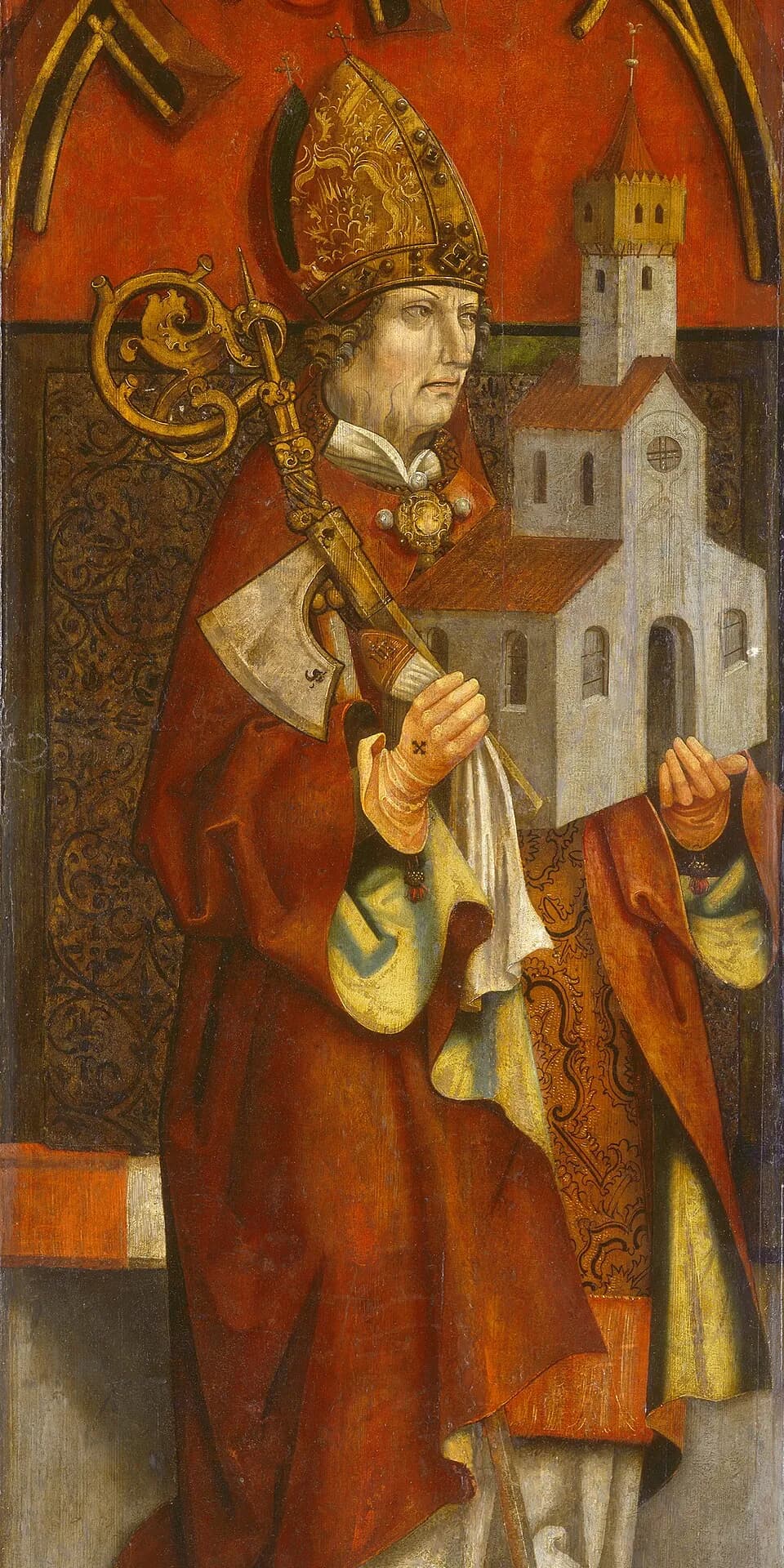
- Patron saint of
- The city and Diocese of Regensburg and Old Bavaria; woodcutters, carpenters, charcoal burners, wood carvers and the unjustly condemned; invoked against stroke, paralysis, heavy bleeding and skin inflammations 3. The Diocese of Regensburg adds sculptors, woodworkers, boatmen and shepherds 4
- Born
- About 934 according to the 1912 Catholic Encyclopedia 1; c. 924 according to Franciscan Media 2, and 924 at Pfullingen according to the Diocese of Regensburg 4
- Bishop of Regensburg
- From Christmas 972 until his death 1
Saint Wolfgang was a Swabian schoolmaster who became a Benedictine monk at Einsiedeln and then, from Christmas 972 until his death in 994, Bishop of Regensburg in Bavaria. 1 He reformed its monasteries, taught the boy who became the Emperor Saint Henry II, and kept trying to slip away into solitude, once to the lakeside in Austria that now bears his name. 123 The 1912 Catholic Encyclopedia counts him with Saints Ulrich and Conrad as one of the "three brilliant stars of the tenth century" in Germany. 1
A teacher before he was a monk
The sources do not agree on where he came from. Ulrich Schmid, who wrote the encyclopedia's article, says Wolfgang sprang from a family of Swabian counts of Pfullingen and was born about 934. 1 The Diocese of Regensburg gives 924 at Pfullingen, and Franciscan Media also has about 924. 24 katholisch.de, the German bishops' portal, describes the family as respected but poor and places it at Reutlingen. 3
On his schooling they agree. A cleric taught him at home from the age of seven 1, and he then went to the monastery school at the abbey of Reichenau. 12 There he became close friends with Henry, brother of the Bishop of Wurzburg, and followed him to the cathedral school at Wurzburg to hear the Italian grammarian Stephen of Novara. 1 When Henry became Archbishop of Trier in 956, he called Wolfgang there as a teacher in the cathedral school, and Wolfgang worked with him for the reform of the archdiocese "notwithstanding the enmity with which his efforts were met." 12
Trier also brought him into contact with the reforming monastery of St. Maximin and with a monk named Ramwold, who would matter to him later. 1 After the archbishop died in 964, Wolfgang entered the Benedictine abbey of Einsiedeln in Switzerland. 1 The diocese dates his entry to 965; Franciscan Media adds that he was made director of the abbey school. 24 He was ordained a priest by Saint Ulrich of Augsburg, in 968 according to the encyclopedia and the diocese, in 965 according to katholisch.de. 134
Missionary and bishop
After their defeat at the Lechfeld in 955, the pagan Magyars had settled in old Pannonia, and the encyclopedia says that at Ulrich's request and the wish of Otto the Great, Wolfgang was "sent to Magyars" as the man best suited to evangelize them. 1 The sources judge the mission very differently. Franciscan Media says his zeal "yielded limited results." 2 katholisch.de places his preaching in Alpine Noricum instead and speaks of unusually great success. 3
Either way, he came to the notice of Bishop Pilgrim of Passau, under whose jurisdiction the new mission field lay. 13 When Bishop Michael of Regensburg died in September 972, Pilgrim obtained Wolfgang's appointment to the see, and he became bishop at Christmas that year. 1 The encyclopedia says only that the appointment came "from the emperor." 1 Franciscan Media and katholisch.de name Otto II; the Diocese of Regensburg names Otto I. 234
He kept the monk's habit and lived austerely as a bishop, according to Franciscan Media, which also notes his vigorous preaching and his particular concern for the poor. 2 His most important reform, in Schmid's account, was at the old abbey of St. Emmeram. The bishops of Regensburg had for years held it as abbots in commendam, which had done the monastery no good; Wolfgang gave it back an abbot of its own and in 975 called Ramwold from Trier to fill the post. 1 He also reformed the convents of Obermunster and Niedermunster, founded the convent of St. Paul at Regensburg in 983 as their example, and helped restore the abbey of Niederaltach. 1 katholisch.de adds that he pressed hard for a better education of the clergy, which it calls wholly inadequate at the time. 3
When Otto II wanted to take territory from the diocese to form the new see of Prague in 975, Wolfgang agreed, and the encyclopedia credits him with "genuine episcopal generosity" for it. 1 He was also a prince of the empire, attending its diets, going with Otto II on his campaign to Paris in 978 and sitting in the great Diet of Verona in 983. 1
The tutor of Henry II
As bishop, Wolfgang became the teacher of the young Henry of Bavaria, the future Emperor Saint Henry II, "who learned from him the principles which governed his saintly and energetic life," in Schmid's words. 1 The Diocese of Regensburg says he taught the children of the Bavarian duke, naming Henry and his sister Gisela, who married King Stephen of Hungary. 4 Among his other pupils the encyclopedia names Poppo, later Archbishop of Trier, and Tagino, Archbishop of Magdeburg. 1
The hermit of the Wolfgangsee
The pull of solitude never left him. 2 At one point he withdrew to live as a hermit at a lonely spot in Austria, now the lake of St. Wolfgang, until a hunter found him and he was brought back to Regensburg. 1 Schmid gives two explanations: "apparently on account of a political dispute," but "probably" in the course of a visit to the monastery of Mondsee, which belonged to the bishops of Regensburg. 1 Franciscan Media says simply that he left to devote himself to prayer and that his duties called him back. 2 katholisch.de notes that the lake, once the Abersee, was renamed for him, and that the town of St. Wolfgang on its shore is the best known of the many places that carry his name. 3
The best-known story about him belongs here, and the encyclopedia tells it as an event in his life without saying where it comes from. Having chosen a solitary place, he prayed and then threw his axe into the thicket, taking the spot where it fell as the place God meant him to build his cell; the axe, Schmid writes, "is still shown" in the market town that grew up there. 1 The story explains why painters give him an axe. 1 A second story, which the encyclopedia itself calls "the legend," has Wolfgang forcing the devil to help him build a church, and it reaches the encyclopedia only as the subject of a painting by Moritz von Schwind. 1
Death at Pupping
In 994, while traveling on the Danube to Pochlarn in Lower Austria, he fell ill at the village of Pupping near Linz, asked to be carried into the chapel of Saint Othmar there, and died in it. 12 katholisch.de says he was on a visitation and was seventy years old. 3 His friends Count Aribo of Andechs and Archbishop Hartwich of Salzburg brought the body up the river to Regensburg, and he was buried in the crypt of St. Emmeram. 1
The encyclopedia says many miracles were performed at his grave, and he was canonized in 1052. 12 The Diocese of Regensburg says Pope Leo IX raised his bones into a shrine that year and declared him a saint, and that the shrine stays in the crypt for most of the year and is brought up into the church only during Wolfgang Week. 4 The oldest surviving account of his life was written about 1050 by Othlo, a monk of St. Emmeram, and the encyclopedia calls it the basis of all later accounts. 1
What is Saint Wolfgang the patron saint of?
katholisch.de calls Saint Wolfgang patron of the city and Diocese of Regensburg and of Old Bavaria, and of woodcutters, carpenters, charcoal burners, wood carvers and the unjustly condemned. 3 It also names him as a protector against stroke, paralysis, heavy bleeding and skin inflammations. 3 The Diocese of Regensburg, of which he is patron, lists sculptors, woodworkers, carpenters, boatmen and shepherds. 4 The encyclopedia does not give patronages, but notes that soon after his death many churches chose him as their patron and towns were named after him. 1
Saint Wolfgang's feast day
His feast is October 31 234, the day on which the encyclopedia, katholisch.de and the diocese date his death. 134 Franciscan Media runs him as its Saint of the Day for October 31 and says the feast is celebrated widely in central Europe, although the dates printed under its heading give his death as August 31, 994. 2
In the Diocese of Regensburg the day is kept as a solemnity: the diocese reported a crowded Pontifical Mass at the Basilica of St. Emmeram for it on October 31, 2010, after which the bishop and his clergy went down to pray at the saint's altar in the crypt. 4
Praying with Saint Wolfgang
Much of what the sources record is ordinary church business done thoroughly. He gave a neglected abbey its own abbot again, set an example convent beside two that needed one, and taught boys who went on to run an empire and two archdioceses. 1 He gave up part of his own diocese so that Prague could have a bishop. 1 None of it is dramatic, and Franciscan Media's reflection pictures him as a man with his sleeves rolled up. 2
He also left. Franciscan Media says the desire for solitude never left him and that once he went away to pray until his responsibilities called him back; the encyclopedia has a hunter find him and bring him home. 12 Neither says how he felt about returning, and the encyclopedia is not even sure why he went. 1 What they record is the return, and that he died a bishop, still on the road. 1
The German lists of those who call on him are long and practical: woodcutters, carpenters, carvers, boatmen and shepherds, and the sick, among them people after a stroke or living with paralysis. 34 The axe that ties him to the woodworkers comes from a story the encyclopedia tells without naming its source. 1 The rest of what is known about him is a working life that ended in a village chapel on the Danube, a long way from the lake. 1
Saint Wolfgang of Regensburg, pray for us.
Sources
- 1.Ulrich Schmid, "St. Wolfgang," The Catholic Encyclopedia, Vol. 15 (New York: Robert Appleton Company, 1912).
- 2."Saint Wolfgang of Regensburg," Saint of the Day, October 31, Franciscan Media.
- 3."Wolfgang," Heilige, 31.10, katholisch.de, portal of the Catholic Church in Germany (in German).
- 4."Hochfest des Heiligen Wolfgang," Diocese of Regensburg, October 31, 2010 (in German).
Saints to turn to next
Others in this collection who are turned to for some of the same things.
- Saint Dunstanc. 909 or earlier - May 19, 988Work and vocationPrayerStudy and teaching
- Saint Ephremc. 306 - June 9, 373Study and teachingPrayerWork and vocation
- Saint Lawrence of Brindisi1559 - July 22, 1619Study and teachingPrayerWork and vocation
- Saint LiobaBirth unknown - September 28, 779 or 782Study and teachingPrayerWork and vocation