Saint Dunstan
c. 909 or earlier - May 19, 988
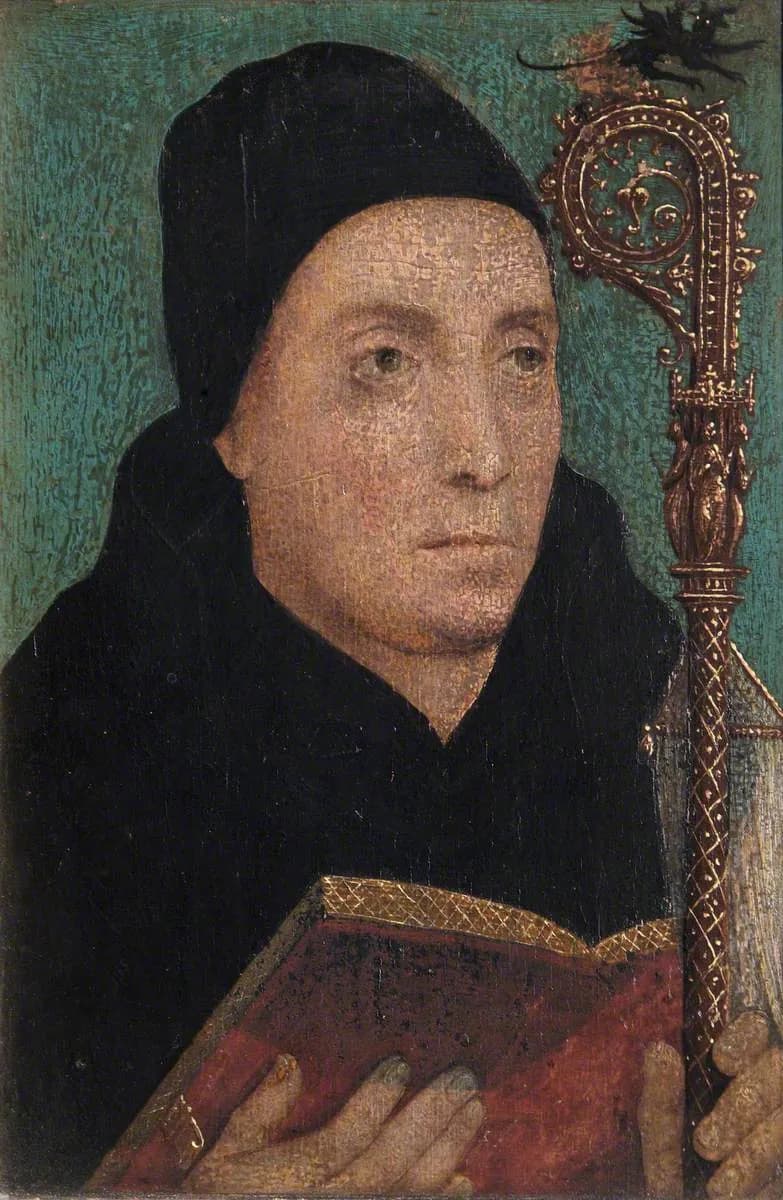
- Patron saint of
- The goldsmiths' guild throughout the Middle Ages 1; goldsmiths, jewelers and locksmiths 2
- Born
- In 909 at Baltonsborough, near Glastonbury, according to ICN 2; near Glastonbury, probably in the earliest years of the tenth century, according to the Catholic Encyclopedia 1
- Bishop of
- Worcester and London, held together 1
- Archbishop of Canterbury
- From 959 according to ICN 2; appointed after Edgar became king in October 959, receiving the pallium from John XII in Rome in 960, according to the Catholic Encyclopedia 1
- Represented with
- A pair of smith's tongs; sometimes a dove, or a troop of angels 1
Saint Dunstan was a Benedictine monk from Glastonbury who became Archbishop of Canterbury and principal adviser to the Wessex kings of his day. 12 He rebuilt monastic life in a country where it had nearly died out and worked all his life with his hands, at metal, bells and organs. 12 Until Thomas Becket overshadowed him, the Catholic Encyclopedia says, he was the best-loved saint of the English people. 1 He is pictured holding a pair of smith's tongs, which belong to a legend about the devil. 12
Glastonbury, a court, and a pit
His father, Heorstan, was a West Saxon noble with an estate near Glastonbury, and his mother was named Cynethryth. 1 When he was born is disputed. Independent Catholic News gives 909, at Baltonsborough. 2 The Catholic Encyclopedia sets aside the late-eleventh-century writer Osbern, who dated the birth to 924 or 925, and puts it "probably" in the earliest years of the tenth century. 1
As a boy he was handed to the Irish scholars who then kept the ruined sanctuary at Glastonbury. 1 He took to every kind of learning and showed real skill with his hands, and the encyclopedia says he was known all his life for "his mastery of many kinds of artistic craftsmanship." 1 He was tonsured, received minor orders, and went first into the service of his uncle Athelm, Archbishop of Canterbury, and then to the court of King Athelstan. 12
Court went badly. The encyclopedia says jealous kinsmen accused him of studying heathen literature and magic; ICN says he was expelled in 935 for studying pagan poetry and being a musician. 12 As he left the palace, by the encyclopedia's account, his enemies beat him, tied him up and threw him into a filthy pit, probably a cesspool. 1 He crawled out and went to his relative Aelfheah the Bald, Bishop of Winchester, who urged him to become a monk. 1 Dunstan was unsure he was called to celibacy, and ICN says he considered marriage. 12 A severe illness, swelling that he took for leprosy, settled the question. He made his profession under Aelfheah and went back to Glastonbury as a hermit. 1
The cell, the harp and the tongs
At Glastonbury he built a cell against the old church of St. Mary, five feet long and two and a half feet deep, where he studied, worked at his crafts, and played his harp. 1 ICN adds metalwork and painting to what he did there. 2
It is in this cell that the best-known story about him is set. The encyclopedia is careful to call it a late eleventh-century legend: the devil came to tempt him, and Dunstan seized him by the face with his tongs. 1 ICN tells it as the nose, again "according to legend." 2 The tongs became his emblem all the same, and the encyclopedia says he is most often shown holding them. 1
Abbot of Glastonbury
The second royal falling-out ended more strangely than the first. King Edmund had brought him to court at Cheddar and then, stirred up by courtiers, sent him away. 1 A few days later, the encyclopedia relates, the king was hunting a stag that ran over the Cheddar cliffs with the hounds after it. Seeing his own horse about to follow, Edmund remembered how he had treated Dunstan and promised to make amends; the horse stopped at the edge. 1 He rode to Glastonbury, sat Dunstan on the abbot's throne, and promised him every help in restoring worship and regular observance. 12
Dunstan rebuilt the church of St. Peter, the cloister and the enclosure, and put the abbey's business affairs in his brother Wulfric's hands, "so that neither himself nor any of the professed monks might break enclosure." 1 The encyclopedia says the Rule of Saint Benedict was the basis of the restoration, and that the school he founded for local boys became the most famous of its time in England. 1 ICN says monastic life in England had all but died in the Danish invasions, and that under his rule it was reborn and lasted until the Reformation. 2
Exile, and Canterbury
Under King Eadred he became keeper of the royal treasure and, for nine years, the dominant voice in the kingdom; he turned down the bishoprics of Winchester and Crediton rather than leave the king. 1 Then Eadwig came to the throne in 955. On the day of his coronation the young king left the feast, and Dunstan went after him and brought him back to the hall with the crown set back on his head. 1 Dunstan lost his property and fled to Flanders, where Count Arnulf lodged him at the abbey of Mont Blandin near Ghent. 1 The encyclopedia notes that this exile let him see for the first time the strict Benedictine observance that had revived at Cluny. 1
He was recalled before the end of 957, when the Mercians and Northumbrians chose Eadwig's brother Edgar as their king, and was made bishop of Worcester and then of London as well. 1 ICN dates his appointment as Archbishop of Canterbury to 959. 2 The encyclopedia places it after Edgar became king of the West Saxons in October 959, and says he went to Rome in 960 to receive the pallium from Pope John XII, giving away so much on the road that his steward complained there was nothing left. 1
With Edgar's backing, and with Oswald at Worcester and Aethelwold at Winchester, he pressed reform in Church and kingdom alike: new monasteries, canons made to live by a rule, parish priests expected to live chastely and to teach their people useful crafts along with the faith. 1 ICN credits him with refounding Malmesbury, Westminster, Bath and Exeter, and says a national code of monastic observance based on the Rule of Saint Benedict was drawn up in 970. 2 It also says the coronation rite still used in England derives from the one he prepared for Edgar, whom he crowned at Bath in 973 with the Archbishop of York. 12
His last years and death
After he crowned Aethelred in 978 with a solemn warning about the murder that had made him king, Dunstan's influence at court was over, and he withdrew to Canterbury. 1 The encyclopedia describes long hours of prayer day and night, building and restoring churches, judging suits and defending widows and orphans. 1 He still made bells and organs and corrected the books in the cathedral library. 1 He taught the boys of the cathedral school, and his first biographer, a friend, shows the old man sitting among them and telling them stories of his youth. 1 ICN says he was a gentle teacher and much loved, and records a contemporary's line about him singing at Mass: "He seemed to be talking with the Lord face to face." 2
On Ascension Day in 988 he celebrated Mass and preached three times, announcing in the last sermon that he was about to die. 12 He chose the place for his tomb that afternoon and took to his bed. 1 Early on Saturday, May 19, he received the last rites and died as he spoke these words of thanksgiving: "He hath made a remembrance of his wonderful works, being a merciful and gracious Lord: He hath given food to them that fear Him." 1 After the cathedral burned in 1074, Lanfranc moved his relics to a tomb beside the high altar; his shrine was destroyed at the Reformation. 1
What is Saint Dunstan the patron saint of?
The Catholic Encyclopedia says that throughout the Middle Ages he was patron of the goldsmiths' guild. 1 Independent Catholic News names him patron of goldsmiths, jewelers and locksmiths. 2 Both patronages follow from the craftsman's life the sources describe, and from the smith's tongs he carries in art. 12
Saint Dunstan's feast day
His feast is May 19, the day he died in 988. 1 The Catholic Encyclopedia records that the Synod of Winchester in 1029 ordered it "to be kept solemnly throughout England on 19 May." 1 It stands on that date today in the National Calendar for England, published by the Liturgy Office of the Catholic Bishops' Conference of England and Wales, as an optional memorial of "St Dunstan, bishop." 3
When John Paul II became the first pope to visit Canterbury, in 1982, he told the congregation in the cathedral: "Here too we recall Augustine and Dunstan and Anselm and all those monks who gave such diligent service in this church." 4
Praying with Saint Dunstan
Much of Dunstan's life was spent near power and twice it threw him out. He was beaten and left in a cesspool by one court, sent away by a second king, and stripped of his property and driven abroad by a third. 1 Each time the sources record him going back to a cell or a monastery, and the exile in Flanders is where he first saw the observance he would bring home. 1
He also never stopped working with his hands. The young hermit at Glastonbury and the old archbishop at Canterbury were both making things: metalwork and a harp in the one case, bells, organs and corrected books in the other. 12 The encyclopedia says he wanted parish priests to teach their people crafts that would improve their lot alongside the truths of the faith. 1
The picture of him at the end is mostly a picture of a teacher. He sat among the cathedral schoolboys telling stories about his own boyhood, and long after his death, the encyclopedia says, children prayed to him for protection from harsher teachers. 1 On his last feast of the Ascension he spent what strength he had preaching three times to his people. 12
The devil and the tongs is a legend, and the sources say so. 12 What lies under it is plainer: a monk in a cell five feet long, praying and working at a forge or a harp, who later had the ear of kings and spent his last years at Canterbury in prayer and teaching. 1
Saint Dunstan, pray for us.
Sources
- 1.Leslie Toke, "St. Dunstan," The Catholic Encyclopedia, Vol. 5 (New York: Robert Appleton Company, 1909).
- 2."St Dunstan," Saints, Independent Catholic News.
- 3."National Calendar for England," Liturgy Office, Catholic Bishops' Conference of England and Wales.
- 4.John Paul II, Homily at the Ecumenical Celebration in Canterbury Cathedral, May 29, 1982.
Saints to turn to next
Others in this collection who are turned to for some of the same things.
- Saint Ephremc. 306 - June 9, 373Study and teachingPrayerWork and vocation
- Saint Lawrence of Brindisi1559 - July 22, 1619Study and teachingPrayerWork and vocation
- Saint Peter Chrysologusc. 406 - c. 450Study and teachingPrayerWork and vocation
- Saint Rose Philippine DuchesneAugust 29, 1769 - November 18, 1852PrayerWork and vocationStudy and teaching