Saint Lioba
Birth unknown - September 28, 779 or 782
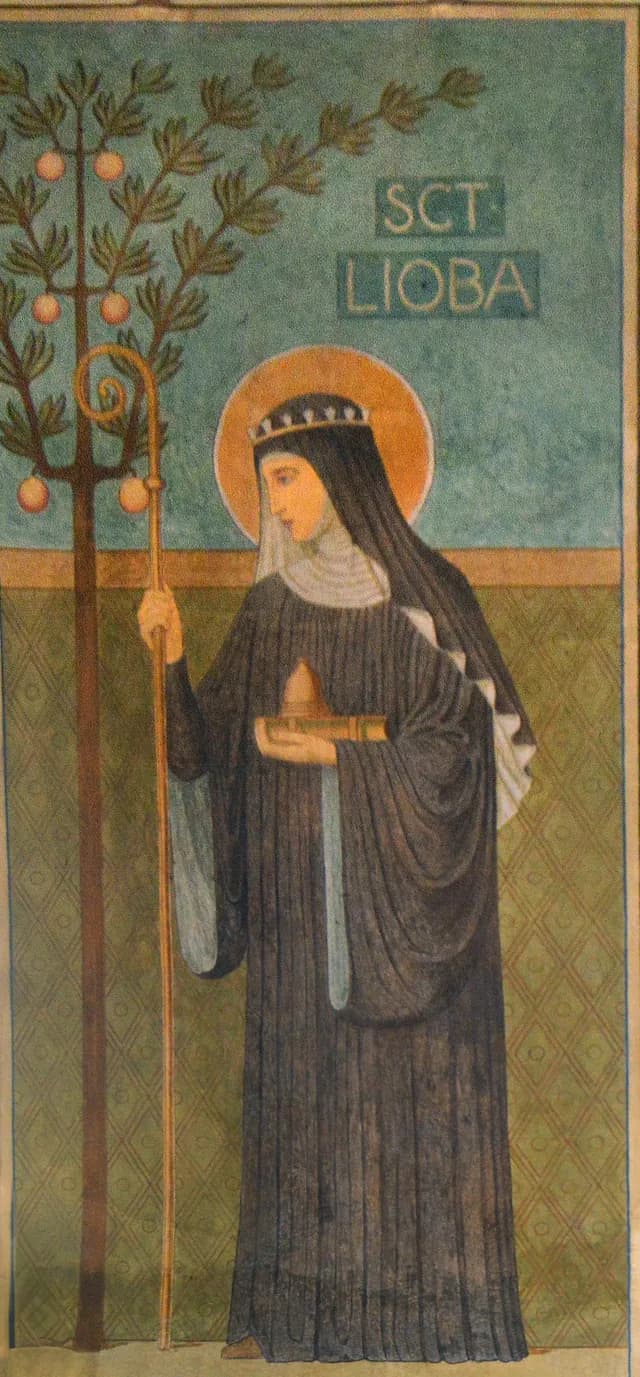
- Feast day
- September 28, per the New Catholic Encyclopedia 3
- Patron saint of
- No patronage is named in the sources consulted 3
Saint Lioba was an English nun from Wimborne whom her kinsman Saint Boniface brought to Germany and made abbess of Bischofsheim, and before he left on the mission that killed him he asked that her bones be laid next to his. 13 Rudolf of Fulda, who wrote her life about fifty years after her death, remembered her as a reader: "the Scriptures were never out of her hands." 1 Her feast is kept on September 28. 3
What we know, and from whom
Almost everything comes from one book. Rudolf, a monk of Fulda and pupil of Rabanus Maurus, wrote the Life of Leoba at his master's command. 16 Talbot, its translator, dates it to about 836; the Catholic Encyclopedia gives 838. 16 Rudolf never met her. He worked from notes kept by a priest named Mago, who had them from four of her nuns, Agatha, Thecla, Nana and Eoloba, and he complains that Mago wrote in "a kind of shorthand" and died before he could put any of it in order. 1
The other early witness is her own voice. One letter she wrote to Boniface survives in his correspondence, along with a short note he sent her as abbess. 2 Later reference works disagree on several dates, and the disagreements are set out below. 345
A child dedicated before she was born
Her parents were noble West Saxons, Dynno and Aebba, and for a long time they had no children. 1 Rudolf says that when they were past hope her mother dreamed she was carrying a church bell in her bosom, which "rang merrily" when she drew it out, and the old family nurse told her the dream meant a daughter who must be given to God. 1 The child was named Thrutgeba "surnamed Leoba because she was beloved, for this is what Leoba means." 1 In her letter she calls herself her parents' only child. 2
She was handed over to Tetta, abbess of the double monastery at Wimborne in Dorset, a sister of the king who ran a house so strictly enclosed that even bishops were kept out. 17 The New Catholic Encyclopedia says she was first placed at Thanet and professed at Wimborne. 3 Her own letter credits her Latin verse to "my mistress Eadburga," whom Talbot's note identifies as abbess of Minster in Thanet. 2
Rudolf's young nun learned from everyone around her, copying "the continence of one, the cheerfulness of another." 1
The letter to Boniface
Talbot dates it to soon after 732. 2 She writes to "the most reverend Boniface, dearly beloved in Christ and related to me by kinship," asks him to remember his old friendship with her father, now eight years dead, and to pray for her mother, who was ill. 2 Then she asks for something more personal: "there is no other man in my family in whom I can put my trust as I can in you." 2
She asks him to correct "the homely style of this my letter," and adds four lines of Latin hexameter, explaining that she wrote them "not because I imagine myself to have great ability, but because I wished to exercise my budding talents." 2 The New Catholic Encyclopedia notes both the poem and the request, and says some of the correspondence that followed survives. 3
Abbess of Bischofsheim
Boniface wrote to Tetta asking for her. Rudolf says the abbess was "exceedingly displeased at her departure" but let her go, and that Boniface received her with great affection, "not so much because she was related to him on his mother's side" as because of what she could do. 1 He made her abbess of Bischofsheim, on the Tauber. 16
The date is unsettled. The New Catholic Encyclopedia puts her at Tauberbischofsheim in 735. 3 Casanova, writing for the Catholic Encyclopedia in 1912, has Tetta sending her and Walburga with many other nuns in 748, and in another article "about 748-49." 45 The New Catholic Encyclopedia counts thirty nuns in the party, among them Thecla and Walburga. 3 Walburga and Thecla both lived under her rule at Bischofsheim before they went on to govern houses of their own. 45
That was the pattern. Rudolf says her nuns did so well that "there was hardly a convent of nuns in that part which had not one of her disciples as abbess." 1 Casanova notes a letter from Boniface addressed to Lioba, Thecla and Cynehilde as heads of separate communities, and says "its tone reveals how far the nuns had entered as intelligent fellow-labourers into his apostolate." 5 Pius XII, in his 1954 encyclical on Boniface, singled her out among the monks and nuns he called over as "an outstanding example of evangelical perfection." 8 Benedict XVI, without naming her, said of Boniface's mission that "women too had a very important role in this work of evangelization." 9
Rudolf's abbess is a scholar first. She read the whole of both Testaments and "the writings of the church Fathers, the decrees of the Councils and the whole of ecclesiastical law." 1 She was also sensible about it. Her nuns rested after the midday meal in summer, and she would not let them stay up late, "for she said that lack of sleep dulled the mind, especially for study." 1 When she rested she had Scripture read aloud, and the young nuns admitted they sometimes misread on purpose to see if she was asleep; she always caught them. 1
An accusation, and Rudolf's miracles
The story Rudolf calls her first public miracle in Germany began as a scandal. A crippled girl who begged at the convent gate, fed from the abbess's own table, bore a child in secret and threw it at night into a pool by the river; the village found the body and blamed the nuns. 1 Lioba had the community pray the psalter with arms outstretched and walk in procession three times a day, and at None, standing before the cross, she prayed aloud. Rudolf says the girl then cried out the abbess's name and confessed. 1
He records others: a fire in the village put out with water into which she had sprinkled salt blessed by Boniface, and a storm that drove the villagers into the church until she opened its doors and prayed. 1 This page reports them as his account.
Boniface's request
Before leaving for Frisia, Boniface called her to him and urged her "not to abandon the country of her adoption." 1 He commended her to his successor, Lull, and to the senior monks of Fulda, "reaffirming his wish that after his death her bones should be placed next to his in the tomb, so that they who had served God during their lifetime with equal sincerity and zeal should await together the day of resurrection." 1 Then he gave her his cowl and went to his death. 1
She stayed. Charlemagne summoned her to court many times; Queen Hildegard loved her "as her own soul." 13 Rudolf is blunt about how Lioba felt: she "detested the life at court like poison." 1 Bishops consulted her on Scripture and church discipline, but her real concern was visiting the convents and pressing them on. 1 Because of Boniface's wish she alone was allowed into Fulda to pray, arriving by day with one older nun and leaving at nightfall. 13
Old and frail, she settled with a few nuns at Schornsheim, four miles south of Mainz, on Lull's advice. 1 Called to Aachen by Hildegard, she went reluctantly, refused to stay, and took leave of the queen as "most precious half of my soul," saying they would not meet again on earth. 1 A few days after returning she fell ill, received viaticum from an English priest named Torhthat, and died. 1
What is Saint Lioba the patron saint of?
Saint Lioba's feast day
The New Catholic Encyclopedia gives her feast as September 28, the day of her death. 3 Rudolf dates her death to "the fourth of the kalends of October," with no year. 1
The year is disputed. The New Catholic Encyclopedia gives 782; Talbot's introduction to the Life gives 779. 13 Both are recorded here.
The monks of Fulda carried her body home but were afraid to open the martyr's tomb, so they buried her on the north side of the altar Boniface himself had consecrated. 1 Years later Abbot Eigil moved her bones to the west porch, and Rudolf, who says he saw two cures there himself, writes that she and Boniface, "though they do not share a tomb, yet lie in one place." 1
Praying with Saint Lioba
The first thing she left behind is a request for correction. A young nun sends an older kinsman a small gift, a prayer for her dead father, and four lines of verse, and asks him to fix her style. 2 It is a modest letter, and it is also the beginning of a working partnership that took her across the sea and ended with him asking to be buried beside her.
Rudolf's abbess read constantly and still sent her nuns to bed. 1 The detail about the afternoon rest and the dulled mind is small, but it sits next to the claim that she knew the whole of Scripture and church law, and it is hard to read one without the other.
Her career was spent turning out other abbesses. 15 The measure Rudolf gives is how many convents had one of her disciples in charge, and Boniface's last instruction to her was to stay and extend the work, not to finish it. 1
And the court did not keep her. She was honored by Charlemagne, loved by his queen, consulted by bishops, and she went back each time to the convents. 1 The friendship with Hildegard was real enough that their parting is the most tender scene in the Life, and she still would not stay. 1
Saint Lioba, pray for us.
Sources
- 1.Rudolf of Fulda, The Life of Saint Leoba (c. 836), with introduction, in C. H. Talbot, trans., The Anglo-Saxon Missionaries in Germany (London and New York: Sheed and Ward, 1954), in the Internet Medieval Sourcebook (Fordham University).
- 2.The Correspondence of St. Boniface, letters 17 (Leoba to Boniface, soon after 732) and 41 (Boniface to Leoba), in C. H. Talbot, trans., The Anglo-Saxon Missionaries in Germany (1954), in the Internet Medieval Sourcebook (Fordham University).
- 3.J. L. Druse, "Lioba, St.," New Catholic Encyclopedia (Gale), via Encyclopedia.com.
- 4.Gertrude Casanova, "St. Walburga," The Catholic Encyclopedia, Vol. 15 (New York: Robert Appleton Company, 1912).
- 5.Gertrude Casanova, "St. Thecla," The Catholic Encyclopedia, Vol. 14 (New York: Robert Appleton Company, 1912).
- 6.Patricius Schlager, "Rudolf of Fulda," The Catholic Encyclopedia, Vol. 13 (New York: Robert Appleton Company, 1912).
- 7.Douglas Raymund Webster, "Wimborne Minster," The Catholic Encyclopedia, Vol. 15 (New York: Robert Appleton Company, 1912).
- 8.Pius XII, Ecclesiae Fastos, encyclical on Saint Boniface, June 5, 1954, no. 14.
- 9.Benedict XVI, General Audience on Saint Boniface, March 11, 2009.
Saints to turn to next
Others in this collection who are turned to for some of the same things.
- Saint Dunstanc. 909 or earlier - May 19, 988Work and vocationPrayerStudy and teaching
- Saint Ephremc. 306 - June 9, 373Study and teachingPrayerWork and vocation
- Saint Lawrence of Brindisi1559 - July 22, 1619Study and teachingPrayerWork and vocation
- Saint Madeleine Sophie BaratDecember 12, 1779 - May 24 or 25, 1865Study and teachingWork and vocationPrayer