Saint Madeleine Sophie Barat
December 12, 1779 - May 24 or 25, 1865
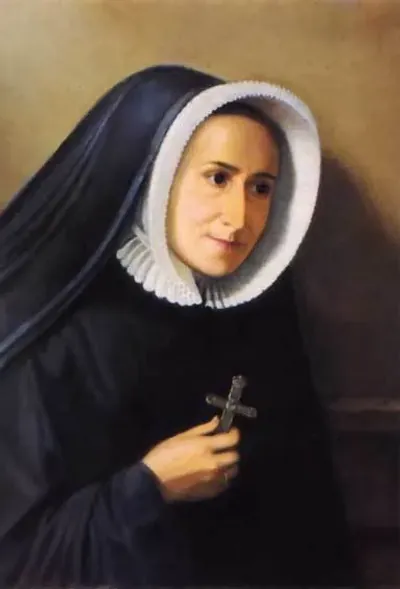
- Patron saint of
- Educators and teachers 3
- Died
- Paris, May 24, 1865 according to the Catholic Encyclopedia; May 25, 1865 according to Franciscan Media and the Society of the Sacred Heart 134
- Beatified
- 1908 4
Saint Madeleine Sophie Barat was a cooper's daughter from Burgundy who founded the Society of the Sacred Heart, an order of women devoted to educating girls, at the age of twenty, and was its superior general from 1806 until her death in 1865. 14 In 1818 she sent Philippine Duchesne to plant it in America; by her death it numbered more than 3,000 women, and today it reaches 41 countries. 14 Franciscan Media names her a patron of teachers, and her feast is May 25. 34
A cooper's daughter with a demanding brother
She was born at Joigny, in Burgundy, on December 12, 1779, the youngest child of Jacques Barat, whom the Catholic Encyclopedia calls a vine-dresser and cooper, and his wife Madeleine Foufé. 1 She was baptized the morning after she was born, and her godfather was her brother Louis, then eleven. 13
Louis is the reason she was educated at all, or at least educated the way she was. 13 When he came back to Joigny as a young professor at the seminary, Alice Power writes in the encyclopedia, he taught his sister Latin, Greek, history, natural science, Spanish and Italian, until she was reading the classics in the original and outdoing his seminarians. 1 Franciscan Media lists Latin, Greek, history, physics and mathematics, by the age of fifteen a thorough grounding in the Bible, the Fathers and theology, and calls Louis's regime "oppressive." 3 It adds that she thrived anyway and came out of it with a real love of learning. 3
She was ten when the Revolution's Reign of Terror began, Franciscan Media says. 3 Afterward Louis brought her to Paris to train her for the religious life she wanted; the Society of the Sacred Heart dates the move to 1795. 14
The Society of the Sacred Heart
In Paris Louis joined the Fathers of the Faith, priests who hoped to become Jesuits once the Society of Jesus was restored. 1 One of them, Father Varin, had inherited from Léonor de Tournély a plan for a society of women devoted to the Sacred Heart, which would do for girls what the restored Jesuits would do for boys. 12 Janet Stuart, writing the encyclopedia's article on the order in 1912, notes that two earlier attempts, by a former Benedictine abbess of the Bourbon-Condé family and by an Austrian archduchess, had both failed. 2
Varin found what he was looking for in Louis's sister. 12 Power says he explained the project to her, and that she accepted his judgment that it was God's will for her. 1 On November 21, 1800, she and three companions consecrated themselves to the Sacred Heart, the date from which the Society counts its foundation. 124
The first convent opened at Amiens in 1801. 12 It could not yet use its real name, since "Sacred Heart" might have suggested the royalist cause, so the sisters were known as the Dames de la Foi or the Dames de l'Instruction Chrétienne. 12 When the superior proved unequal to the post, Sophie, the youngest of them, was named in her place, in 1802 by Power's account. 12 Power records that her first act in office was to kneel and kiss the feet of each of her sisters. 1 In 1806 she was elected superior general, by a majority of one vote, Power says. 124
Philippine Duchesne and the New World
In 1804 she received into the Society a small group of former Visitation nuns at Sainte-Marie-d'en-Haut, near Grenoble. 12 Power dates it to November 1804; the Society's own history says she and Philippine Duchesne first met that December. 14 The Society describes the deep friendship that grew between the two women, of very different temperaments, and says that for twelve years Sophie's patient wisdom formed the ardent Philippine, who longed to take the Gospel to the native peoples of America. 4
In 1818 she sent Duchesne with four companions to the New World. 1 Power writes that her "strong and holy hand was ever ready to support and guide this first missioner of the Society." 1 The first houses were in Missouri and Louisiana. 2
The Society's history of that period is less comfortable than the encyclopedia's. It says Philippine decided to involve the Society in slavery, "with the support of Sophie," and that the schools' eventual success owed much to "the many enslaved people whose forced labor built and maintained them." 4 Writing of her leadership, the Society says her consultative approach is evident in her letters to American members who in the 1820s and 30s asked for "and, unfortunately, receiving" her permission and support to become slaveholders. 4 It calls this a "shameful part of our history." 4
Two crises, and forty years on the road
The young Society nearly broke apart twice. 24 The first time, Stuart writes, a priest of the Amiens diocese took control of the house there, drew up rules of his own in which devotion to the Sacred Heart scarcely appeared, and sent orders from Rome renaming the sisters "Apostolines." 2 The decisive letter turned out to be a forgery. 2 Power says the means she used against him were prolonged prayer, silent suffering, tact, respect and charity. 1 The constitutions she drew up with Varin were accepted by all the houses in 1815, and Leo XII approved the Society in 1826. 123
The second came later, when a general congregation wanted the constitutions brought closer to the Jesuits'. 2 Stuart says she foresaw the changes would not suit a congregation of women but allowed a three-year trial, after which Gregory XVI sent the Society back to the constitutions Leo XII had approved. 2 The Society's history counts 1806 to 1815 and 1839 to 1851 as the two periods when her leadership was tested. 4
For forty years after the approval she traveled from convent to convent and wrote "many thousand letters," in Power's words; the Society puts the surviving letters at 14,000. 14 Power counts some eighty foundations, beginning with Grenoble and reaching North America in 1818, Italy, Switzerland, Belgium, Algiers, England, Ireland, Spain, Holland, Germany, South America, Austria and Poland, though Stuart gives different years for several of them. 12 At Lyons she founded the Children of Mary for former pupils, and in 1832 at Turin she began retreats for laywomen. 1 Power says new foundations were always entrusted to others, whom she guided by counsel and usually from far away. 1
She died at the mother-house in Paris on Ascension Day, 1865, after four days' illness; Power gives the date as May 24. 1 Franciscan Media and the Society give May 25, and Franciscan Media says she had been stricken with paralysis that year. 34 She was buried at Conflans, and Power reports her body was found intact in 1893. 1 She was declared Venerable in 1879 and beatified in 1908. 14 The Society's pages disagree on the day of her canonization in 1925, giving May 24 on one and May 25 on another. 45
One curious note about her face: the Society says no authentic portrait from her lifetime exists, because she refused to be photographed, and that a photograph taken on her deathbed became the source of several later portraits. 4 The painting on this page is one of those later likenesses.
What is Saint Madeleine Sophie Barat the patron saint of?
Franciscan Media lists Saint Madeleine Sophie Barat as a patron saint of educators and teachers. 3 No other source consulted names a patronage. The vocation fits the record: Stuart's article describes an order whose choir religious took a vow to consecrate themselves to the education of youth, running boarding schools, free schools for the poor and, in England, training Catholic teachers. 2 Franciscan Media counts more than 100 schools run by her Society today. 3
Saint Madeleine Sophie Barat's feast day
Her feast is May 25. Franciscan Media states that "her liturgical feast is celebrated on May 25," though it runs her story in its Saint of the Day on May 29. 3 The Society of the Sacred Heart also gives May 25, on both pages cited here. 45
She shares the date with others. Vatican News's Saint of the Day calendar for May 25 lists Saint Gregory VII, Saint Bede the Venerable and Saint Mary Magdalene de' Pazzi, and does not list her. 6 That calendar is selective, and its silence is not evidence against her feast.
Praying with Saint Madeleine Sophie Barat
She did not set out to found anything. Power describes a modest, retiring girl of twenty who wanted the religious life, to whom a priest explained someone else's plan. 1 By her death she was guiding more than 3,000 of them across several continents. 4 What came between was mostly letters, journeys, meetings and long patience with people who opposed her.
The Society says she learned to set her learned view of God as a harsh judge against her experience of the love of God revealed in the Heart of Christ. 4 That is a quieter kind of conversion than most saints' stories offer, and it happened over years, inside a life of administration. Power locates the real source of her influence in prayer and in her habit of withdrawing from the outside world, and says it distressed her when bishops credited the Society's success to her. 1
Her own order does not let her stand only as a model. The same page that praises her preference for consultation over decree, and for "the realistic option, rather than the impossible ideal," uses her letters approving slaveholding in America as the example of that approach. 4 The Society tells both halves together, on the same page, and does not resolve one into the other.
Franciscan Media's reflection draws a simpler line from her story: she had received an education that other girls were being denied, and it grieved her. 3 She spent the rest of her life on giving it to them, rich and poor alike. 3
Saint Madeleine Sophie Barat, pray for us.
Sources
- 1.Alice Power, "Ven. Madeleine-Sophie Barat," The Catholic Encyclopedia, vol. 2 (New York: Robert Appleton Company, 1907).
- 2.Janet Stuart, "The Society of the Sacred Heart of Jesus," The Catholic Encyclopedia, vol. 14 (New York: Robert Appleton Company, 1912).
- 3."Saint Madeleine Sophie Barat," Saint of the Day, Franciscan Media.
- 4."Key figures in our history," Society of the Sacred Heart, United States - Canada Province.
- 5."From the Archives: Canonization of Madeleine Sophie Barat Virtual Exhibit," Society of the Sacred Heart, United States - Canada Province, 2025.
- 6.Saint of the Day, calendar for 25 May, Vatican News.
Saints to turn to next
Others in this collection who are turned to for some of the same things.
- Saint Ephremc. 306 - June 9, 373Study and teachingPrayerWork and vocation
- Saint Peter Chrysologusc. 406 - c. 450Study and teachingPrayerWork and vocation
- Saint Dunstanc. 909 or earlier - May 19, 988Work and vocationPrayerStudy and teaching
- Saint Lawrence of Brindisi1559 - July 22, 1619Study and teachingPrayerWork and vocation