Saint Willigis
Died February 23, 1011
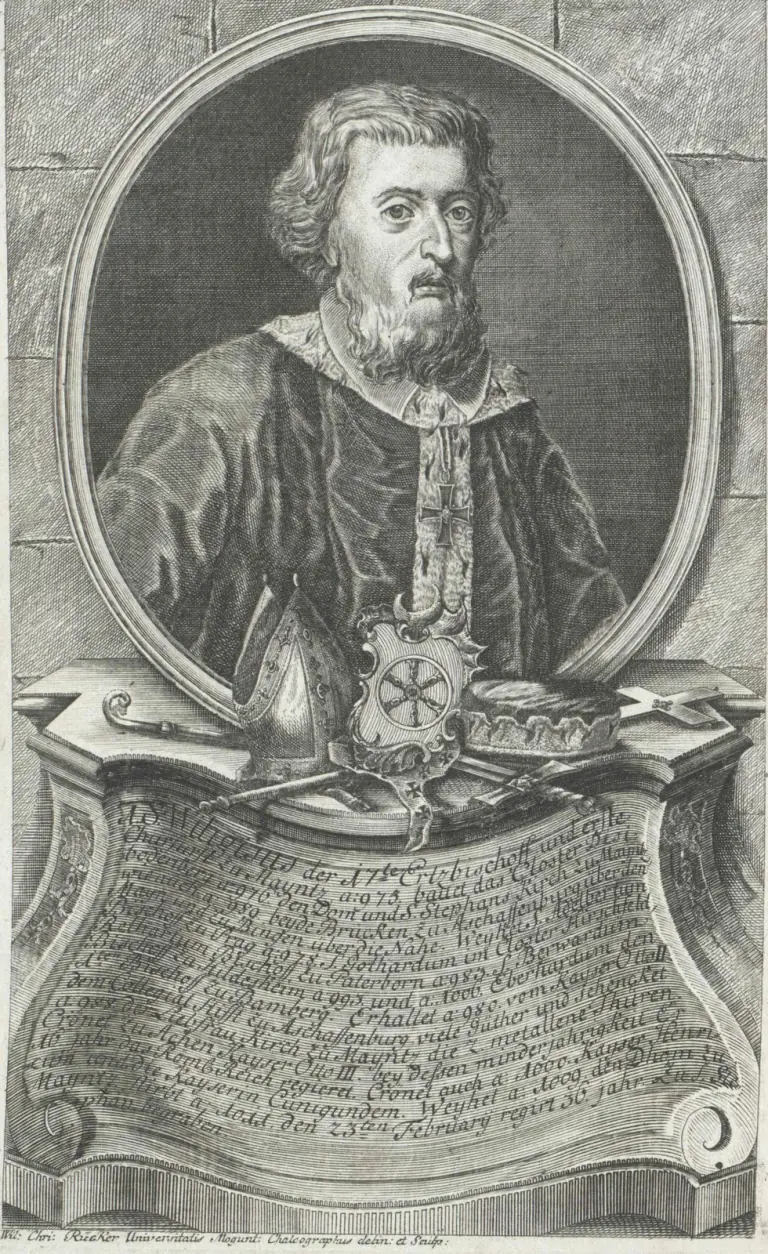
- Born
- Of humble family; at Schöningen in Lower Saxony, says katolsk.no, by legend the son of a wheelwright 13
- Known for
- Crowning Otto III and Henry II, and helping to govern the empire in Otto III's minority 123
- Patronage
- Wheelwrights, says katolsk.no 3
Saint Willigis was a man of humble birth who rose through the service of the German emperors to become archbishop of Mainz and primate of Germany in 975. 13 He crowned two emperors, helped hold the empire together while Otto III was a boy, and built churches, bridges and roads; the cathedral he built burned down on the day he consecrated it. 123 His feast is February 23. 4
From a wheelwright's house to the court
Very little is known of his early life. 3 The Catholic Encyclopedia says only that "though of humble birth he received a good education." 1 The Norwegian bishops' saints database (katolsk.no) says he was born at Schöningen in Lower Saxony and, according to legend, was the son of a wheelwright. 3
He became a priest and a canon of Hildesheim. 3 Someone at court noticed him. The Catholic Encyclopedia names Bishop Volkold of Meissen as the man through whose influence he entered the service of the emperor Otto I; katolsk.no calls him Wolkold, a member of Otto II's household who became bishop of Meissen in 969. 13 Willigis served as a chaplain at court and, from 971, as chancellor. 13
Archbishop of Mainz
In 975 Otto II made him archbishop of Mainz and archchancellor of the empire. 1 In March of that year Pope Benedict VII sent him the pallium and named him primate of Germany. 1 katolsk.no adds that in 976 the same pope made him papal vicar for Germany. 3
The Catholic Encyclopedia quotes the German church historian Hauck, who called him "an ideal bishop of the tenth century." 1 He had a good education and expected one in his clergy, and he was known as a good and fluent speaker. 1 katolsk.no says he studied the Bible every day and had thirty poor people fed every day. 3
His province was large. J. Lins's article on Mainz in the same encyclopedia says that under Willigis the new sees of Prague and Olmütz were made subject to it, and that he obtained from the pope the right to preside over all synods held within the empire and to crown the newly elected king. 2 katolsk.no credits his efforts with the spread of Christianity in Schleswig, Holstein, Denmark and southern Sweden. 3
Crowning emperors
Otto II died in 983, leaving a young son. On Christmas Day that year, the Catholic Encyclopedia says, Willigis crowned the child Otto III at Aachen. 1 Lins says that Willigis "saved the empire from disintegration during the minority of Otto III." 2 katolsk.no describes him governing alongside the boy's mother, the empress Theophano, and his grandmother, the empress Adelaide, until Otto came of age. 3
In 996 he traveled to Italy with Otto III and assisted at the consecration of Pope Gregory V, the first German pope, and at the synod held a few days afterward. 13 In 1002, when Otto III died young, katolsk.no says the electors chose Duke Henry of Bavaria on Willigis's advice. 3 Willigis crowned Henry II that June. The Catholic Encyclopedia says at Mainz; katolsk.no says at Paderborn, and that he crowned Henry's wife, Saint Cunegunde, there too. 13
In 1007 he presided at the Synod of Frankfurt, where thirty-five bishops signed the bull of Pope John XVIII founding the diocese of Bamberg. 1
Adalbert and Gandersheim
Prague was a suffragan of Mainz, and Willigis had consecrated Saint Adalbert as its bishop. 1 When Adalbert, "unable to bear the opposition to his labours," left his diocese, Willigis pressed at that synod of 996 for him to be sent back, and after much correspondence between the Holy See and Willigis, Adalbert was made to return. 1
He was on good terms with Rome; in 997 Pope Gregory V sent the decrees of a synod of Pavia to Willigis, "his vicar," to publish. 1 The one serious quarrel of his episcopate was with the bishop of Hildesheim, over which of them had jurisdiction over the convent of Gandersheim, which had been moved from the diocese of Hildesheim into that of Mainz. 1 katolsk.no names the bishop of Hildesheim as Saint Bernward, and says the quarrel was stirred up by one of the nuns, a sister of Otto III. 3
Pope Silvester decided for Hildesheim. When the sentence was to be published at a synod at Pöhlde in June 1001, Willigis walked out "in great excitement," and the papal delegate suspended him. 1 The encyclopedia says he did not mean to defy Rome, and that on January 5, 1007, at Gandersheim, he gave up all his claims in a public declaration. 1 katolsk.no calls it the only stain on an energetic and blessed episcopate, and says he admitted he had been wrong and withdrew with dignity. 3
A cathedral that burned
In his diocese, the Catholic Encyclopedia says, he "laboured by building bridges, constructing roads, and fostering art." 1 Lins adds that he fostered the commerce of Mainz. 2 katolsk.no gives his motto as "through art to the knowledge and service of God." 3
His great work was a new cathedral of Saint Martin at Mainz; katolsk.no says he laid its foundation stone in 979. 3 He consecrated it on August 29, 1009, and on the same day it burned down. 123 The cathedral was finished after his death, in 1037. 2 He also helped restore the old church of Saint Victor, built the church of Saint Stephen, and aided the monasteries of Bleidenstadt, Saint Disibod and Jechaburg. 1
He died at Mainz on February 23, 1011, and was buried in Saint Stephen's. 13 Lins's article on Mainz dates his episcopate from 975 to 1010. 2 katolsk.no says his cult arose of its own accord immediately after his death. 3
What is Saint Willigis the patron saint of?
Saint Willigis's feast day
Praying with Saint Willigis
Willigis was a statesman as much as a bishop, and the sources do not separate the two. He crowned emperors and helped rule for a child; he also fed thirty poor people a day and read the Bible daily. 123
His one great quarrel was over jurisdiction, and he lost it. He walked out of the synod that ruled against him and was suspended. Six years later he went to Gandersheim and gave up his claims in public. 13
He spent years on a cathedral and saw it burn on the day it was consecrated. 12 Another archbishop finished it a generation later. He was buried in Saint Stephen's, one of the churches he had built himself. 123
Saint Willigis, pray for us.
Sources
- 1.F. Mershman, "St. Willigis," The Catholic Encyclopedia, Vol. 15 (New York: Robert Appleton Company, 1912).
- 2.J. Lins, "Mainz," The Catholic Encyclopedia, Vol. 9 (New York: Robert Appleton Company, 1910).
- 3."Den hellige Willigis av Mainz," Den katolske kirke, the saints database of the Catholic Church in Norway, katolsk.no (in Norwegian).
- 4.Roman Martyrology, entry for February 23, "San Villigiso, vescovo," Santo del giorno, Conferenza Episcopale Italiana (in Italian).
Saints to turn to next
Others in this collection who are turned to for some of the same things.
- Saint Aelred of Rievaulx1109 - January 12, 1166 (or 1167)Work and vocationStudy and teaching
- Saint Albert the Greatc. 1206 - November 15, 1280Study and teachingWork and vocation
- Saint Alexander Sauli1533 or 1534 - October 11, 1592Work and vocationStudy and teaching
- Saint Angela MericiMarch 21, 1474 - January 27, 1540Study and teachingWork and vocation