Saint William of Vercelli
1085 - June 25, 1142
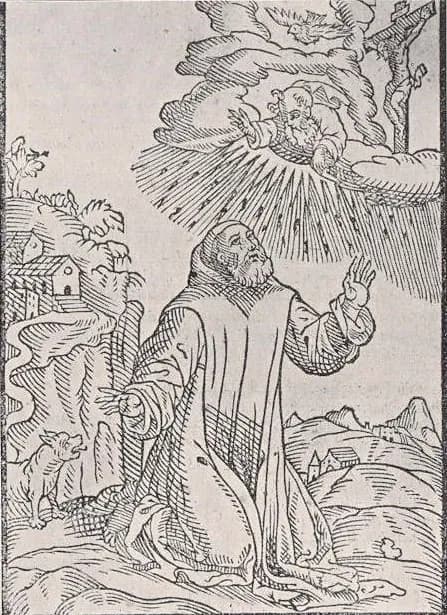
- Also called
- William of Monte Vergine 4
- Patron saint of
- Irpinia, declared its primary patron by Pope Pius XII in 1942 1
Saint William of Vercelli walked out of his home in Vercelli as a boy, barefoot, to go on pilgrimage to Compostela, and never really stopped. 1 He meant to go on to Jerusalem and got no farther than southern Italy, where he became a hermit on a mountain near Avellino, and the hermitage became the abbey of Montevergine. 123 The Vatican News calendar sums him up in a line: "Pilgrim, hermit, abbot, and finally a pilgrim again." 6 He died on June 25, 1142, and that is his feast. 23
A boy on the road to Compostela
He was born in 1085 at Vercelli, to noble parents who both died while he was small, and a relative brought him up. 24
He left young. Vatican News says he was fourteen and the 1912 Catholic Encyclopedia says fifteen when he decided, in the encyclopedia's words, "to renounce the world and lead a life of penance." 12 He gave up his title, put on a tattered habit, and set out barefoot for the shrine of Saint James at Compostela in Spain, which Vatican News calls the most famous pilgrimage of his time. 1
Vatican News says the journey took five years, on foot the whole way, on bread and water, sleeping on the ground. 1 The encyclopedia adds a harder detail: "not content with the ordinary hardships of such a pilgrimage, he encircled his body with iron bands to increase his suffering." 2 Catholic Culture calls this pilgrimage "the turning point of his life." 4
Jerusalem, and why he never got there
Back from Spain, he set out for the Holy Land. 12 He did not arrive, and the sources explain it two ways.
The encyclopedia says simply that "it was revealed to him that he would be of greater service to God if he remained in Italy." 2 Vatican News tells a rougher story. Looking for a ship in the south, William was set upon at Brindisi by robbers who, finding he had nothing worth taking, beat him badly. While he recovered he went to see Giovanni da Matera, John of Matera, himself later a saint, who persuaded him that the attack was a sign and that his work was to preach the Gospel in Italy. 1
The Roman Martyrology keeps the same friendship in view. It says William founded Montevergine at the invitation of Saint John of Matera. 5
The hermit of Monte Vergine
In 1118, by Vatican News's date, he went to Irpinia, to the foot of Monte Partenio, and became a hermit. 1 The encyclopedia says he "built himself a hut on Monte Vergine, wishing to become a hermit and live in solitude." 2 Its article on the abbey notes that the mountain had once held a temple of Cybele, and a chapel of the Virgin after it. 3
The solitude did not last. Word of a holy man spread, and people came, drawn, the encyclopedia says, "by the sanctity of his life and the many miracles which he performed." 12 Catholic Culture mentions the cure of a blind man as the thing that made him known, and says he had gone to the mountain in the first place to get away from the admiration. 4
A monastery was built, dedicated to the Blessed Virgin. 24 Both encyclopedia articles date it to 1119; Vatican News says the order of Monte Vergine was officially recognized in 1126. 123 The abbey article describes the house as "a monastery of strict observance and perpetual abstinence." 3
There was little written down at first. William, Vatican News says, "led more by example than by instruction": hard penance, constant prayer, and service to the poor. 1 Catholic Culture says the rule he gave was inspired in large part by Saint Benedict's. 4
Leaving his own monastery
He did not stay, and here again the accounts differ. In Vatican News the cause is William himself. His "desire to go on pilgrimage could not be quenched," so he entrusted the community to his disciples and went back to the road, traveling through southern Italy as far as Sicily. 1
The encyclopedia puts the cause in the monks. They "began to murmur against him, saying that the life was too austere, that he gave too much in alms, and so on," and he left in order to "take away from the monks the cause of their grievances." 2 Catholic Culture agrees: some wanted better food and an easier schedule, William would not relax the rule for himself, and so he named a prior and set out with five companions to found a house as strict as the first. 4
Catholic Culture names one of the five as "St. John of Mantua" and says the two friends, both natural leaders, later agreed to part and found separate monasteries. 4 Vatican News and the Martyrology name his friend as John of Matera. 15
More foundations followed. The encyclopedia says he established "many monasteries, both of men and of women," and the Martyrology says the same of the regions of southern Italy. 25
The wolf, the king and the court
The best-known story about him is the one Vatican News calls famous, the Miracle of the Wolf. A wolf killed the donkey William used for his work, and the saint ordered the wolf to carry the donkey's loads instead; it "became perfectly tame." 1 Catholic Culture lists a saddled wolf among the ways he is pictured. 4
He also had a royal patron. Vatican News names him as Roger II, "a Norman king," and counts him among the friends whose gifts made the abbey prosper. 1 The encyclopedia calls him "Roger I of Naples" and says he was so taken with William's counsel that, "in order to have him always near him, he built a monastery opposite his palace at Salerno." 2
Catholic Culture tells of the resentment this caused at court. Men who disliked William's influence sent a woman to tempt him and so expose him as a fraud. She failed. "It seems that she repented and gave up her life of sin," the page says. 4 The other sources do not have the story.
Death at Goleto
Vatican News says his strength gave out on a journey to see the king. 1 The encyclopedia says he knew "by special revelation that his end was at hand" and withdrew to his monastery of Guglieto, its spelling of Goleto, where he died and was buried in the church. 2 The date was June 25, 1142. 24
His relics stayed at Goleto until the nineteenth century, when they were moved to Montevergine. 1 His successor, Blessed Robert, gave the monastery to the Benedictines. 3 The abbey article reports, citing Castellain, that William was canonized by Pope Alexander III. 3
What is Saint William of Vercelli the patron saint of?
Saint William of Vercelli is the patron saint of Irpinia, the region where he settled. Vatican News records that in 1942, eight hundred years after his death, "Pope Pius XII declared him the primary patron of Irpinia." 1 Catholic Culture lists his patronage as "Irpinia and Vercelli," without giving an authority. 4
Saint William of Vercelli's feast day
Praying with Saint William of Vercelli
Almost nothing in this life went where he aimed it. He set out for Jerusalem and was stopped at Brindisi. He wanted to be alone on a mountain and found himself an abbot. 12 Vatican News, telling the first of these, quotes the proverb "man proposes, God disposes." 1
The sources cannot agree on whether he walked away from Montevergine because he wanted the road or because his monks wanted an easier life. 124 Either way he did not fight for the place. He handed it over and started again somewhere else. 14
He seems to have taught very little in words. What his first companions had to go on was how he prayed, how he did penance, and how he treated the poor. 1 The Martyrology remembers him as a man who made himself poor for the love of Christ and then taught others what he knew. 5
The pilgrimage to Compostela was the start of all of it, a boy of fourteen or fifteen deciding something for good. 124
Saint William of Vercelli, pray for us.
Sources
- 1."St. William, Abbot, Founder of the Congregation of Montevergine," Saint of the Day, 25 June, Vatican News.
- 2.Paul Brookfield, "William of Vercelli," The Catholic Encyclopedia, vol. 15 (New York: Robert Appleton Company, 1912).
- 3.James Grey, "Monte Vergine," The Catholic Encyclopedia, vol. 10 (New York: Robert Appleton Company, 1911).
- 4."St. William of Monte Virgine, Abbot," Liturgical Year, June 25, Catholic Culture.
- 5."San Guglielmo, abate," Santo del giorno, 25 giugno (from the Roman Martyrology), Conferenza Episcopale Italiana.
- 6.Saint of the Day, calendar for 25 June (summary entry for St. William), Vatican News.
Saints to turn to next
Others in this collection who are turned to for some of the same things.
- Saint Agnes of Bohemiac. 1200-1205 - March 1281 or 1282Poverty and simplicityPrayerDiscernment
- Saint Benedict Joseph Labre1748 - April 16, 1783Poverty and simplicityPrayerDiscernment
- Saint Celestine V1215 (or 1210) - May 19, 1296DiscernmentPrayerPoverty and simplicity
- Saint ChadBirth date unknown - March 2, 672PrayerDiscernmentPoverty and simplicity